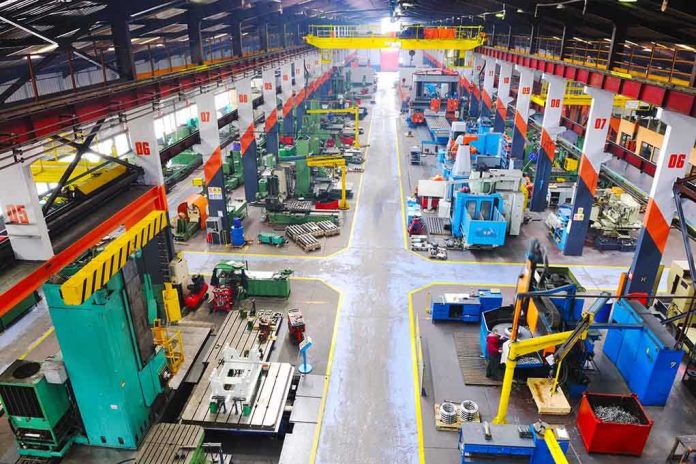
The core of Marco Rubio’s manufacturing argument is deceptively simple: America’s embrace of cheap imports and offshoring lowered prices in the short run, but it did so by deliberately dismantling the nation’s industrial base, eroding supply-chain security, and sacrificing millions of middle‑class jobs—problems he now argues must be corrected through tariffs and an assertive industrial policy.
Key Points
- Rubio frames U.S. deindustrialization as a conscious, bipartisan policy choice after the Cold War, not an inevitable outcome of technology or globalization.
- He argues that prioritizing low‑cost manufacturing overseas “deindustrialized our country” and cost “millions of jobs,” especially after China’s entry into the WTO.
- His remedy is a mix of tariffs, reshoring incentives, and targeted industrial policy to rebuild domestic capacity in critical sectors from autos to pharmaceuticals.
- Critics accept localized job loss but contend that the “collapse” narrative is overstated because manufacturing output remained high and service‑sector gains offset much of the employment damage.
- The result is a fundamental debate: should U.S. trade and industrial policy be optimized for cheap consumer goods and aggregate efficiency, or for strategic resilience and place‑based employment?
Rubio’s Core Claim: Deindustrialization Was a Choice, Not Fate
Rubio’s starting point is historical judgment: the United States did not drift into deindustrialization; it chose it. In speeches and op‑eds stretching back several years, he has described the post‑Cold War consensus for “free and unfettered trade” as an ideological project that treated offshoring as a feature, not a bug. At the Munich Security Conference, now as Secretary of State, he put it bluntly: “Deindustrialization was not inevitable. It was a conscious policy choice… shipping millions of working and middle-class jobs overseas… handing control of our critical supply chains to both adversaries and rivals.” In his telling, leaders of both parties encouraged factories to move abroad, confident that cheaper consumer goods and financial gains would compensate for the loss of production at home.
That choice, he argues, created dependence. American retailers enjoyed low‑cost imports; large manufacturers optimized global supply chains; but entire regions lost their economic anchor as steel mills, machine shops, and assembly plants shuttered. Rubio treats that pattern not only as an economic mistake but as a strategic one: a country that cannot make what it needs, especially in critical sectors, cannot be a true great power.
Cheap Prices vs. Lost Jobs: The China Shock in Rubio’s Narrative
Rubio’s most pointed critique centers on China’s integration into the global trading system around 2000. He has called the bipartisan China trade deal and the decision to back Beijing’s permanent membership in the World Trade Organization a turning point that “strangled the American dream.” That agreement opened the door for a surge of imports produced under state‑subsidized, often underregulated conditions, competing directly with U.S. factories.
In campaign and policy documents, Rubio repeatedly cites the early‑2000s as the decade when something “dramatic happened”: manufacturing employment fell sharply, with roughly one‑third of factory jobs disappearing between 2000 and 2010. Academic work on the so‑called “China shock” broadly aligns with the idea that import competition from China caused significant manufacturing job losses concentrated in specific regions and among workers without college degrees. Rubio emphasizes the human geography of those statistics—towns where the plant was the main employer, neighborhoods where losing a unionized job meant not just a lower wage, but the unraveling of community institutions.
The trade‑off he highlights is encapsulated in a line that has now circulated widely: “Prices were cheaper… but it ended up deindustrializing our country and costing us millions of jobs.” From a narrow consumer perspective, the policy worked; from the vantage point of industrial workers and national resilience, he argues, it was disastrous.
From Diagnosis to Prescription: Tariffs and Industrial Policy
Rubio’s argument is not merely retrospective. It underpins a concrete policy agenda: constrain offshoring, re‑anchor production in the United States, and rebuild industrial capacity in strategically chosen sectors. In office and in prior Senate work, he has backed a broad toolkit.
First, he wants to change corporate incentives. In a Newsweek piece, Rubio pointed to roughly 300,000 jobs outsourced annually and called for revoking trade benefits for companies that offshore, arguing that trade agreements should make America a more attractive place to produce—not a staging ground to move factories abroad. He has led efforts to bar automakers that offshore domestic manufacturing from claiming certain clean‑energy tax credits, explicitly tying federal support to keeping production and jobs at home.
Second, he favors targeted protection and enforcement. Rubio has advocated tariff measures aimed at Chinese goods in sensitive sectors, and backed legislation like the “Fair Trade with China Enforcement Act” to raise taxes on U.S. firms’ income from China and restrict sales of certain sensitive products to Chinese buyers. These tools are part of a broader Trump administration strategy that he defends: using tariffs and economic leverage to counter what he describes as China’s whole‑of‑state industrial planning and predatory trade practices.
Third, he argues for affirmative industrial policy—government coordination and strategic investment rather than laissez‑faire neutrality. He has pushed for a national development strategy to restore manufacturing leadership, co‑sponsoring legislation with Representative Ro Khanna to coordinate federal support across agencies. He has called for ramping up federal R&D funding for small businesses, modernizing infrastructure, and explicitly identifying “critical” sectors that warrant priority attention—from medical devices and pharmaceuticals to advanced machinery and critical minerals.
Supply Chains and National Security: Beyond Economics
Rubio deliberately blurs the distinction between economic and security policy. In his view, supply chains are not merely logistics; they are arteries of national power. He has warned that outsourcing production of pharmaceuticals, critical minerals, and other essentials to adversaries or unstable regions leaves the United States vulnerable to coercion or disruption.
That concern flows directly into his foreign‑policy portfolio. As Secretary of State, Rubio has launched an Economic Diplomacy Action Group to align U.S. diplomatic efforts with economic priorities, explicitly including support for American firms to invest in friendly countries and onshore critical production closer to home. In global forums, he has urged Western allies to “reclaim industrial leadership and supply chains,” framing industrial capacity as central to maintaining a “free and prosperous republic” in a more adversarial world.
The Venezuela strategy underscores the same logic. By helping reshape Venezuela’s oil industry under an interim government and designing mechanisms that route revenues into controlled accounts for essential services and purchases of U.S. goods, the administration aims both to stabilize a crisis state and to steer a critical energy producer away from China, Russia, and Iran. Behind those moves sits the same premise: who controls production and supply chains controls strategic leverage.
The Counterargument: Output, Productivity, and Service‑Sector Gains
Rubio’s critics do not deny that factories closed or that specific communities were harmed. Their challenge is to his broader narrative of collapse. Analysts at libertarian and market‑oriented institutions like the Cato Institute point out that U.S. manufacturing output, measured in real terms, did not implode over the past few decades; it continued to grow or stabilize even as employment fell, largely because productivity rose. Machines and automation allowed fewer workers to produce more goods.
They also stress that national employment impacts are more complicated than plant‑level losses. Studies responding to the China shock literature argue that while manufacturing jobs declined in exposed regions, some of those losses were offset by gains in service‑sector employment in other parts of the country. In that lens, the economy reallocated labor rather than simply shedding it, and policy should focus on smoothing those transitions—through education, mobility, and safety nets—rather than trying to freeze the industrial structure in place.
For these critics, Rubio’s industrial policy agenda risks “intrusive” government intervention that distorts markets, favors politically connected sectors, and ultimately reduces consumer welfare by raising prices. They warn that tariffs and reshoring mandates can trigger retaliation abroad, erode export opportunities for other U.S. industries, and lock the United States into less efficient production patterns.
Where the Real Disagreement Lies
The substantive divide is not over whether globalization and offshoring harmed some workers; the evidence on regional pain is robust enough that both sides acknowledge it. The disagreement is over what metric should guide national policy and what kind of country Americans want to live in.
Rubio anchors his case in place‑based outcomes—manufacturing jobs, community stability, and strategic independence. When he talks about deindustrialization, he is less interested in aggregate output curves than in towns “once characterized by strong, stable employment and vibrant community life” that became hotbeds of discontent and social breakdown. In that framework, an economic model that tolerates large regional dislocations in exchange for cheap imported goods and higher national averages is not acceptable.
His critics anchor theirs in aggregate performance—national output, productivity, consumer prices, and overall employment. If manufacturing output holds up and workers eventually find jobs elsewhere, they argue, then the system is functioning, even if the transition is painful. Industrial policy and protectionism, for them, threaten to undermine those strengths by politicizing investment decisions and constraining trade.
There is also a philosophical disagreement about the state’s role. Rubio and those who share his view believe the government has a duty to shape the industrial base actively—to “identify the critical value of specific industrial sectors and spur investment in them,” as one sympathetic memo framed it. Opponents prefer a state that sets broad rules and then gets out of the way, trusting markets and individuals to adjust.
**Marco Rubio Defends Trump’s Tariff Strategy to Revive U.S. Manufacturing**
U.S. Secretary of State **Marco Rubio** says decades of relying on cheaper overseas manufacturing weakened America's industrial base and led to the loss of millions of jobs.
Rubio argued that President… pic.twitter.com/cH7E79xZfX
— Trivane News (@TrivaneNews) August 2, 2026
What Rubio’s Agenda Signals About the Next Era of U.S. Economic Policy
Regardless of where one stands on the debate, Rubio’s framing captures a shift that has already begun in both parties. Trade skepticism, concern about China, and unease with fragile supply chains have moved industrial policy from the margins into the mainstream. The Trump administration’s tariffs and reshoring pushes are no longer treated as aberrations; they are part of a broader reconsideration of the old free‑trade orthodoxy.
Rubio’s contribution is to knit these strands into a coherent narrative: policy choices deindustrialized America; those choices can be reversed. That story resonates in communities that experienced the downside of globalization firsthand, and among voters who now prioritize resilience and security over the lowest possible price. The counter‑story—that output is fine, services grew, and consumers benefited—speaks more to economists and urban professionals than to displaced welders or line workers.
In the coming years, U.S. economic strategy will likely be judged on its ability to reconcile these two realities: maintaining the productivity and innovation that come from open markets, while rebuilding enough industrial depth and geographic balance to make the country both secure and socially cohesive. Rubio has made clear which side of that balance he favors. Whether his vision becomes the durable new consensus will depend on how well tariffs, reshoring incentives, and industrial policy deliver not just headlines, but enduring, broadly shared prosperity.
Sources:
youtube.com, profarmer.com, state.gov, x.com, foxnews.com, cato.org, presidency.ucsb.edu, newsweek.com, americanrhetoric.com, facebook.com, americanmind.org, linkedin.com, amo.house.gov, nationalaffairs.com, rubio.senate.gov, khanna.house.gov, niskanencenter.org, washingtonpost.com, floridapolitics.com