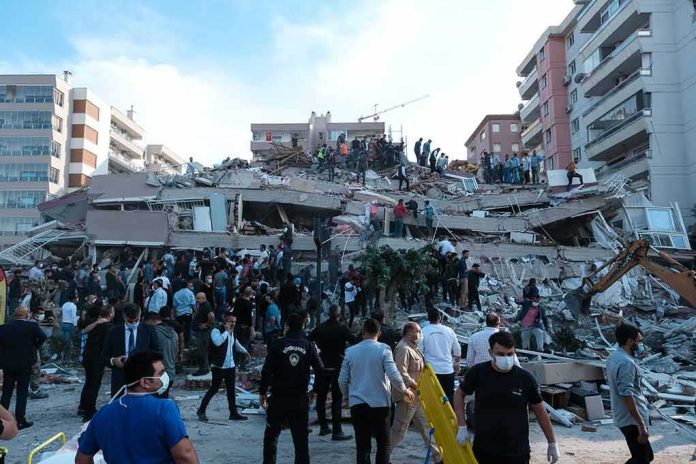
The first six months after a war decide whether reconstruction ever gets off the ground; funding helps, but governance, security, and sequencing are the true bottlenecks. That’s the quiet logic behind the Board of Peace’s $2.45 billion Gaza recovery package: it’s a starter plan aimed at making reconstruction possible, not a promise to finish the job.
At a Glance
- A U.S.-backed Board of Peace outlined a six-month, $2.45 billion Gaza recovery program centered on 66 projects across housing, rubble removal, health, infrastructure, security, and economic restart.
- The plan functions as an early “day-after” package: enabling return, restoring basic services, and creating conditions for implementation — not full rebuild.
- Independent assessments peg total reconstruction needs around $71 billion over a decade, with physical damage alone estimated at roughly $35 billion.
- Security and governance capacity will determine whether pledged money turns into delivered projects — a lesson drawn from prior Gaza rounds and wider post-conflict experience.
What the six-month plan actually does
The Board of Peace proposes 66 near-term projects to stabilize daily life and make later, larger-scale works feasible. The portfolio, as described in contemporaneous reporting, spans temporary housing to accelerate safe returns, large-scale debris clearance to unlock construction sites and utility corridors, emergency repairs to hospitals and clinics, and priority fixes to water, electricity, and transport links that underpin basic services and commerce. It also earmarks funding to reanimate small businesses and employment, recognizing that a functioning local economy is both a humanitarian need and a security requirement. Finally, the plan sets aside resources for public order and transitional security support — the scaffolding that allows engineers, contractors, and aid agencies to actually work without interruption.
In design terms, this is not a blueprint for rebuilding Gaza in six months; it’s the enabling phase that clears obstacles and reduces risk so subsequent investments are possible. That distinction matters. Post-conflict timelines slip when projects outrun permitting, when utilities can’t be made safe, or when crews can’t reach sites. The plan’s emphasis on rubble, lifeline services, and basic security sequencing reflects lessons learned in Gaza and other theaters where optimistic budgets met hard realities on the ground.
Scale of need versus the first tranche of funding
Independent assessments converge on a sobering math. The World Bank, European Union, and U.N. estimated physical infrastructure damage in Gaza at about $35.2 billion, with broader conflict-related impacts and needs bringing the total recovery bill to roughly $71.4 billion over a decade. That range aligns with other expert syntheses placing full reconstruction in the tens of billions of dollars, likely stretching over decades rather than years given logistics, material flows, and governance constraints. Against that backdrop, $2.45 billion is the appropriate magnitude for an initial, six-month push — large enough to matter, small enough to be deployable if the prerequisites are met.
Two numbers from the reporting clarify priorities. First, the physical damage estimate — approximately $35.2 billion — anchors expectations for what “full rebuild” means in civil works, utilities, and public facilities. Second, the broader ten-year need — roughly $71.4 billion — folds in the soft tissue of recovery: economic reactivation, human capital, and systems that make rebuilt assets productive. The six-month package situates itself at the mouth of that pipeline: clear, repair, reconnect, and stand up enough governance to keep momentum.
Security, governance, and the problem of implementation
Money is seldom the scarcest resource in early reconstruction; legitimacy, security, and administrative capacity are. Comparative research on post-conflict outcomes is blunt: durable security provision is the necessary condition for successful reconstruction, with multiple viable governance pathways so long as safety and predictable enforcement exist. In Gaza, prior rounds after earlier wars were slowed not only by funding gaps and material restrictions but also by fragmented authority and contested control — dynamics that convert appropriations into underspending and delays.
This is why the Board of Peace’s plan builds in stabilization components alongside civil works. Debris removal cannot proceed in areas where explosive hazards remain uncleared; hospital repair schedules collapse if supply convoys are intermittently interdicted; utility crews won’t trench if personal safety is uncertain. A transitional security architecture — whether through trained local police, international stabilization support, or hybrid arrangements — is less a political flourish than the precondition for construction timelines to hold.
How we got here: repeated cycles and a sequencing rethink
Gaza’s reconstruction history features a recurring pattern: ambitious pledges bookending fragile ceasefires, then long lag times before funds translate into projects, as contracting, access, and coordination grind forward unevenly. Academic reviews of the post-2021 and 2022 periods document a marked slowdown in implementation compared with earlier efforts, and identify a shift in primary constraints from materials access to governance and institutional bottlenecks — a warning that pouring more money into an unchanged execution environment is not a fix.
The six-month package reflects a sequencing rethink. Rather than promise signature rebuilds up front — which attract headlines but stall when enabling conditions are absent — the plan funds the mundane but decisive steps first: site clearance, lifeline repairs, modular shelter, and administrative capacity that can process permits, manage contractors, and audit flows. If past attempts taught one lesson, it is that early wins must be engineered to be achievable, visible, and cumulative; each completed tranche should reduce the cost and risk of the next.
Where the real disagreements lie
The salient debates are not over the need for recovery but over who secures the ground, who governs the process, and how to ensure Palestinian ownership while maintaining conditions that keep militants disarmed and civilians safe. Those choices cascade into procurement rules, customs regimes at crossings, and dispute resolution when contractors and agencies inevitably clash. Some models prioritize international trusteeship with heavy oversight; others back a technocratic Palestinian administration with external guarantees. Comparative evidence suggests multiple configurations can work if security provision is reliable; none work if it is not.
There is also a philosophical divide on pacing. Advocates of “quick impact” argue for visible service restoration to build confidence; institutionalists warn against shortcuts that bypass local capacity and create dependency. The six-month plan tries to split the difference — fund tangible works quickly while financing the administrative scaffolding that will outlast the initial push.
We also set out the 6-Month Gaza Recovery Programme: 66 costed programmes, around US$2.45bn, ready to begin the moment funding and access allow. Shelter, water, hospitals, schools, power, roads and jobs, delivered by Gazan contractors and engineers. Not a wish list, a plan. (2/5)
— Nickolay E. MLADENOV (@nmladenov) September 23, 2026
What success would look like six months in
Set aside grand totals and focus on operational markers. A credible on-ramp would show: (1) hazardous rubble cleared from priority corridors; (2) water and power reliability measurably improved in designated zones; (3) emergency rooms and surgical theaters in key hospitals back to safe operating standards; (4) thousands of families in dignified temporary housing with pathways to permanent rebuilds; (5) small enterprises accessing working capital and rehabilitated marketplaces; and (6) a functioning security-and-permitting workflow that moves projects from scope to site without stalling. Each of those outcomes is specific, auditable, and the kind of progress that convinces skeptical residents that plans are more than paperwork.
The bottom line
The Board of Peace’s $2.45 billion, six-month package is best read as a test of capacity rather than a cure-all. It aligns with independent estimates of the scale and timing of Gaza’s needs, and it centers the enabling functions — clearance, lifelines, governance, and security — that determine whether larger investments will stick. If those conditions are met, the first six months can unlock the next sixty. If they are not, no headline number will matter.
Sources:
politico.com, english.ahram.org.eg, jfeed.com, siasat.com, jordannews.jo, payments.jpost.com