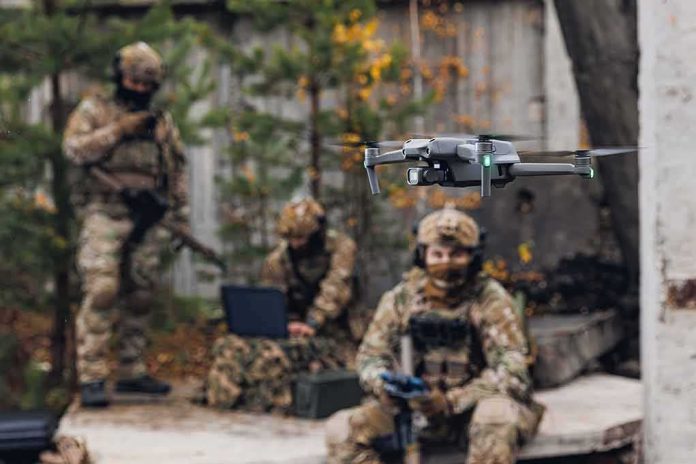
The important story here is not that the Marine Corps discovered drones; it is that small units are now being trained to combine reconnaissance and precision strike at distances that once belonged to mortars, artillery, or higher-echelon aviation. In South Korea, Marines publicly completed their first live-fire first-person-view attack-drone series, using the Neros Archer to hit targets in a controlled training environment and demonstrating a claimed reach of roughly 20 kilometers.
Key Points
- The Marine Corps says it successfully completed its first live-fire FPV attack-drone series in South Korea.
- The system in question, the Neros Archer, is described as giving squads and platoons precision-strike reach out to about 20 kilometers.
- The drills were conducted as live-fire training, not in combat, but they matter because they show how quickly FPV drones are moving from novelty to doctrine.
- The broader significance is tactical: this is about extending small-unit lethality while keeping operators farther from direct danger.
What the Marines Actually Demonstrated
According to the Marine Corps, Marines assigned to the 4th Marine Regiment and the 3rd Marine Division “successfully concluded” the service’s first series of live-fire first-person-view attack-drone flights in South Korea. Reporting from multiple outlets places the exercise at Rodriguez Live-Fire Complex in Pocheon and describes the drone as the Neros Archer, a system used for anti-armor and antipersonnel strikes. The essential point is straightforward: this was not a symbolism-only showcase. It was live-fire training with explosive payloads, conducted in a highly managed environment, and publicly presented as a milestone in force modernization.
The claim that these drones can hit targets 20 kilometers away comes from the Marine Corps’ own framing and from subsequent technical reporting on the Archer’s range. That distance matters because it places FPV drones in a category that is operationally different from the short-range scout drone culture most people still associate with hobbyist quadcopters. At that range, a small unit is no longer just looking over the next ridge; it is reaching far enough to threaten armor, exposed personnel, and equipment well beyond the immediate firefight.
Why the 20-Kilometer Figure Matters
Range is the central metric in this story because it determines whether a drone is merely an observation tool or a genuine organic strike asset. The Marine Corps has said FPV drones can provide squad-level lethality out to 20 kilometers, and one Marine Corps training account explicitly contrasted that reach with the 1-to-2-kilometer envelope of current rifle-squad and platoon systems. That is a serious doctrinal shift. It means a small unit can potentially observe, decide, and strike without waiting for a higher headquarters to allocate aircraft or heavier fires.
There is also a practical human factor: FPV systems let operators remain farther from the target while still steering the munition in real time through a camera feed. That reduces exposure for the drone team and changes the tempo of engagement. Instead of firing a round and hoping it lands where intended, the operator can guide the weapon to impact, which is why these systems are often described as precision strike tools rather than mere cheap explosives with propellers.
How the Marine Corps Is Integrating FPV Drones
This training did not appear in isolation. Marine Corps materials indicate that the service has been working through the problem of armed FPV drones for some time, including earlier live-fire testing and task-force work aimed at speeding adoption. The South Korea event involved coordination with U.S. Army and South Korean partners to establish airspace and safety procedures, which is exactly what one would expect when a new class of munition is being introduced into a joint exercise area. In other words, the event was not just about flying drones; it was about building the procedural scaffolding needed to field them responsibly.
That detail matters because precision strike is not only a hardware issue. It is also a training, deconfliction, and targeting issue. A drone that can physically fly 20 kilometers is only useful if the unit can launch it, steer it, identify targets, and coordinate fires without creating fratricide or airspace chaos. The public reporting suggests the Marines are treating FPV drones less like one-off gadgets and more like a repeatable capability that can be folded into joint exercises and, eventually, routine small-unit operations.
What Is New Here, and What Is Not
The genuinely new element is not the existence of FPV drones. Ukraine and Russia have already made clear that small, cheap, camera-guided attack drones can reshape battlefield economics. What is new for the Marine Corps is the visible move from observation and experimentation to a live-fire attack-drone regime on the Korean Peninsula. That matters because the Marines are a forward-deployed force. A capability that shortens the sensor-to-shooter chain for a dispersed unit is especially valuable in a theater where speed, concealment, and distributed operations are central to survival.
What should not be overstated is the difference between a controlled exercise and battlefield validation. Live-fire success shows the system works in training conditions; it does not, by itself, prove performance under electronic warfare, weather, terrain masking, or enemy counter-drone fire. The public record here supports confidence in the drill’s execution, not a fantasy of combat certainty. That is the proper reading. The Marine Corps has demonstrated a credible new tool and signaled its intent to make it part of the force. It has not, and cannot yet, demonstrate every wartime condition in a peacetime test lane.
U.S. Marines just conducted their first-ever live-fire FPV attack drone training in South Korea.
On Aug 5, Marines from the 4th Marine Regiment used the Neros Archer to strike anti-armor and anti-personnel targets — with an effective range of about 20 km.
A big step toward… pic.twitter.com/VpYEvvFTdu
— Ababeel (@AbabeelMilitary) August 7, 2026
The Larger Consequence for Small-Unit Warfare
The strategic significance is easy to miss if one fixates on the word “drone” and imagines a toy with a camera. FPV attack drones are doing something more consequential: they are collapsing the old separation between reconnaissance and strike. A squad or platoon equipped with a system like the Archer can identify a target and, in some cases, immediately prosecute it with a weapon that is far cheaper and more portable than traditional guided missiles. That is exactly why militaries are racing to adapt them into doctrine.
For the Marine Corps, the value proposition is plain. If the service can field a low-cost precision weapon that extends the reach of small units to roughly 20 kilometers, it changes how a platoon thinks about terrain, contact, and fire support. The battlefield becomes deeper, faster, and more lethal at the edge. That does not make drones a universal answer; nothing in war is. But it does mean that the small unit of the near future will likely carry a very different menu of effects than the infantry squad of the recent past.
Sources:
taskandpurpose.com, war.gov, stripes.com, koreatimes.co.kr, ednews.net, aa.com.tr, dvidshub.net, oananews.org, naval-technology.com, instagram.com