
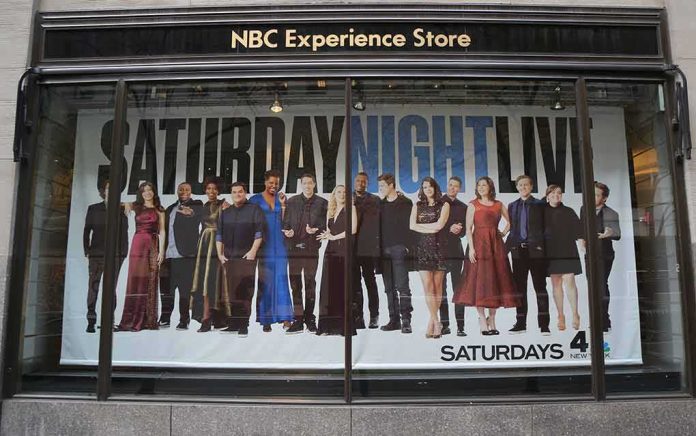
Comedy controversies don’t hinge on a single punchline; they turn on who audiences believe the joke is really about—and on broadcast stages like Saturday Night Live, context is never evenly shared.
At a Glance
- Shane Gillis’s SNL monologue blended self-deprecation with a deliberately jarring “either gay or Hitler” tag meant to lampoon binary thinking, but it offered no developed argument about polarization.
- The gym-clothing bit used the word “whores,” which critics treated as the joke’s actual target rather than a satirical device, igniting charges of misogyny and calls for accountability.
- Dan Levy’s on-record condemnation, amplified by entertainment press and celebrity support, framed audience interpretation before many watched the full set.
- SNL’s live, mass-audience format heightens the stakes: material calibrated for club provocation often reads as literal on network TV, where expectations for targets and tone diverge sharply.
What actually happened on stage
Gillis’s seven-ish-minute monologue played in the familiar SNL host slot: quick observational beats, conspicuous self-flogging, and one line engineered to stick. He described himself as a fat guy navigating a “nightmare” gym culture and joked about his receding hairline; he then pivoted to an absurdist binary—if he brushed his hair to the side he’d look like Hitler, and if he didn’t, he looked “gay”—landing on, “You’re either gay or you’re Hitler. Isn’t that where we’re at as a country?” That tag announces polarization as a theme, but nothing in the set expands it into argument. The gym bit, by contrast, uses a blunt slur about women’s attire; there is no explicit framing within the monologue that relocates the target from women to, say, male insecurity or media moral panics.
Because it aired live on NBC, the monologue was encountered by a broad, non-consenting audience in the media-theory sense: viewers didn’t opt into a club act with local norms, they tuned into a legacy sketch show where the line between observational ribbing and group-directed contempt matters more. That is the perennial SNL friction point—provocation without club-context cues tends to be read at face value.
The dispute: satire about polarization, or misogyny on live television?
Supporters of Gillis’s approach point to structure: the set repeatedly dunks on the comic himself, and the climactic line yokes a taboo reference (Hitler) to an identity shorthand (gay) to parody the way online discourse collapses nuance into reputational extremes. As a claim about the mechanism of the joke, that’s plausible; the Hitler line is formally an exaggeration, not a literal taxonomy of Americans.
The criticism counters on two fronts. First, intent aside, the gym material labels women with a term widely recognized as demeaning; critics argue that, absent clear satirical redirection, the joke’s surface meaning is its social meaning. Dan Levy’s response made that case cleanly—women’s clothing is not grounds for sexual judgment; men who make it so are being misogynistic—and his comments spread quickly across mainstream outlets. Second, the platform matters: jokes that might function as edgy role-play in a club are different when recited on a flagship network comedy show, where the potential for normalization and harm is greater, the argument goes.
The evidence record, weighed
On the text of the monologue, the polarization thesis is present only as a punchline, not as a developed satirical arc. In contrast, the gym bit’s language is direct and group-directed. That asymmetry explains why many viewers and commentators interpreted the set as misogynistic rather than as criticism of digital-era binaries: the clearest, most elaborated part of the material targets women’s clothing; the higher-order claim is gestured at, not built.
Gillis’s history complicates reception further. In 2019 he was dropped from SNL after resurfaced clips showed racist and homophobic slurs; the new backlash explicitly referenced that past, supplying a ready-made interpretive frame for ambiguous lines. While past conduct does not determine present intent, media effects research and common sense align here: prior associations shape how audiences fill in gaps when a joke’s target is unclear.
Why SNL keeps ending up here
SNL is a sketch show that periodically hands its live mic to stand-ups whose craft depends on tension—status role-play, taboo-testing, controlled discomfort. That artistic engine collides with broadcast expectations every few years. The show’s long ledger of blowups—from Andrew Dice Clay to Dave Chappelle—reflects a structural problem, not a particular comic’s moral deficit: mass-audience comedy compresses context, while controversial stand-up depends on it. The result is predictable. When the satirical “who” is ambiguous, the “who” that hears itself named will answer back, and platform operators will be pressed to adjudicate.
Scholarly work on offensive humor underlines the mechanism. Audiences infer a comedian’s character and intent from the text when contextual cues are thin; in experiments, people more readily support sanctions when they attribute demeaning intent, even if they do not endorse blanket censorship. Parallel work on “cancel culture” and comedy suggests comedians are not uniformly silenced, but the scrutiny cycle is faster and consequences more distributed—bookers, advertisers, and social feeds all act as filters and amplifiers.
How to read the Gillis set on its own terms
As craft, the monologue interleaves three classic devices: self-deprecation (degrading oneself to lower the speaker’s status and license edgier moves), incongruity (colliding Hitler and sexual identity to expose absurd binaries), and taboo flourish (deploying a stigmatizing label for shock). The first two can shield a risk-taking bit if the audience trusts the satirical aim; the third erodes that trust if the target looks like an out-group rather than a behavior or idea. Gillis leaned heavily on the third in the gym segment without explicit repositioning—no tag or turn that signals, within the bit, that the butt of the joke is male insecurity, algorithmic outrage, or the absurdity of gym fashion commentary itself. The line about polarization, parked later, cannot retrofit intent into earlier, plainer language for many listeners.
Could different framing have changed reception? Likely. Club comics often insert clarifying pivots—narrative reveals that expose the narrator’s own pettiness or hypocrisy—so that the derogation lands squarely on the speaker persona. On broadcast, that sort of belt-and-suspenders targeting is less an artistic nicety than a survival skill.
Implications for comedians, bookers, and audiences
For comics, the lesson is not to avoid hard topics; it is to surface the satirical target in-line when working in mass settings, especially with reputational history that primes suspicion. For bookers and producers, the SNL pattern argues for stronger editorial dialogue: if a set depends on role inversion or satire-by-exaggeration, build the cues on stage, not in post-show explainers that rarely come. For audiences, a durable heuristic helps: if a joke’s target is ambiguous, judge the clearest object of derision you heard, not the presumed argument you wish was there. That approach neither coddles nor over-polices comedy; it simply reads the text in the room.
Where the real disagreement sits
The live dispute is not whether the line “You’re either gay or you’re Hitler” is hyperbole—it obviously is. The disagreement is over whether the surrounding material credibly signals a critique of polarization or mostly rehearses an old habit: punching down and calling it commentary. Given the record—an undeveloped polarization tag, explicit derogation in the gym bit, and a platform that strips away club context—critics have the stronger case on this monologue as aired.
After Shane Gillis controversy, does #SNL need to consider the audience before booking guests? #SNL pic.twitter.com/byJCiaq8M2
— Frank Torres (@MrFrankTorres) October 12, 2026
Bottom line
Satire survives translation to mass television only when its target is unmistakable in the moment. Gillis’s monologue gestured at a critique of binary culture, but the clearest, most quotable lines aimed down and left little for audiences to reinterpret. In the economy of live TV, that is not a culture-war mystery; it is an editorial outcome.
Sources:
facebook.com, nytimes.com, yahoo.com, independent.co.uk, advocate.com, nbcnewyork.com, theglobeandmail.com, usatoday.com