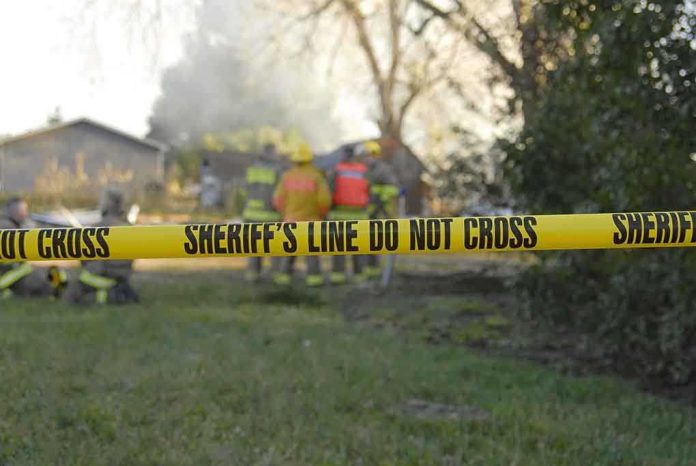
A school shooting is never just a burst of violence; it is an immediate test of whether the response system can contain danger, protect bystanders, and establish facts quickly enough to prevent rumor from hardening into the record. At Warner Robins High School, law enforcement and district officials said a shooting occurred on campus, at least one student was injured, and the scene remained an active investigation.
Key Points
- Officials said a shooting occurred on the Warner Robins High School campus and the school went into lockdown.
- Authorities reported that students were secured in classrooms while law enforcement responded and roads around the school were closed.
- Contemporaneous coverage converged on the same core facts, though early accounts varied on the exact number of injured students and the precise sequence of events.
- The episode fits a familiar pattern in school-violence reporting: immediate containment first, fuller factual clarity later.
What officials confirmed and why it mattered
The most consequential fact is simple: this was not treated as a rumor, drill, or ambiguous disturbance. The Houston County Sheriff’s Office said a shooting was reported at Warner Robins High School, and Sheriff Matt Moulton confirmed a shooting occurred on campus. The Houston County School District said the school was in Code Red, that a student had been shot, and that one injury had been reported while law enforcement took control of the scene. That combination of school-district and sheriff confirmation is what turns an initial alarm into a credible public-safety event.
Authorities also moved quickly to shape the perimeter around the incident. Reporting described a significant law-enforcement presence, road closures near South Davis Drive and Demon Valley Road, and instructions to avoid the area so first responders could work. In a school setting, those details are not incidental; they are the operational footprint of a live response. They indicate containment, evidence preservation, and a deliberate effort to keep traffic, parents, and curious onlookers from complicating an already unstable scene.
How the first version of events was assembled
Early school-shooting coverage usually comes together from three imperfect but necessary streams: official statements, scanner traffic, and on-scene reporting. That is exactly what happened here. Initial accounts described a shooting on campus and, in some reports, a victim shot in the leg and treated with a tourniquet before being located inside the school. Other reports said a student had been injured and transported to a hospital, with law enforcement searching for a suspect and urging the public to stay clear. The details were still moving, but the central fact pattern was stable.
That is why the strongest reporting did not pretend to know more than it did. Some contemporaneous accounts said one student was shot; others said two students were injured; and one outlet noted that it was not yet clear how the injuries were sustained. Those differences are not unusual in the first hours of a school-violence incident. Numbers often sharpen as the scene is secured and the injured are accounted for, which is why the public should treat the earliest figures as provisional unless and until officials repeat them consistently.
What the injury reports suggest, and what remained uncertain
The public record supports a careful distinction: a shooting on campus was confirmed, and at least one student was reported injured; the exact count of injured people was still being reconciled across outlets and official updates. Some reporting said two students were taken to a hospital with non-life-threatening injuries, while other reports spoke of one student shot. Those are not incompatible in the way casual readers sometimes assume. A single developing incident can produce staggered updates as additional victims are identified, transported, or reclassified.
What was not fully settled in the earliest reports was the exact sequence of the shooting, the motive, and whether a suspect had already been secured when some of the first alerts went out. That is the normal boundary of breaking-news information, not a reason to doubt the core event. In fact, the reporting shows the opposite: officials were communicating what they could verify in real time, while responders stabilized the campus and the district kept students in classrooms under controlled release.
A heavy police presence appeared at Warner Robins High School, as multiple law enforcement officers responded to a shooting Wednesday afternoon.#WGXA #Deveoping #WarnerRobins https://t.co/aeuPZry3tQ
— WGXA (@WGXAnews) August 12, 2026
Why Warner Robins fit the familiar school-crisis template
Warner Robins High School is at 401 South Davis Drive, and that location matters because high schools are dense civic environments: students, staff, nearby residents, church traffic, and morning or afternoon car flow can all become part of the response problem within minutes. The larger pattern is familiar in school emergencies. Officials prioritize immediate safety, lock down the campus, and reduce movement; then reporters and families try to make sense of fragments before the formal incident report exists. The result is a public information environment that is fast, necessary, and often incomplete.
This is also why the broader media ecosystem around school shootings can look noisy even when the underlying facts are not especially mysterious. Social platforms and live video reward speed; local television rewards visible response; official statements reward restraint. When those three systems overlap, the public sees a flood of partial confirmation before it sees a clean chronology. In Warner Robins, the most reliable through line was not sensational detail but institutional convergence: sheriff, district, and multiple outlets all pointed to the same core event on campus.
What the case means beyond the immediate scene
The significance of the Warner Robins shooting lies in how it illustrates modern school-crisis management. The first task is not public narrative control; it is stopping the bleeding, securing the building, and accounting for everyone inside. The second task is to separate verified fact from rumor while the situation is still fluid. The third task, which comes later, is to explain how a weapon reached a campus, who was responsible, and what failures or interventions may have preceded the violence. The early reporting in Warner Robins clearly covered the first two tasks; the third awaited the investigation.
For parents and communities, that sequence matters because it determines trust. A district that communicates plainly that a student was shot, that law enforcement is on scene, and that dismissal will be controlled is doing the minimum necessary work of public stewardship. A sheriff’s office that confirms a shooting, sets a perimeter, and asks people to avoid the area is doing the equally necessary work of scene control. The hard lesson of incidents like this is that the most useful facts are usually the least dramatic ones: where the event happened, who is safe, who is hurt, and when the investigation will produce something more definitive than the first flurry of alerts.
Sources:
insiderpaper.com, timesnownews.com, youtube.com, fox5atlanta.com, cbsnews.com, macon.com, wgxa.tv