
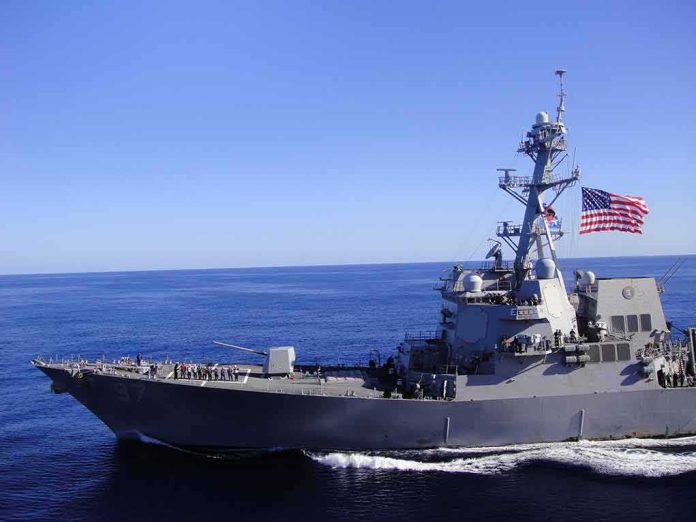
Power at sea is not the same thing as sovereignty; a navy can dominate a chokepoint for a season, but international law rarely lets battlefield leverage harden into title. The Strait of Hormuz—through which a substantial share of the world’s seaborne oil must pass—illustrates that distinction with unusual clarity.
The Short Version
- President Trump has said the United States has “total control” over the Strait of Hormuz and has mused about declaring it U.S. territory after defeating Iran; those are political claims, not legal facts.
- By prevailing legal doctrine, Hormuz is an international strait overlain by the territorial seas of Iran and Oman; no outside state can convert it into its own territory by proclamation or blockade.
- Navigation rights through such straits exist irrespective of who has the bigger fleet; the regime is transit or innocent passage, not ownership.
- Domestic and foreign audiences read sovereignty talk as leverage; the legal regime resists it, which is why Hormuz disputes cycle as crises of passage, not transfers of title.
What was claimed, and what it does—and does not—mean
President Trump has asserted that the United States has “total control over the Strait of Hormuz,” describing a “wall of steel” blockade and adding, “I think we will keep it.” In a separate flourish, he suggested he could declare the strait a U.S. territory after Iran is defeated. Such statements signal intent and confidence; they do not, by themselves, alter the law of the sea. Iran, for its part, has publicly rejected U.S. control claims, insisting the waterway remains blocked pending its terms—counter-claims that underscore the gap between operational control and legal status. The net effect is a familiar standoff: military measures press for advantage while each side frames legitimacy for diplomatic leverage and domestic consumption.
For a reader sorting signal from noise, two points anchor the analysis. First, a belligerent can exercise sea control—deny or enable shipping—in a defined battlespace for a period of time. Second, sovereignty is a legal quality of territory that changes hands by recognized cession, adjudication, or state succession—not by unilateral declaration. The statements and even a successful blockade affect traffic and bargaining power; they do not confer title.
How Hormuz is actually governed: international straits and passage rights
Hormuz connects the Persian Gulf to the Gulf of Oman and the Arabian Sea. At its narrowest, it is roughly 21 nautical miles across, meaning the territorial seas of Iran and Oman overlap to cover the waterway; there is no slice of “high seas” running through its middle. That geometry places Hormuz within a legal category called an international strait: waters that connect one part of the high seas or an exclusive economic zone to another and are used for international navigation. The consequence is not ownership by outside powers, but a specific navigation regime that coastal states must accommodate. Analyses from international-law scholars and institutions are remarkably consistent on this point: no single state “owns the Strait of Hormuz as a whole,” and the United States has no sovereign rights to claim it as territory.
What navigation regime applies? Under the United Nations Convention on the Law of the Sea (UNCLOS) and customary law, international straits are generally subject to transit passage—a continuous and expeditious right for ships (and, controversially, warships and aircraft) that coastal states cannot suspend. Some experts emphasize that, because the United States and Iran are not parties to UNCLOS, the precise contours are argued through custom and older instruments; a minority view holds that only innocent passage—more limited, and potentially regulable—applies at Hormuz. But across these debates, one constant holds: passage rights do exist, and they do not hinge on outsiders owning the strait.
Why rhetoric drifts toward “ownership” and why the law resists it
Why talk of “we own it” at all? Because sovereignty rhetoric compresses a complex reality into a potent signal. For a leader managing a blockade, it communicates dominance, deters adversaries, shores up alliances, and can create negotiating leverage by framing an operational fact as a settled outcome. Iran counters to preserve sovereign dignity, sustain its claim to regulate or condition passage, and deter normalization of foreign control narratives. This is bargaining theater with real ships and real risk behind it. Yet maritime law evolved precisely to prevent chokepoint control from becoming a passport for annexation. Even when major powers have policed or patrolled straits—think Gibraltar, Malacca, or Bab el-Mandeb—the governing settlement has not morphed into transferred title simply because one navy could stop ships at will. The Hormuz regime fits that lineage: coastal sovereignty over territorial seas, coupled with non-suspendable navigation rights for others.
Multilateral organs tend to reinforce that line. When Iran signals authority to close or condition Hormuz broadly, states have pushed back, urging non-recognition of sweeping sovereignty claims and any attempt to obstruct transit passage; that same instinct would meet any comparable claim by an outside power to declare the strait its territory. In other words, the system’s reflex is to protect navigation and resist unilateral rewrites of status—no matter who asserts them.
Sea control, blockade, and the limits of force as a lawmaker
A well-executed blockade can drastically curtail shipping; a dominant fleet can screen convoys, interdict war materiel, and police traffic separation schemes. Those are operational levers, not conveyances of title. Blockade itself is a belligerent act governed by the law of naval warfare, which permits certain interdictions in armed conflict but does not confer peacetime sovereign rights or dissolve the passage regimes that reassert themselves once hostilities recede. This is why, across oil-price spikes and shipping slowdowns, legal analysis still returns to the same bedrock: Hormuz remains an international strait overlain by the territorial seas of Iran and Oman, and navigation rights for others persist by rule, not by grace.
There is, to be sure, a live debate at the margins. Some legal scholars argue that because Iran and the United States are non-parties to UNCLOS, each can advance narrower readings of transit passage or demand prior notification for warships; others respond that the core of transit passage has crystallized as customary law. A related view posits that only innocent passage applies in Hormuz, especially for non-parties, which would give coastal states somewhat greater regulatory tools. These disagreements matter for practice—routing, notifications, the scope of military activities during passage—but they do not open a path for an extraregional power to declare the waterway its territory.
🔥 12-HOUR BOMBSHELL ROUNDUP: Trump’s Hormuz Power Grab + SpaceX’s $60B AI Takeover + Markets & Crypto Shocks 🔥
1/2
Politics ignited this Friday. President Trump announced he will “pretty soon” declare the Strait of Hormuz a territory of the United States once Iran is defeated,… pic.twitter.com/YBYTnrjwR0— Numeros Guy (@NumerosGuy) August 15, 2026
What to watch: the real stakes for shippers, navies, and policymakers
For commercial operators, the key variable is not who “owns” Hormuz—no one outside Iran and Oman does—but whether sea control is contested on a given day. Insurance premia, war-risk surcharges, and route decisions respond to projectile ranges and interdiction behavior, not to proclamations. For navies, the technical question is the balance between asserting passage rights and managing escalation risks inherent in convoying, minesweeping, or interdiction. For policymakers, rhetoric that blurs the line between control and sovereignty may mobilize support at home but complicates coalition diplomacy abroad; partners often sign on to defend navigation, not annexation. The legal North Star remains stable: keep the strait open to the extent compatible with the law of armed conflict during hostilities, and restore full passage regimes promptly thereafter.
The enduring lesson is simple and durable. In chokepoints, power is transient and performative; law is conservative and sticky. Leaders will continue to claim more than the law allows because leverage rewards maximalist framing. But when the ships sail tomorrow, their rights of passage will still spring from the same sources they did yesterday—and not from any one nation’s assertion that it “owns” the sea.
Sources:
feedpress.me, cnbc.com, reuters.com, aljazeera.com, bloomberg.com, en.wikipedia.org, cnn.com, theguardian.com, wsj.com, abcnews.com, onestnetwork.com