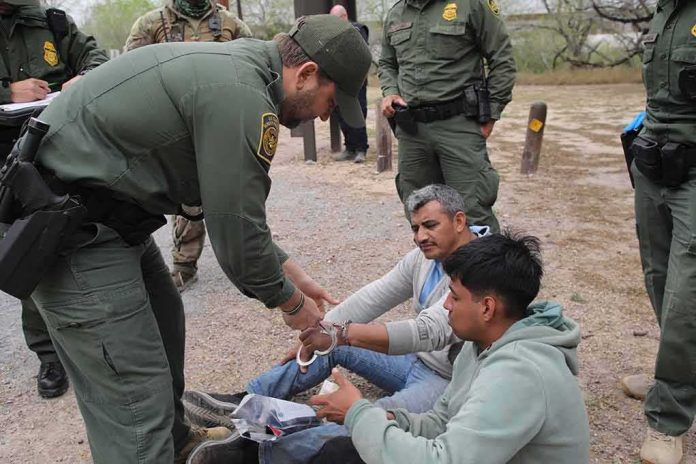
When an immigration case hinges on nine border tries, on-scene arrest, and a suspect’s own admission, it becomes more than a headline; it is a clear window into how repeat entry, local detainer policies, and federal fieldwork interact in the real world.
At a Glance
- ICE arrested Ernesto Alejandro Perez-Garcia in Redondo Beach, identifying him after he initially denied who he was
- ICE says he entered the U.S. illegally five times and made four additional attempts to enter
- After booking, Perez-Garcia admitted he lied to agents about his identity when first confronted
- ICE cites prior detainer requests declined by Redondo Beach Police in 2020 and 2026, setting the cooperation backdrop
What Happened: An on-scene ICE arrest tied to multiple prior entries
U.S. Immigration and Customs Enforcement arrested Ernesto Alejandro Perez-Garcia in Redondo Beach, California, during a field operation that a reporter observed as it unfolded. According to ICE’s account reported in that on-scene coverage, Perez-Garcia had crossed the border illegally five times and attempted to enter four additional times. At first contact, he denied he was the person agents were seeking; when agents produced a previous booking photo, he acknowledged his identity. After his booking, he explained the denial bluntly: he had lied to see if he could get away with it. These factual elements—the arrest, the identity denial, the mugshot confirmation, and the post-booking admission—anchor the case in direct observation and direct quotation rather than inference.
The same reporting ties Perez-Garcia to a local arrest history dating to 2003, including five disorderly-conduct arrests since 2020—four by the Redondo Beach Police Department—with two in spring 2026. ICE additionally asserted that local authorities declined immigration detainer requests in 2020 and again in 2026, a point that often shapes how and when federal custody can be effected in community settings.
Mechanics: Identity, custody, and the repeat-entry pattern
Identity is the pivot in field arrests. In practice, agents establish it through a layered approach: biographic questioning; comparison with prior booking photos; and, once in custody, biometric checks that match fingerprints against DHS and FBI databases. The described sequence—initial denial followed by acknowledgment when confronted with a prior mugshot—is consistent with that playbook. Once identity is established, custody may be based on an administrative arrest under the Immigration and Nationality Act, separate from any criminal charge such as illegal reentry under 8 U.S.C. § 1326. The reported history of multiple crossings fits a broader enforcement reality: federal sentencing research shows illegal-reentry cases rise and that the average offender has been deported multiple times before the current prosecution, underscoring how recidivism at the border complicates both deterrence and case management.
Repeat attempts also intersect with how Border Patrol and ICE track encounters. Border Patrol reports and independent analyses have documented meaningful swings in repeat-encounter rates, reflecting shifts in migration flows, enforcement posture, and return policies. While the labels differ—encounters, apprehensions, removals, voluntary returns—the operational burden is similar: the same individual can cycle through the system multiple times, taxing field resources and increasing the premium on accurate identification at every step.
Local–federal coordination: how detainers shape the field
Detainers—requests from ICE asking a local jail to hold a noncitizen up to 48 hours beyond release—have become a fulcrum of immigration enforcement outside the border region. Jurisdictions vary widely in how they respond, from broad acceptance to categorical limitations absent a judicial warrant or defined criminal predicates. Research and advocacy accounts document this divergence: some analyses argue noncooperation leads to releases that complicate federal enforcement, while peer-reviewed work finds sanctuary policies reduce overall deportations without increasing local crime, especially not for violent offenses.
In practical terms, when a detainer is declined, ICE must shift to at-large operations—arrests in public or at residences—requiring surveillance, deconfliction with local activity, and added officer risk. The Redondo Beach arrest unfolded this way: agents located the subject in the community and executed the custody transfer themselves. That operational reality is precisely why detainer decisions, even in routine misdemeanor contexts, can materially change how and where federal arrests occur.
The legal architecture: administrative custody versus criminal reentry
Two distinct legal tracks govern cases like this. First is civil immigration enforcement: an administrative arrest places a noncitizen into removal proceedings or, if there is a prior final order, into reinstatement, an expedited path that revives that order for prompt removal. Second is criminal prosecution for illegal reentry after removal under § 1326, a felony conditioned on proof of a prior removal, subsequent unauthorized reentry, and alienage. Nationally, illegal-reentry prosecutions have increased markedly since 2021, reflecting a prosecutorial emphasis on recidivist crossings and cases with aggravating factors; sentencing data chronicles the scale and average removal histories of those prosecuted. Not every arrest leads to a criminal charge; many cases proceed solely in the civil track, especially where resources or equities point that way.
The Perez-Garcia account, as reported, centers on the field arrest and underlying entry attempts; it does not hinge on a new indictment. That distinction matters for timeline and consequence. Administrative custody can move quickly if a prior order exists; criminal cases add the layers of indictment, arraignment, and trial or plea, followed by Bureau of Prisons custody before removal. The operational through-line in both tracks is the same: confirmed identity and documented removal history drive the next step.
Why the case resonates: a single file, several national debates
A field arrest along a Southern California esplanade may seem local, but the strands it braids together are national. It illustrates how repeat entry functions as a structural feature of border enforcement rather than a rare outlier; why detainer policy is not an abstraction but a variable that changes where arrests happen; and how identity, once confirmed, funnels a case into predictable legal channels. It also shows why public narratives often harden around vivid moments—an at-large arrest, a suspect’s quoted admission—while the administrative machinery hums in the background. The national data on illegal-reentry prosecutions and removal histories gives that vivid moment statistical context, anchoring an individual story in the broader enforcement landscape.
For communities, the implication is pragmatic. Where local cooperation with detainers is limited, expect more at-large operations and the visibility that comes with them. For federal agencies, repeat crossers demand better tools of identity resolution and file integration so that operational risk remains as low as possible during arrests like this one. And for the courts and policymakers, the tradeoffs are familiar: calibrate criminal prosecution and civil removal to target the right cases, at the right time, with outcomes that credibly shape future behavior at the border.
………Ernesto Alejandro Perez-Garcia was successfully arrested and detained by U.S. Immigration and Customs Enforcement (ICE) during his morning walk. He is currently in federal custody facing deportation.[
An exclusive report and video broadcast by Fox News Digital captured the…
— JV (@joveg8) August 22, 2026
Bottom line
ICE arrested Ernesto Alejandro Perez-Garcia in Redondo Beach after identifying him despite an initial denial; the agency says he has five prior illegal entries and four additional attempts. His post-booking admission and the reported history of declined detainers explain both why the arrest happened in public and why the case has outsize resonance. Set against national data on repeat entry and reentry prosecutions, this episode is not an anomaly; it is a case study in how contemporary immigration enforcement actually works.
Sources:
facebook.com, foxnews.com, usa.gov, dhs.gov, acis.eoir.justice.gov, cbp.gov, ice.gov, oig.ssa.gov