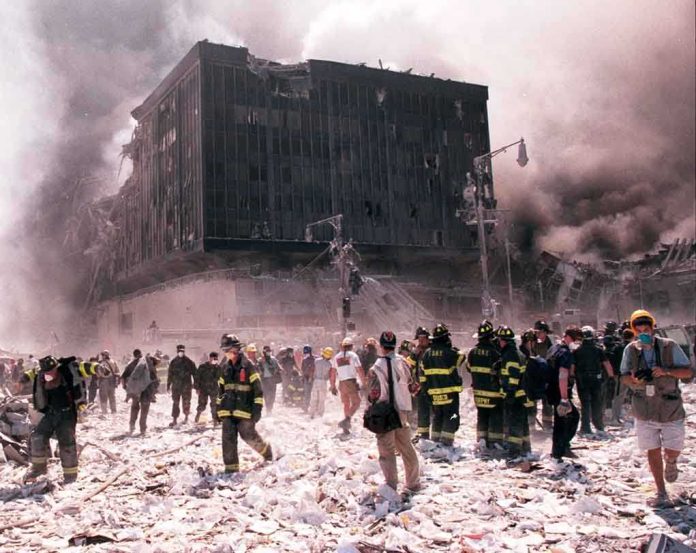
The Presidential Medal of Freedom is as much about the stories a nation chooses to elevate as it is about the individuals it honors; Welles Crowther’s posthumous award affirms a specific story of 9/11—ordinary courage under catastrophic pressure—as a permanent part of America’s civic memory.
At a Glance
- President Trump posthumously awarded Welles Remy Crowther the Presidential Medal of Freedom for lifesaving heroism on September 11, 2001.
- Crowther, the “Man in the Red Bandana,” is credited with leading multiple groups to safety from the South Tower before he was killed.
- The choice reflects how presidents use the Medal to shape public remembrance of national trauma and valor, often with broad discretion and posthumous recognition.
- The ceremony capped years of community and bipartisan advocacy to honor Crowther’s actions formally.
What Was Decided and Why It Matters
President Trump conferred the nation’s highest civilian honor on Welles Remy Crowther, the 24-year-old equities trader and volunteer firefighter who died saving others during the September 11 attacks. The White House announcement explicitly linked the award to Crowther’s documented rescues in the South Tower and the indelible detail by which survivors knew him: the red bandana he used as a makeshift respirator and rallying signal. This was not a symbolic nod buried in a longer list of honorees; the moment was constructed to center one narrative of 9/11—initiative, composure, and self-sacrifice by a citizen responder—at the apex of national recognition.
The choice resonates because Crowther’s story has long served as a bridge between personal grief and public meaning. The Medal of Freedom formalizes that bridge. In a field of post-9/11 remembrance spanning official memorials, annual readings of names, and survivor testimonies, the presidential honor fixes his actions within the canon of national exemplars—individuals whose conduct clarifies what the culture esteems under duress.
The Mechanics of the Medal: Broad Discretion, Deliberate Symbolism
The Presidential Medal of Freedom is awarded at the president’s discretion for “especially meritorious” contributions across security, peace, culture, and public or private endeavors. Its modern form, reinstated by President Kennedy in 1963, deliberately lacks narrow criteria and requires no congressional approval, which makes it an instrument of presidential storytelling as much as a recognition of accomplishment. Posthumous awards are routine under this framework; the governing executive order explicitly allows them, and historical reviews show they recur with regularity across administrations.
That latitude matters in cases like Crowther’s. The president can elevate a single act of improvised leadership to the level of national ethos without navigating legislative compromise or adjudicating standardized metrics. In practice, the Medal’s power stems from its parsimony: few awards, each carrying the presumption that recipients model virtues the country wishes to remember and replicate.
Crowther’s Actions on 9/11: The Factual Spine
Crowther worked on the 104th floor of the South Tower for Sandler O’Neill & Partners. After United Flight 175 struck, survivors later recalled a young man with a red bandana taking command—triaging the injured, organizing evacuations down the stairs, and returning upward to lead additional groups. Multiple accounts credit him with saving many lives before he was killed when the tower collapsed. The White House summary mirrors those survivor narratives and anchors the award squarely to that conduct.
Those details, corroborated over years through interviews, documentaries, and anniversary profiles, are why the bandana became more than a keepsake; it became shorthand for a pattern of behavior under existential threat. For an honor that purports to recognize exemplary contribution to the national interest, it is difficult to imagine a clearer fit than a citizen who repeatedly chose to re-enter danger so that others could live.
How This Recognition Came to Be
Although the president alone confers the Medal, campaigns to recognize Crowther’s heroism matured over time. Community leaders and elected officials in his native New York advocated formally, building a bipartisan case that blended local pride with national remembrance. Public signals preceded the ceremony: announcements at events, statements from members of Congress, and coverage that framed the prospective honor as overdue rather than controversial.
By the time of the award, the arc was familiar: a grassroots initiative grounded in survivor testimony and family stewardship intersected with presidential agenda-setting around a major anniversary. The result served several constituencies at once—families of the fallen, first responders, and a broader public that continues to seek legible meaning in an event that resists it.
What Presidents Use the Medal For—And Why Crowther Fits
Because the Medal’s remit is so expansive, each conferral is an act of curation. Administrations have used it to canonize cultural icons, diplomatic figures, scientists, and, in moments of national mourning, individuals whose deaths galvanized the public. A longitudinal analysis of recipients underscores two constants: the award’s legal flexibility and the recurring use of posthumous honors to anchor collective memory. In the language of political science, the Medal is a unilateral symbolic power: it shapes public narratives precisely because it can be deployed quickly, personally, and with ceremony.
Applied here, that power narrows the focus of 9/11 commemoration to a single, teachable gesture—turning back up the stairs. Crowther’s example also broadens the aperture beyond uniformed service: he was a trained volunteer firefighter but a civilian by profession, which makes his actions legible to any office worker who has ever walked a stairwell in a fire drill and wondered how they would behave when the lights go out.
President Trump posthumously awards the Presidential Medal of Freedom to the family of Welles Crowther, known as the “Man in the Red Bandana,” who risked his life to save others on 9/11.
The tribute rally on the White House lawn honored the nearly 3000 lives lost, and families… pic.twitter.com/AD9lgJi9II
— Jack Bradley (@jackgbradley) September 8, 2026
The Stakes of Memory: From Private Loss to Public Standard
Honors attach obligations. When the presidency puts its imprimatur on a story like Crowther’s, it implicitly asks institutions—schools, civic groups, media—to retell it. That is not mere sentimentality. The operational lessons are real: decentralized leadership matters when systems fail; small, concrete acts—finding the usable staircase, improvising a mask—scale into population-level survival when repeated. Embedding those lessons in narrative memory is a practical investment, not only an emotional one.
The medal also stabilizes how future generations will encounter 9/11. As living memory recedes, curated exemplars will carry more weight, and the “Man in the Red Bandana” will stand among them. The family’s custodianship of the story and the survivors’ testimonies gave it durability; the Presidential Medal of Freedom gives it institutional permanence.
Where This Leaves the Broader Conversation
Not every posthumous Medal of Freedom resolves to such uncontested terrain, but Crowther’s does. It aligns the purpose of the award with a case of clear, consequential heroism, using presidential discretion exactly as designed. In doing so, it offers a rare point of shared civic reference in a fractured era: a reminder that, when the test arrived without warning, one citizen met it with competence, courage, and care for strangers. That is the kind of memory a country should keep.
Sources:
youtube.com, nytimes.com, thehill.com