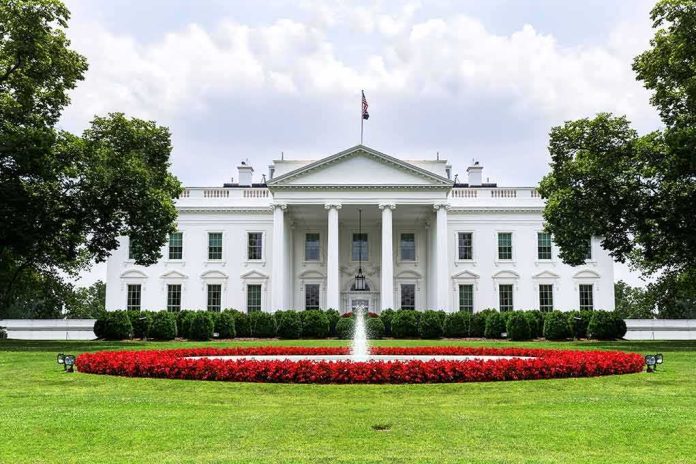
Presidents do not write the rules of a frontier technology in a single stroke; they convene the people who can. President Trump’s White House lunch with leading AI chiefs was exactly that kind of forum—an explicit bid to keep U.S. leadership in artificial intelligence while steering the conversation toward industry-led guardrails rather than new federal mandates.
At a Glance
- The White House hosted a policy-focused luncheon on artificial intelligence with top tech and AI executives.
- Discussion centered on balancing rapid innovation with safety and oversight, with an emphasis on self-regulation.
- Named participants included leaders from Meta, Anthropic, OpenAI, and Nvidia, among others.
- The meeting coincided with a government digital initiative, positioning AI as both an economic engine and service-modernization tool.
What Happened: A policy summit framed around innovation and self-governance
The event was a formal White House luncheon—described by multiple outlets as a meeting in the East Room—where President Trump and House Speaker Mike Johnson brought in senior executives from the companies at the center of today’s AI race. Reuters and CNBC identified this as a focused policy conversation about finding equilibrium between the pace of AI development and the need for oversight; neither outlet framed it as a symbolic photo-op but as a working session with the country’s most consequential industry leaders. Named attendees reported across outlets included Meta’s Mark Zuckerberg, Anthropic’s Dario Amodei, OpenAI’s Greg Brockman, and Nvidia’s Jensen Huang—precisely the people who can translate policy lines into engineering standards and product governance.
From the administration’s side, the message was consistent: keep the U.S. lead in AI and avoid throttling the underlying research and deployment engine. Trump publicly rejected the notion of slowing development and leaned into self-regulation by the companies themselves, a posture that situates the Justice Department and other agencies as backstops rather than first-order rule-makers. That policy signal, coming from the White House, matters; where a President plants the flag in an emerging-technology debate often defines the baseline for subsequent negotiations with Congress and state regulators.
Who was in the room, and why those specific firms matter
Why these companies? Because today’s AI stack is a tightly coupled system with a small number of choke points: compute, models, data, and deployment platforms. Nvidia effectively monopolizes the accelerator hardware used to train and serve large models; OpenAI and Anthropic sit at the tip of frontier model capability; Meta controls a ubiquitous consumer platform and has open-weight model ambitions; and each brings a different posture on openness, safety techniques, and commercialization. Reports consistently pointed to Zuckerberg, Amodei, Brockman, and Huang as central figures at the lunch—an attendee constellation that makes sense if the objective is to hash out norms that actually bind in the places that matter operationally (training runs, release gating, and incident response).
Speaker Mike Johnson’s participation underscored the intended bridge to Congress—less about drafting a bill in the room than ensuring any legislative trajectory does not undercut the administration’s growth-first stance. Reuters summarized the declared aim as balance: innovation with oversight, but not a pause or moratorium—a framing consistent with Trump’s public comments in the run-up to and around the meeting.
Mechanisms on the table: self-regulation, risk management, and DOJ as backstop
“Self-regulation” is not a synonym for laissez-faire. In practice, it means industry commits to process controls—internal red-team thresholds, release reviews, external audits of safety claims, incident reporting pathways, and board-level accountability—while preserving speed. The policy question is who defines sufficiency and how quickly the bar rises as capabilities advance. Public remarks linked to the White House event leaned on the idea that companies will police one another’s behavior and that federal enforcement can address fraud, misuse, or negligence after the fact, rather than setting pre-market licensing regimes. This stance rejects the European-style ex-ante compliance model in favor of flexible norms hardened by liability and reputational risk.
There is precedent for this path. The Biden administration’s 2023 CEO sessions produced voluntary commitments—real, but nonbinding—around safety testing, transparency, and misuse mitigation. Those readouts were consequential as signals and as early templates; they were also criticized for vagueness and lack of enforcement. The Trump meeting fits the same American tradition of early-stage industry compacts while Congress assesses how far to codify them and in what sectors to be more prescriptive.
The policy backdrop: pairing AI leadership with service modernization
The luncheon did not stand alone. Reporting tied the day’s agenda to a broader government digital effort, including an AI-enabled federal services portal described as America.gov. The pairing is coherent: if you want the public to accept the premise that AI should move fast, show them a concrete dividend—simpler, faster, more accurate access to government services. In policy communications, the complement of “growth narrative” and “citizen benefit narrative” is not accidental; it builds a permission structure for continued investment, data center expansion, and infrastructure accommodation in localities that shoulder the costs of power and land use.
That local dimension featured in the White House framing: data centers as engines of regional wealth, tax base expansion, and community benefits. For mayors and governors, those claims translate into negotiations over siting, power procurement, water usage, and workforce pipelines—areas where federal signaling can either smooth coordination or spark resistance. The administration’s line positions Washington as an accelerant and conciliator, not a brake.
How this compares to other governance models
Globally, AI governance is fragmenting into three recognizable models. Europe pushes toward ex-ante regulation and conformity assessment—a preventive paradigm that prioritizes documented controls before deployment. China fuses state direction with rapid industrial policy, aiming to shape platforms and censorial guardrails within a tightly governed public sphere. The United States, as evidenced again by this White House summit, continues to favor a risk-based, sector-specific approach that invites industry to formalize best practices and relies on enforcement and liability to discipline egregious behavior. The bet is that this blend preserves speed—crucial for competitiveness—while giving regulators sufficient hooks when harms surface.
Where do serious disagreements remain? Two places. First, frontier thresholds: what constitutes a “high-risk” capability that demands pre-release evaluation beyond company norms—think autonomous code execution, powerful bio-design agents, or persuasive synthetic media at scale. Second, auditability: whether third-party evaluations can be credibly conducted without statutory access rights to models, data, and compute logs. Those questions did not get resolved over lunch; they rarely do. But the presence of the firms that control the levers means any norms discussed can be operationalized quickly if the participants align.
BREAKING: President Trump and Elon Musk discuss how AI is rapidly transforming entire industries following a White House meeting with top tech executives. #NYI pic.twitter.com/9tnjpv3Iwi
— NewYork-Insight (@NewYork_Insight) September 29, 2026
What it means going forward
Summits like this are accelerators for coordination. They rarely mint law, but they can fix ideas into shared expectations that ripple through product roadmaps, procurement requirements, and investor diligence checklists. With President Trump signaling opposition to a slowdown and a preference for industry-led safety regimes, the center of gravity in U.S. AI policy remains: move fast, document controls, and expect enforcement to punish outliers rather than licensing to pre-clear innovation. That approach puts a premium on credible, testable internal governance at the companies generating and deploying the most capable systems—and on a federal capacity to investigate and prosecute when lines are crossed.
The practical next steps are predictable. Agencies and Hill offices will request follow-on briefings; companies will memorialize their safety and audit practices in public-facing documents; localities will negotiate data center terms with an eye to power reliability and water use; and investors will price execution risk against the policy climate. The White House lunch did not settle the AI governance debate. It did, however, mark the administration’s choice of instrument—industry compacts over immediate statute—and its north star: retain U.S. leadership while building just enough shared discipline to keep the engine running fast.
Sources:
finance.yahoo.com, abc7.com, cnbc.com, reuters.com