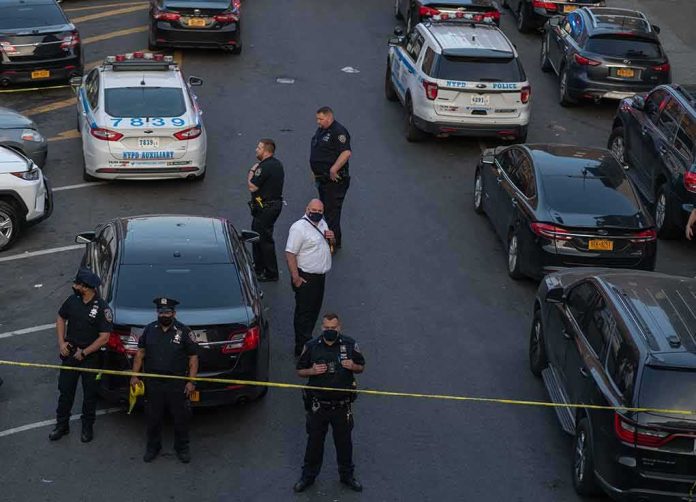
When a knife attack erupts in a crowd, the question that governs everything—from the first police command to the last report filed—isn’t abstract: it is imminence. The Times Square incident makes that plain in the hardest possible way.
At a Glance
- NYPD officers fatally shot 49-year-old Pamela Cisneros after she stabbed two people near Times Square; one victim died.
- Officials say officers gave repeated commands, attempted a Taser, and fired only after Cisneros advanced while armed with knives.
- Body-worn camera footage of the confrontation was publicly released, depicting the minutes-long standoff.
- Experts frame such encounters through imminence, distance, and available alternatives in a dense, high-risk setting.
What happened in Times Square—and why it mattered in seconds
On a late afternoon near West 41st Street and Seventh Avenue, police confronted Pamela Cisneros of Queens after two rapid stabbings in a packed corridor of Times Square. The attacks were described by police as random and unprovoked; a 32-year-old Bank of America vice president died of her wounds, and a 68-year-old tourist survived with injuries. Within minutes, uniformed officers encountered Cisneros holding two knives. According to officials and multiple news organizations, they issued sustained commands to drop the weapons, attempted a Taser, and ultimately fired when she advanced while armed. Cisneros was transported to a hospital and pronounced dead. Two knives were recovered at the scene.
Commissioner Jessica Tisch summarized the officers’ imperative bluntly: they faced an immediate lethal-threat scenario in one of the most crowded public spaces in the city. Her account—echoed across outlets—cites explicit threats Cisneros made toward officers during the standoff and the failure of less-lethal tools to stop her advance before gunfire. In that context, the officers’ use of deadly force tracks standard doctrine: when a subject armed with an edged weapon closes distance after warnings and less-lethal attempts, lethal force is justified to protect life.
The sequence, as captured and corroborated
Reports place first contact shortly after 4:24 p.m. Officers engaged for several minutes, issuing commands that the body-worn cameras recorded. The audio, as described by officials and journalists who reviewed the footage, includes Cisneros rejecting commands—“I’m not dropping anything”—and threatening to kill the officers. When a Taser deployment failed to incapacitate her, she continued to move on officers with the knives, at which point two fired their service pistols. This progression—command, less-lethal, lethal—matches widely taught force continua, but more important in court and policy review, it aligns with the immediacy standard: an advancing, armed assailant in a crowd presents an acute risk to officers and bystanders.
Location matters. Times Square compresses risk because movement and backdrop are both dense; any misstep sends danger laterally into a bystander stream. Officers have to solve for geometry as much as intent: angles of fire, backdrop safety, and distance to the threat. Expert commentary has largely affirmed the justification under these constraints, while warning that firing without fully clearing the backdrop carries intrinsic risk in such an environment—a reminder that necessity and risk management coexist uneasily in close quarters.
How knife-threat doctrine actually works
Edged-weapon encounters do not lend themselves to tidy de-escalation once a subject is mobile and noncompliant at close range. The governing legal lens—often summarized under Graham’s “objective reasonableness”—asks what a reasonable officer would do given the threat, the distance, the warnings issued, and the alternatives immediately available. A knife at conversational distance is a lethal threat; a knife closing distance after warnings and an ineffective Taser is more so. Each discrete application of force still must be justified at the instant it is used, but officers and courts consider the short run-up: the stabbings, the explicit threats, the failed less-lethal attempt, and the proximity of civilians.
This is why trainers teach officers to manage space relentlessly. Distance buys time; time buys options. In a corridor like Seventh Avenue at rush hour, distance collapses quickly. The fact pattern reported in Times Square—two victims stabbed within seconds, the suspect still armed, warnings issued, a less-lethal tool attempted and ineffective, the suspect advancing—meets the archetype in which deadly force is not just permitted but required to prevent further serious injury or death.
Video disclosure and the narrative sequence
The NYPD released body-worn camera footage documenting the encounter. In modern policing, that disclosure does more than inform the public; it locks in the narrative sequence: context of prior violence, visible warnings, a nonlethal attempt, and the moment of advance that triggers shots. While departments still control initial release, which shapes early reception, the broader trend is toward faster publication in high-salience cases, in part because knife encounters hinge so cleanly on imminence that the relevant cues read clearly on video—movement, distance, officer commands, subject responses.
The legal processes that follow—internal review, district attorney assessment, and any civil litigation—will analyze the same core elements the footage and reports lay out. They do so with a structured lens: did officers have a reasonable belief of imminent danger; did they issue warnings when feasible; were less-lethal options used or unavailable; and did backdrop considerations inform tactics and fields of fire. On the public-safety axis, the Times Square shooting sits in the zone where force decisions are fast, consequences are irreversible, and the burden of precision rests on officers already behind the time curve of violence that began before they arrived.
The NYPD has released harrowing body-worn camera footage capturing the intense moments leading up to a fatal officer-involved shooting in Times Square on August 31. The visual evidence corroborates initial police accounts of a rapid and violent double-stabbing rampage that… pic.twitter.com/b0FTQ961RA
— Havoc89 (@Havoc890) September 26, 2026
Why this case resonates beyond Midtown
The Times Square attack compresses the recurring dilemmas of urban policing: mental-health instability intersecting with public spaces, edged-weapon lethality at short range, and the moral hazard of hesitation in a crowd. The operational through-line is straightforward: once a suspect has already inflicted lethal harm and continues to threaten with a weapon at close range, improvisation narrows to a binary—stop the threat or risk additional victims. That logic does not diminish tragedy; it explains outcome in the language policy and courts recognize.
Sources:
thegatewaypundit.com, bbc.com, amny.com, 6abc.com, abc7ny.com, theguardian.com, pbs.org, us.headtopics.com, ground.news, apnews.com, propublica.org