
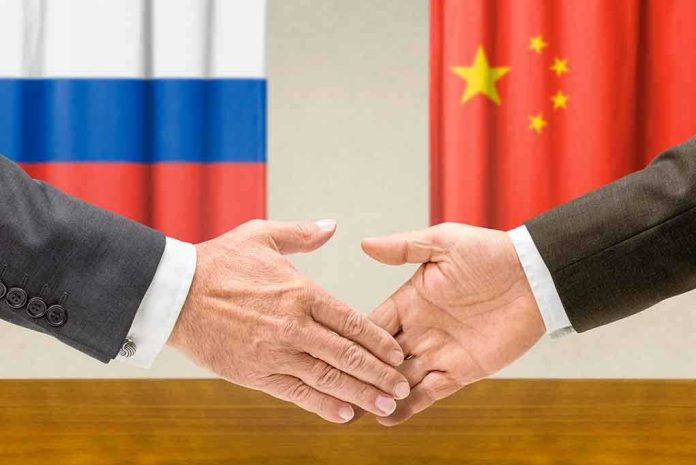
The strategic significance of the Shenzhen summit is not that it solved nuclear rivalry in a day, but that it created a direct, leader-level channel among the United States, Russia, and China at a moment when such a channel had not existed—turning a triangular standoff into a structured conversation with declared aims around stability and risk reduction.
At a Glance
- President Trump, President Putin, and President Xi held a trilateral summit in Shenzhen on November 19, 2026, the first joint meeting of the three leaders.
- The leaders issued a declaration committing to continued dialogue on strategic stability and international security.
- Beijing framed the theme as safeguarding world peace and promoting major-power strategic stability; Washington underscored ongoing leader-level engagement.
- The summit launched a channel; it did not produce a negotiated arms-control treaty or verifiable force changes.
What Happened in Shenzhen and Why It Matters
The facts are straightforward: President Trump, President Putin, and President Xi met in Shenzhen for a trilateral summit and issued a joint declaration committing to continued engagement on strategic stability and international security. The White House described an in-depth exchange on the international situation and a shared commitment to maintain strategic stability; Beijing’s account stressed the theme of safeguarding world peace and managing major-country relations constructively. Chinese state media and international outlets alike characterized the gathering as the first joint summit of these three leaders, emphasizing its novelty and diplomatic weight.
That first is not semantic. In great-power politics, format governs possibility: having the principals in one room creates a decision loop that no working group can replicate. The Shenzhen configuration—three nuclear-armed heads of state in a structured conversation—matters because the United States and Russia hold the world’s largest arsenals and China’s is expanding; strategic stability among all three is a systems problem, not a bilateral one. The leaders’ decision to institutionalize dialogue is therefore a meaningful procedural step, even absent immediate, quantifiable arms-control outputs.
Mechanism: What a Leader-Level Channel Can and Cannot Do
Leader summits excel at authorizing process: they set objectives, delineate lanes, and instruct ministries to turn principles into drafts. They do not, in a single sitting, adjudicate warhead ceilings, verification intrusiveness, or telemetry-sharing rules—matters that demand months of technical work and reciprocal concessions. Policy institutes analyzing the meeting framed its realistic deliverable set in exactly those terms: establish shared principles, deconflict immediate risks, and direct experts to begin or resume negotiations under a trilateral umbrella.
The Shenzhen declaration’s generality—commitments to maintain strategic stability and continue dialogue—fits that pattern. It is not an arms-control accord; it is the political architecture that can make such accords negotiable. Where the bilateral U.S.–China component is concerned, Beijing’s official readout highlights a vision of relationship management grounded in respect, fairness, and reciprocity—language that, while aspirational, signals intent to stabilize a rivalry that had been drifting into crisis-prone competition.
History and Context: From Bilateral Templates to a Triangular Reality
For half a century, nuclear risk management has been built on U.S.–Soviet and then U.S.–Russian bilateral agreements: SALT, START, New START, and a lattice of risk-reduction mechanisms from hotlines to launch notification regimes. That scaffolding never had a trilateral load path. As China’s arsenal grew and its enrichment capacity expanded, analysts warned that a two-party framework could not indefinitely support a three-party reality. The Shenzhen meeting acknowledges that structural shift by bringing all three principals into one negotiating geometry.
This matters beyond numbers. Strategic stability is a function not only of inventories but of doctrine, early warning, missile defense, hypersonic delivery systems, dual-capable platforms, and command-and-control resilience. Even modest confidence-building measures—expanded crisis hotlines, pre-notification of certain tests, or guardrails on dangerous intercepts—often require top-level endorsement before militaries will codify them. A trilateral summit can legitimate that work and direct it to proceed concurrently on several fronts rather than in brittle silos.
Trump says nuclear powers need only 'about 10' weapons before Xi, Putin summithttps://t.co/Fvd8Z31XRA
— Yeni Şafak English (@yenisafakEN) November 19, 2026
What Was and Was Not Achieved
Three outcomes are clear. First, the summit occurred in a formal, head-of-state format; second, the leaders jointly committed to continued engagement on international security and strategic stability; third, the bilateral U.S.–China track explicitly emphasized steering relations toward stability and reciprocity. Major outlets described the gathering as the first joint summit of these three leaders, underscoring its diplomatic novelty and the opening of a direct channel among them.
Three outcomes did not materialize. There is no signed arms-control treaty text with numerical limits or verification protocols; no announced changes in nuclear force posture or alert status; and no documented settlements on active conflicts. Contemporary reporting ahead of the meeting properly set expectations: the session would address global conflicts and nuclear risk, but concrete, enforceable deliverables were unlikely at this first sitting. That forecast aligns with the communiqués’ breadth and the absence of technical annexes.
Strategic Significance: Process as a Form of Power
Seasoned practitioners treat process as capability. A durable channel among Washington, Moscow, and Beijing is a risk-management tool in its own right: it lowers miscalculation probability, shortens escalation ladders, and allows cross-issue trade space to emerge. It also tests propositions. If, as some experts suggest, a one-day meeting can at least fix principles and direct expert talks, then the months after Shenzhen should show whether working groups convene, crisis lines function, and military-to-military contacts regain disciplined cadence.
On the U.S.–China axis, leadership-level messaging about respect and reciprocity can empower bureaucracies to de-escalate tactical friction—unsafe air and maritime encounters, opaque exercises, or cyber signaling—that otherwise accumulates into strategic hazard. On the U.S.–Russia axis, where existing arms-control agreements have lapsed or frayed, a trilateral frame can both complement and, where necessary, substitute for bilateral stagnation by introducing third-party incentives and reputational costs.
What to Watch Next
The test of Shenzhen is follow-through. Indicators that matter are concrete and observable: scheduled working-group calendars with public milestones; reinstated or expanded crisis-communication protocols; coordinated test-pre-notification practices; and, if the channel matures, draft texts proposing transparency or verification pilots that can be trialed before full treaties. Analytical communities and allied governments will also watch whether summit themes migrate into defense white papers and budget signals—evidence that words are being operationalized.
None of that diminishes what happened in the room. President Trump, President Putin, and President Xi met in Shenzhen, issued a declaration centered on strategic stability and international security, and, in so doing, pulled a triangular nuclear rivalry into an explicit diplomatic process. In great-power statecraft, that is how substantive agreements begin: with leaders choosing a channel, defining a purpose, and instructing their systems to build the bridge from principle to practice.
Sources:
youtube.com, whitehouse.gov, english.www.gov.cn, cnbc.com, bbc.com, csis.org, dw.com, belfercenter.org, chinaglobalsouth.com, defensenews.com