
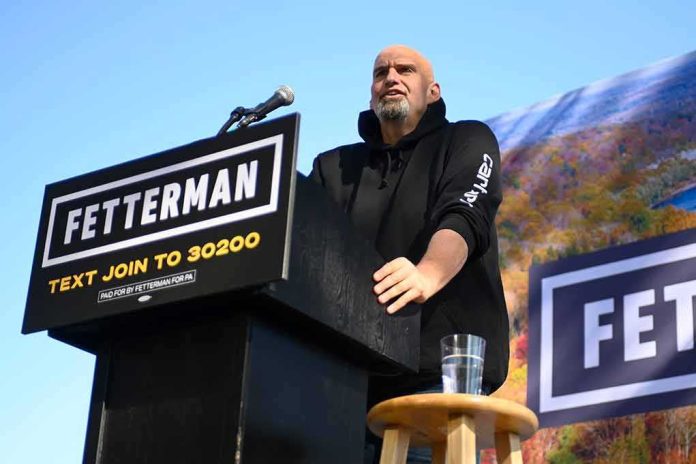
A Senate majority is only as useful as the leader who wields it, and John Fetterman’s blunt intervention in the fight to run the Democratic caucus makes clear that winning seats in November settles nothing about what the party does with them.
Key Points
- Pennsylvania Senator John Fetterman publicly endorsed Chuck Schumer for Senate Democratic leader, confirmed by his office on November 9, 2026, and repeated in his own words days later.
- Fetterman’s intervention came amid an open challenge from Maryland Senator Chris Van Hollen, splitting the caucus into visible camps rather than settling on Schumer by acclamation.
- Fetterman framed his support around party unity and a push toward bipartisan governance, while also sharply criticizing Van Hollen’s record and positions.
- Separate reporting around the same period described Fetterman suggesting he could leave the Democratic Party if a leader critical of Israel took the gavel, adding a substantive policy fault line beneath the personality contest.
- Senate leadership races have historically exposed divisions that routine floor votes conceal, and this one is no exception.
The Vote That Mattered More Than the Election
Democrats secured a Senate majority in the 2026 midterms, a result that by itself tells a reader little about how the chamber will actually function. The real contest for control of the agenda, the committee gavels, and the party’s public voice happens inside the caucus, at a closed-door leadership election. That is where Chuck Schumer, the incumbent Democratic leader, found himself facing an insurgent challenge from Chris Van Hollen of Maryland rather than a coronation. Contemporaneous counts tracked by outlets covering the race showed senators publicly declaring for one side or the other, a whip count that functioned less like a formality and more like a genuine contest for the direction of the party.
Into that contest stepped Fetterman, whose office confirmed on November 9, 2026, that he would back Schumer’s bid to remain majority leader. He did not leave the matter to a spokesperson’s statement alone. Days later, in a nationally broadcast interview, he put the endorsement in his own voice: “I absolutely stand with Schumer,” he said, adding plainly, “I’m gonna vote for Schumer”.
An Explicit Endorsement, Not a Whisper
What distinguishes Fetterman’s position from the dozens of quieter commitments logged by Senate reporters is that he said it loudly, repeatedly, and in a venue built for maximum visibility. On November 14, 2026, he appeared on Fox News and framed his support for Schumer around a broader complaint about his own party’s instincts. “After our massive wins, we immediately go back to fighting amongst ourselves,” he said. “Can’t we just, you know, take the win?”. He went further, telling viewers he hoped the caucus would “embrace bipartisan kinds of pursuits” under continued Schumer leadership, a governing argument layered on top of a personal one.
That governing argument stayed general rather than itemized. Fetterman did not name a specific bill, a negotiation, or a legislative target that Schumer’s continued leadership would deliver; the appeal rested on temperament and sequencing — stop fighting, start governing — rather than a scored policy program. That is a legitimate argument in Senate politics, where leadership elections are frequently decided on trust and managerial style rather than detailed platforms, but it is worth naming for what it is: a character and competence argument, not a legislative one.
The Van Hollen Critique and the Israel Fault Line
Fetterman’s case for Schumer came paired with a pointed case against the challenger. He said Van Hollen had “no record of doing anything” and asked why a senator would back “someone like Van Hollen” over an incumbent who, in Fetterman’s telling, had helped recruit a strong incoming Senate class. That characterization is an assertion rather than a documented comparison of legislative output, and the available reporting does not supply a side-by-side record to adjudicate it.
Beneath the personality clash sits a more concrete disagreement. Multiple independent accounts in the days surrounding the leadership fight reported that Fetterman suggested he could leave the Democratic Party altogether if the caucus elevated a leader he viewed as insufficiently supportive of Israel — a line drawn specifically around the prospect of Van Hollen, whose positions on the issue have drawn criticism from Fetterman before. That threat, echoed across outlets covering the Senate beat, reframes the contest as something more than a popularity question between two senators; it is also a proxy fight over foreign policy orientation inside a caucus that is not uniform on the issue.
How Senate Leadership Fights Actually Work
None of this happens in a constitutional vacuum. The Senate operated for most of its early history without formal majority and minority leaders at all; floor leadership in the chamber’s first decades fell to the president pro tempore and to powerful committee chairmen. The modern system, in which each party conference elects its own leader at the start of a Congress, is a product of the late nineteenth and early twentieth centuries, formalized as caucuses grew more disciplined and, in the Senate Democratic case, adopted binding-caucus rules under Maryland’s Arthur Gorman in 1903.
Contested leadership elections are the exception, not the rule, and they tend to surface precisely when a party has just undergone an electoral shock or when a visible strategic disagreement has been building. The Senate’s own history offers a cautionary precedent: when Democratic leader Thomas Martin died in November 1919, the caucus split so badly between James Hitchcock and Oscar Underwood that neither man could consolidate support, and Hitchcock ultimately withdrew before the party settled the matter. A caucus can win an election and still spend weeks discovering it does not agree on who should run it.
Unity Rhetoric Versus Factional Reality
Fetterman’s stated wish — that Democrats “take the win” instead of turning on each other — sits uneasily next to his own sharp-edged attacks on Van Hollen and his reported willingness to consider leaving the party over the Israel question. Both things can be true at once: a senator can genuinely want less infighting while also being an active combatant in it. The leadership race itself manufactures that tension, because public endorsement lists function as loyalty signals as much as policy arguments, and a senator who stays quiet risks being read as uncommitted.
**Fetterman just flagged Van Hollen as a potential deal-breaker for him, turning an underdog leadership bid into a live test of whether Democrats can hold their new majority together.**[[1]](https://t.co/509s0vv1P7)
[Take 7/15 · D-2]
### 1. The Frame
**What people think this is…— GrumpyNews, emotionally clean news. (@GrumpyNews_) November 17, 2026
What It Means Going Forward
Whatever the final tally inside the caucus, the episode has already done something durable: it has put on the record that Democratic unity after a midterm win is conditional, not automatic, and that at least one prominent senator is prepared to make his support contingent on both the identity of the leader and that leader’s posture on a specific, substantive foreign policy question. A majority is a number. Who runs it, and on what terms, is a negotiation — and this one is still being conducted in public.
Sources:
desmoinesregister.com, newsweek.com, aol.com, u92radio.com, yahoo.com, wivb.com, senate.gov