
When a founder-CEO at the center of a strategic industry falls and then returns in less than two weeks, the real story isn’t a single phone call; it is how corporate governance, market dependence on a superstar operator, and national-security policymaking collided—and why that collision made presidential advocacy consequential.
At a Glance
- Nvidia’s board unanimously reinstated Jensen Huang after meetings and an internal assessment of his candor and fitness to lead.
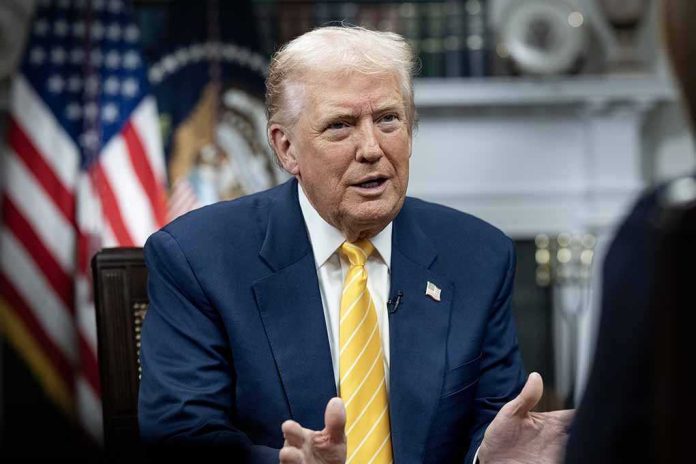
- President Trump publicly urged Huang’s return and said he engaged “directly and indirectly” with Nvidia’s board; the reversal followed soon after.
- Nvidia cited assurances from senior U.S. officials that reinstating Huang posed no national-security risk, though the officials were not named publicly.
- Lawmaker criticism focused on export controls and security vetting; markets responded with a dramatic rally in Nvidia shares.
What Actually Happened: The Board’s Decision and the Sequence Around It
Nvidia’s directors voted unanimously to reinstate Jensen Huang as president, CEO, and board director. In the company’s statement, directors attributed their decision to a series of discussions and meetings with Huang that satisfied the board regarding his candor and his ability to lead the company. That is the formal, on-the-record rationale, and it matters because boards own this decision under fiduciary duty: they must weigh leadership continuity, risk, and long-term value for shareholders—even when the surrounding noise is deafening.
The timing, however, is inseparable from the narrative. Days before the reversal, the board had publicly signaled it would not bring Huang back; then President Trump amplified a case for reinstatement and said he had spoken with the board and with Huang. The reinstatement followed soon after, compressing the governance drama into an eleven-day arc from resignation to return. Causation is not proved by sequence alone, but sequence is the field on which influence is inferred—especially when paired with on-the-record presidential advocacy.
Why Trump’s Advocacy Mattered in This Case
In a routine CEO transition, White House preference is irrelevant. Nvidia is not routine. It is a linchpin of global AI compute, sits at the fulcrum of U.S.-China technology rivalry, and anchors capital spending by cloud, hyperscale, and defense-adjacent customers. When the presidency signals that reinstating a specific CEO is consistent with national-security priorities, boards hear more than a political view; they hear an assurance that their choice will not collide with export rules, enforcement posture, or security assessments. Nvidia itself said it received assurances at senior levels of the U.S. government that bringing Huang back posed no national-security risk. Even without named signatories, that communication—paired with Trump’s public stance—lowered governance friction that otherwise deters directors from reversing course in a high-heat scandal.
None of this negates the board’s stated basis—its assessment of Huang’s candor and capacity. Rather, the most coherent reading is additive: a founder-operator with singular strategic value, a board that re-interviewed and became satisfied, and a presidentially backed signal that the move aligned with national-security guardrails. In that configuration, reversal becomes not capitulation but risk reconciliation.
The Governance Mechanics: Fiduciary Duty Under Strategic Pressure
Boards of founder-led technology firms often discover that formal authority and practical power are not the same thing. Founders concentrate knowledge networks, product vision, and customer trust—intangibles that are hard to replicate on short notice. The closest recent analogue was Sam Altman’s ouster and rapid return at OpenAI in 2023: the vehicle was different, but the physics were similar—stakeholder pressure, talent flight risk, and operational path dependence make quick reversals rational, not erratic, once decision costs are tallied. In Nvidia’s case, the board’s unanimity after new discussions with Huang is the governance signal to watch: unanimity indicates directors believed the reinstatement served the corporation’s long-term interest after material reassessment.
Critically, unanimity does not certify innocence or resolve all compliance questions; it states where fiduciary judgment landed after weighing evidence, risk, and alternatives. That distinction is frequently lost in the heat of public scrutiny, but for sophisticated observers it is where boardwork actually lives.
The National-Security Layer: Assurance Without Disclosure
The most contested feature of the episode is the national-security dimension. Public reporting indicates Nvidia received senior-level government assurances that Huang’s return raised no national-security risk; those assurances were not attributed to named officials in the public record, and no underlying assessment has been released. That asymmetry—clear signaling, sparse documentation—is common when active inquiries, classified reporting, or allied-source protections are in play. It is also the gap through which skepticism flows. Lawmakers across parties questioned the basis for the “no risk” conclusion and flagged export-control compliance as an unresolved line of inquiry. Their argument is straightforward: if the risk calculus is benign, show the work to the relevant committees in a timely manner.
Both positions can be true at once: the executive branch can responsibly brief a company at senior levels to avoid unnecessary disruption while formal oversight bodies demand fuller visibility. Until a classified briefing cycle runs its course or investigative dockets close, the public record will be incomplete by design. That incompleteness neither proves nor disproves the underlying assurance; it simply constrains what can be validated from the outside.
Jensen Huang latest: Trillion-dollar swing after Jensen Huang returns to Nvidia – as questions arise over Trump role https://t.co/5DtEp0lvIh via @SkyNews
— Nino Brodin (@Orgetorix) November 23, 2026
Market Reaction and What It Actually Signals
Markets moved sharply higher on the reinstatement—Nvidia’s stock surged by roughly a third in immediate trading. As a measure of investor belief, that move is unambiguous: shareholders priced Huang’s operational value, product roadmap certainty, and regulatory risk alignment as net positive. As a measure of national-security soundness or long-run compliance posture, it proves very little. Prices telescope vast expectations into a single number; they excel at discounting execution risk and demand signals, not adjudicating espionage allegations or the sufficiency of internal controls. Treat the rally as a referendum on confidence, not on clearance.
The Critique: What Detractors Get Right—and Where the Record Doesn’t Support Them
Critics raise three serious points. First, they argue that presidential advocacy for a named CEO crosses a line, even if a security assessment were benign; an opinion analysis framed this as an unprecedented and risky conflation of roles. Second, they highlight unanswered questions on export controls and potential evasion channels, insisting that Congress deserves full, timely answers. Third, some assert that the initial resignation reflected underlying misconduct or vulnerability inconsistent with continued leadership. The first two critiques are process-valid: bright lines around presidential engagement with individual corporate personnel decisions exist for good reasons, and export-control oversight is a core sovereign function.
Where the detractors are weaker is on proof. Public materials do not provide a line-item catalogue of wrongs, nor do they show investigative findings that would independently bar reinstatement. The government assurance—however frustratingly opaque in public—cuts against claims of clear, present security risk, and the board’s unanimous vote after new interviews is inconsistent with a record of disqualifying deception. Those do not exonerate; they simply indicate that the burden of evidence, as disclosed to date, does not support categorical claims of unfitness.
The Lasting Lesson: How Founder Power, State Power, and Board Duty Interlock
The Nvidia episode will be taught in governance seminars not because it was messy, but because it was clarifying. Founder-dependent systems concentrate execution capacity; when that capacity touches national strategy, state actors will inevitably shape the option set. Boards still decide, but their decision frontier shifts when presidential advocacy and senior-level assurances remove categories of risk that directors cannot resolve on their own timetable. The cleanest takeaway is not that politics overran process, nor that markets dictated outcomes. It is that, in strategic sectors, credible signals from the state can unlock a board’s willingness to reprice a leader’s risk-reward profile—especially when the operational downside of losing that leader is uniquely high.
Sources:
townhall.com, investor.nvidia.com, live.euronext.com, jen.jiji.com, nbcnews.com, charlotteobserver.com, sg.finance.yahoo.com, newsweek.com