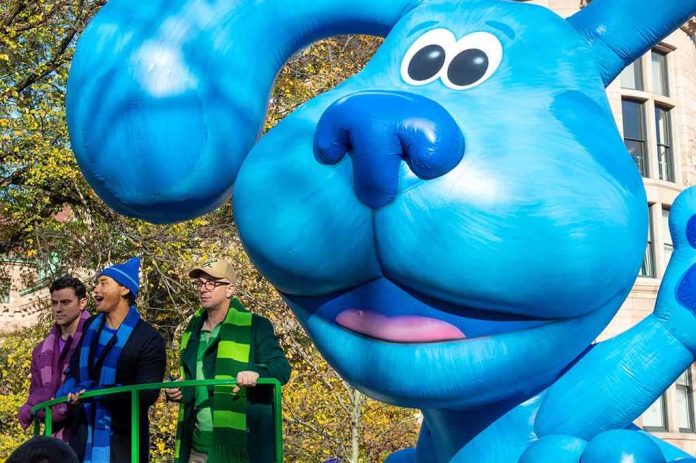
When the Macy’s Thanksgiving Day Parade faces a nor’easter, the decision to fly its giant balloons is not a matter of bravado or tradition; it’s a matter of physics, public safety, and a hard numeric line that New York City drew after hard lessons.
At a Glance
- City safety rules bar large balloons when sustained winds exceed 23 mph or gusts exceed 34 mph—an objective threshold that can ground them even if the rest of the parade continues.
- Forecast nor’easters occasionally put parade hours into the danger zone, creating a genuine risk to balloon flights and a last-minute “go/no-go” decision.
- Complete weather-related grounding has been historically rare; all balloons were fully grounded in 1971, the lone clear-cut instance on record.
- The call hinges on street-level winds along the route and timing; gusts can spike later in the morning, and building “canyons” can locally amplify them.
Why the balloons sometimes stay on the ground
The rule that governs the balloons is straightforward and non-negotiable: no large balloon flies when sustained winds exceed 23 miles per hour or gusts exceed 34 miles per hour. That ceiling is codified in New York City’s safety policy and exists for a reason—giant inflatables present large surface areas that translate wind energy into leverage at street level, where handlers, spectators, traffic lights, and street furniture all stand in close quarters. The constraint is neither ceremonial nor advisory; it’s the product of risk calculus in a dense urban corridor.
When a coastal storm organizes into a nor’easter, the parade’s operating window—roughly from step-off through late morning—can overlap peak gusts. Forecast discussions typically show two features that matter in practice: a tightening pressure gradient that accelerates winds as the storm intensifies, and a timing pivot when gusts begin to exceed the balloon threshold, often mid- to late-morning. In recent years, reputable forecast shops have flagged scenarios with gusts reaching or topping the 34 mph line during parade hours, which puts the balloons at risk of being lowered, flown unusually low, or not launched at all.
The threshold’s origin and the physics underneath
The wind limits did not emerge from a vacuum. They reflect decades of accumulated experience and post-incident analysis, crystallized into a numeric standard simple enough to enforce in real time. Aerodynamically, a 50-foot character balloon is a soft-bodied sail: its cross-sectional area, shape, and tether geometry dictate how much side force the wind can generate and how quickly that force transfers into lateral motion at the handler lines. As gust speeds climb, forces scale nonlinearly; a modest increase in wind can produce a disproportionate jump in load, which is why a few miles per hour around a fixed threshold matter so much for control and safety.
Urban microclimate effects complicate this further. Forecast wind at 10 meters above open terrain does not map cleanly to Midtown’s street canyons. Buildings can both shield and accelerate flow, causing eddies and jets that spike gusts well above the synoptic prediction on particular blocks. That’s why on-the-ground measurements along the route—Central Park West to 6th Avenue—drive the final call, not just the regional model output. Organizers, city officials, and police observe conditions in real time and decide balloon-by-balloon within the policy framework.
How we got here: one hard precedent in a century of parades
Despite perennial headlines, full weather-related grounding is rare. The canonical example is 1971, when wind and rain kept every giant balloon deflated while the rest of the parade proceeded. That episode stands out not because weather never menaces the event, but because an all-out balloon grounding has proven exceptional across a hundred years. The rarity cuts both ways: it underscores how unusual a complete stand-down would be on any given Thanksgiving, and it explains why, when forecasts flirt with the threshold, the potential becomes genuine news.
Since then, enforcement has matured into today’s numeric standard, which narrows discretion and brings clarity to parade-day decisions. The rule changes the nature of risk communication: instead of “Can they handle a windy day?” the operative question becomes, “Will winds during parade hours exceed 23 mph sustained or 34 mph in gusts along the route?” That reframing makes the debate technical, local, and temporal—exactly where weather uncertainty is sharpest.
Forecasts, timing, and the “game-time decision”
In years when a nor’easter times poorly, forecasters often outline a two-act scenario. Early in the morning, sustained winds may sit below the cap, allowing a tentative launch at lower altitudes and with tighter control. By late morning, as the storm deepens and the pressure gradient tightens, gusts can cross the 34 mph line—forcing mid-parade adjustments, lowering, or grounding specific balloons. The parade’s operational playbook anticipates that progression, which is why communications emphasize flexibility: each balloon’s behavior is a function of measured winds at that place, in that moment. Credible outlets have detailed this timing risk when models project gusts in the 30–40 mph range during the critical hours.
Practically, this means the decision is often made in stages. Overnight briefings narrow the likely window, step-off conditions inform an initial posture, and spotters feed live data to command to adjust in real time. The result can be a parade where some balloons fly low, some sit out, and some never leave their inflation pens. A binary “fly or not” headline misses that operational granularity; the policy actually invites calibrated responses that keep as much of the tradition intact as safety allows.
Will wind ground your favorite balloon in the Macy�s Thanksgiving Parade? https://t.co/uLFZyOPckm
— TribLive.com (@TribLIVE) November 24, 2026
Tradition meets safety: what to expect going forward
For viewers and visitors, two truths can coexist. First, the giant balloons are the parade’s marquee draw, and a credible threat to them is substantive, not manufactured drama. Second, the objective wind rule exists to protect spectators and handlers in an environment where margin for error is thin. When robust nor’easter forecasts overlap parade hours, the balloons’ status is legitimately in doubt, and organizers are correct to anchor decisions to measured winds and the city’s numeric thresholds.
As climate variability nudges coastal storm behavior and sea levels, nor’easter dynamics will continue to test holiday traditions along the Eastern Seaboard. But the Macy’s playbook has already adapted: numeric triggers, route-specific observations, and a willingness to lower or ground balloons mid-event. History suggests full groundings will remain infrequent; the 1971 precedent is instructive precisely because it stands alone across a century. When forecasts point to gusts pushing the 34 mph line on Thanksgiving morning, the right expectation is not certainty one way or the other—it is a disciplined game-time decision, measured against a rule designed to ensure the parade ends with memories, not injuries.
Sources:
bnd.com, abc7ny.com, hudsonvalleypost.com, gothamist.com