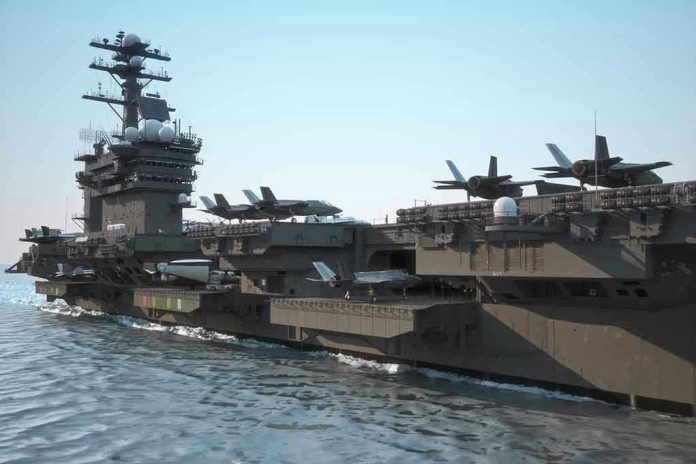
America’s oldest carrier is being kept on duty past 50 years because the Navy and Congress cannot get their new ships built and delivered on time.
Story Snapshot
- The Navy has officially extended the USS Nimitz to March 2027 to avoid dropping below 11 carriers.
- The new Ford-class carrier USS John F. Kennedy is running about two years late, now due in 2027.
- The Nimitz is over 50 years old, yet still doing long deployments and training new pilots.
- Delays and extensions expose deep problems in America’s shipyards, budgets, and “carrier math.”
How the Navy Ended Up Leaning on a 50-Year-Old Carrier
When the United States Navy decided in March 2026 to keep the USS Nimitz in service until March 2027, it was not out of nostalgia; it was to stop the carrier fleet from dropping below the legally required 11 ships. The Navy had planned to retire Nimitz in May 2026, but the next carrier in line, the Ford-class USS John F. Kennedy, slipped to a March 2027 delivery date. Without Nimitz, the fleet would have fallen to 10 carriers for many months, breaking the force level Congress expects.
The USS Nimitz is the oldest active American carrier, commissioned in 1975 and now past the 50-year mark many people assumed would be its limit. Navy leaders have been weighing life extensions for Nimitz-class carriers since at least 2020, because the original 30-year design life was already stretched to 50–55 years. The House Armed Services Committee even ordered the Navy to study how to extend Nimitz beyond 50 years to avoid losing carrier numbers before Ford-class ships arrive. What looks like improvising is, in fact, a long-running pattern of stretching old hulls to cover new delays.
John F. Kennedy’s Delay and the Carrier “Math Problem”
The USS John F. Kennedy was supposed to arrive years earlier but has been postponed again and again, with Navy budget documents showing a slip to March 2027. Reporting ties the delay to problems finishing and certifying new systems like the Advanced Arresting Gear and Advanced Weapons Elevators, which are key parts of the Ford-class design. A Government Accountability Office review warns Kennedy might not be fully in Navy hands until mid-2027, underlining how fragile the schedule has become. Every month of slippage forces the Navy to keep aging carriers in the fight longer than planned.
Today’s carrier fleet is a mix of Nimitz-class ships and the new Gerald R. Ford-class, all designed to serve about 50 years with one major mid-life refueling. Ford-class carriers promise fewer crew, lower long-term costs, and more flight sorties, and they are meant to replace the Nimitz-class over time. But when the shipyards and suppliers struggle, that smooth replacement plan breaks down. Congress has even talked about needing 12 carriers, not 11, to meet global demands, making delays like Kennedy’s even more serious. The math is simple but brutal: if new ships are late, old ships must stay.
What Nimitz Is Still Doing — and What We Do Not Know
Even as planners quietly prepare for Nimitz’s dismantling and nuclear defueling, the ship remains an active warship through March 2027. Nimitz just finished a nine-month deployment across the 3rd, 5th, and 7th Fleets in 2025, and now is serving as a key training platform for new naval aviators. The Navy shifted her homeport from Bremerton, Washington, to Norfolk, Virginia, for this final stretch, keeping her close to East Coast training ranges and maintenance facilities. A 51-year-old carrier is still sailing, deploying, and launching jets so the numbers on paper work out.
Yet there are important gaps in what the public can see. The Navy has not released detailed technical reports on the condition of Nimitz’s nuclear reactors or hull during this extension period. There is no public cost-benefit study comparing the price of extending Nimitz versus pushing Kennedy harder, and no open crew readiness reports that show fatigue or strain levels. Critics point to the ship’s age and the start of dismantling plans as reasons to worry, but they also lack primary data on safety or maintenance backlogs. Both supporters and skeptics are arguing partly in the dark.
What This Says About American Power and the “Deep State” Concerns
The fight over Nimitz’s extra year is about more than one ship; it exposes how America’s defense system often fails basic planning. Shipyard workers face workforce gaps and aging infrastructure, while the Navy depends on single suppliers for key parts, making the whole build process fragile. These are the same kind of supply-chain and management problems many Americans see in other parts of government. Money gets spent, deadlines slip, and the system leans on emergency fixes instead of steady, reliable performance.
BREAKING NEWS: The 51-year-old USS Nimitz (CVN-68) is celebrating America's 250th birthday as the anchor of the International Naval Review in New York Harbor. Following its final Southern Seas 2026 deployment, the supercarrier's service was extended to March 2027, allowing it to…
— AMC NEWS TRACKER 🇺🇸 🚨🌎🦅 (@AMCTALKTOFOX) July 4, 2026
For conservatives tired of runaway budgets and for liberals angry about misplaced priorities, this carrier story reinforces a shared fear: powerful contractors and officials seem to get paid whether or not the job is done on time. Defense firms benefit from drawn-out projects, and Congress keeps writing requirements, like the 11-carrier mandate, that almost guarantee old ships will be stretched to their limits rather than holding the system accountable. Americans who worry about a “deep state” of entrenched interests can reasonably see this as one more example of the rules serving the system first, and the sailors and taxpayers second.
Sources:
19fortyfive.com, navaltoday.com, taskandpurpose.com, stripes.com, navytimes.com, reddit.com, news.usni.org, facebook.com, youtube.com, twz.com