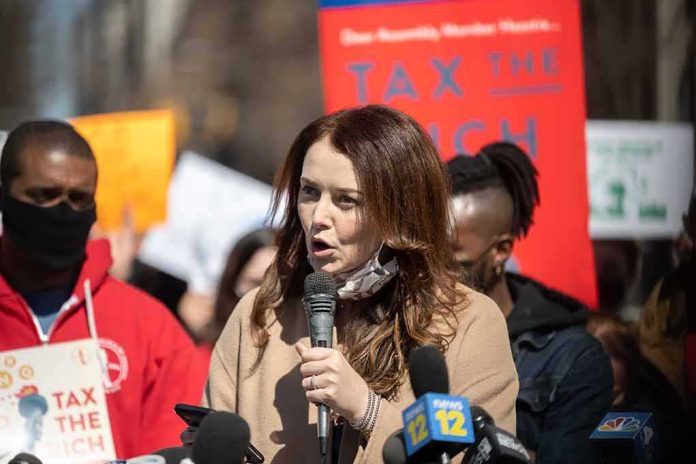
The fight over California’s proposed one-time billionaire wealth tax, and Ro Khanna’s very public defense of it, is really a fight over what kind of economy California wants to be: one that treats extreme wealth as a reserve to shore up public systems in crisis, or one that prioritizes keeping globally mobile capital as frictionless as possible.
Key Points
- California’s 2026 Billionaire Tax Act would impose a one-time 5% levy on the net worth of roughly 200 billionaires, earmarking tens of billions of dollars for health care, education, and food assistance.[4][5][7]
- Ro Khanna has become the political face of this idea, arguing that billionaires who benefited from California’s ecosystem should help plug looming gaps in Medi‑Cal and related programs.[1][4]
- Supporters, including labor unions and progressive tax scholars, see the measure as narrow, fair, and economically manageable, with revenue estimates around $100 billion over five years.[4][6][12][14]
- Opponents — especially in Silicon Valley — warn that it is a confiscatory tax on unrealized gains that will accelerate billionaire flight and may leave the state fiscally worse off, with some modeling suggesting a negative net present value.[3][10][11][13][15][17]
- The deep disagreement is not about the basic mechanics of the tax, but about behavior and risk: how many ultra‑rich will leave, how fast, and how much future innovation and revenue California is willing to trade for a large, one‑time cash infusion.
What the California Billionaire Tax Actually Does
The 2026 Billionaire Tax Act is not a vague slogan; it is a detailed constitutional amendment and statute that would create a one-time 5% tax on the worldwide net worth of California billionaires.[4][7] The tax base is defined as “personal property and wealth, whether tangible or intangible,” including stock, bonds, business interests, art, intellectual property, and other financial assets.[6][7] Directly owned real estate, pensions, and retirement accounts are excluded, though real estate held through business entities remains inside the tax base.[4][5]
The measure applies to individuals and certain trusts whose net worth is at least $1 billion as of a specified valuation date around the end of 2026.[4][6][7] It is deliberately targeted: below $1 billion, the tax rate is zero; between $1.0 and $1.1 billion, the rate ramps linearly from 0% to 5%, and from $1.1 billion upward the full 5% applies.[4][7] In practical terms, roughly 200 taxpayers — people with combined wealth exceeding $2 trillion — would be affected.[2][4][5][12]
Payment is also structured to reduce liquidity shock. Taxpayers can either pay the full amount in the 2026 tax year or spread payments over five years, remitting 1% of net worth annually plus a deferral charge on the unpaid balance.[3][4][5] The initiative describes the levy as an “excise tax on the activity of sustaining excessive accumulations of wealth,” language designed to bolster its constitutional footing as something other than a prohibited direct tax on property.[3][7][20]
Crucially, revenues are earmarked. Around 90% is allocated to public health care services, primarily to offset anticipated federal cuts to Medi‑Cal and related health programs, with the remainder directed to K‑14 education, food assistance, and tax administration.[4][5][6][13][14] Independent revenue estimates by supportive economists put expected collections at roughly $100 billion over 2027–2031, or about $20 billion per year across that five-year window.[4][6][12][14]
Ro Khanna’s Role: From Silicon Valley Representative to Wealth Tax Champion
Ro Khanna represents one of the wealthiest and most technology‑dense districts in the United States — the core of Silicon Valley — and that makes his embrace of a wealth tax unusually consequential.[1][4] For years he has argued that the United States is in a “new Gilded Age,” with billionaire wealth now equivalent to more than 10% of GDP, and that this justifies direct taxation of extreme fortunes to fund health care, childcare, and education.[3][7][8]
Khanna supported national proposals like the Sanders–Khanna federal wealth tax and the “Make Billionaires Pay Their Fair Share Act,” which would impose an annual 5% tax on billionaire wealth to raise an estimated $4 trillion over a decade.[3][11][18] At the state level, he has publicly endorsed the California Billionaire Tax Act and has been willing to antagonize his own donor base in doing so. When prominent tech investors warned that they would leave the state over the proposal, Khanna responded by echoing Franklin Roosevelt’s famous line: “I welcome their hatred” — and has remarked in interviews that he would “miss them very much,” with evident sarcasm.[1][4][5]
In long-form debates, Khanna frames his support in two ways. First, he emphasizes that the tax is one-time and tightly targeted; it does not touch income, non‑billionaires, or founders who have not yet crossed the billion‑dollar threshold.[4][6][14] Second, he insists that the funds are not a generic revenue grab but a response to specific, modeled shortfalls in health spending and nutrition assistance that could otherwise result in millions losing coverage or facing reduced benefits.[4][13][14]
Khanna is not blind to technical issues. He has said he wants clarifications to ensure that the measure does not inadvertently force founders to sell voting shares in illiquid private companies simply to pay the tax, and has suggested that valuation and payment mechanisms must be designed to avoid destabilizing Silicon Valley’s startup ecosystem.[3][6] But on the core principle — that billionaires should bear an extraordinary burden to preserve essential services — he has shown no ambivalence.
The Case for the Tax: Narrow, One‑Time, and Tied to Urgent Needs
Supporters’ argument rests on three pillars: fairness, concentration, and urgency. Fairness is straightforward: the initiative’s findings note that California billionaires pay less than 1.5% of their total wealth in annual taxes across all levels of government, despite having seen their fortunes grow rapidly over the last decade.[7][12] From this vantage point, a one‑time 5% levy — spread over five years and leaving post‑tax wealth still vastly higher than it was a decade ago — looks modest rather than confiscatory.[4][6][14]
The second pillar is concentration. Academic work on California billionaires, notably by Jasper Boll, Emmanuel Saez, and Gabriel Zucman, documents that the state’s billionaires collectively hold well over $2 trillion in wealth, and that a 5% one‑time tax could plausibly raise around $100 billion even with some behavioral response.[12][14] Because the tax applies only to wealth above $1 billion, roughly 200 taxpayers would shoulder the entire burden, while 99.999% of California residents would owe nothing.[2][4][5][12]
The third pillar is urgency. Independent analyses commissioned by labor allies of the initiative project a structural health care gap on the order of $19–30 billion per year driven by federal cuts to Medicaid, public health, and nutrition programs, with as many as 1.6 million Californians at risk of losing Medi‑Cal coverage absent new revenues.[4][13][14] In that context, a time‑limited windfall earmarked for health and basic support looks like a bridge over a very specific, predictable chasm.
Supportive economists also stress design features meant to blunt two standard critiques of wealth taxes: mobility and double taxation. The tax applies based on residency as of early 2026; moving afterward does not cancel the liability, which can be collected via liens and enforcement mechanisms.[3][4][6][14] And the measure allows credits for comparable wealth taxes in other jurisdictions, reducing the risk of the same wealth being taxed twice to the extent the Constitution requires.[4] On their reading, the initiative is a tightly drawn, one‑off response to an extraordinary situation, not a first step toward an open‑ended annual wealth tax.
The Case Against: Flight, Valuation, and Net Present Value
Opponents focus less on the formal structure and more on what they expect billionaires to do in response. Venture capitalists, founders, and business groups have labeled the tax a “confiscation tax” on unrealized gains and warned that it will accelerate an already visible exodus of ultra‑rich Californians to lower‑tax states like Texas and Florida.[1][2][3][10][16] They point to nine publicly known billionaire departures that, according to one Tax Foundation–affiliated study, have already reduced California’s recurring income tax base by nearly $2.8 billion per year.[10][11]
Economists aligned with this camp have modeled the measure’s net present value (NPV) and reached stark conclusions. A widely cited analysis by Hoover Institution–affiliated researchers and a separate report via California State University, Fullerton, argue that once you account for additional billionaire flight and the resulting loss of ongoing income tax and related revenues, the billionaire tax’s NPV is negative — on the order of $25 billion to $24.7 billion, meaning California would be fiscally worse off over time than if it never imposed the tax.[11][13][15][17] On that view, the state is trading a politically satisfying windfall for a structurally weaker revenue base.
Opponents also underscore the administrative complexity and perceived aggressiveness of the valuation rules. The initiative instructs tax authorities to value non‑public business interests based on the greater of ownership share or voting/control rights, a choice critics say systematically overvalues founder stakes in startups and private firms.[3][21] Combined with stringent penalties for under‑valuation, this is framed as a “heads the state wins, tails the taxpayer loses” regime that turns subjective valuation disputes into existential financial risks for entrepreneurs.[3][20][21]
Finally, there is the concern about precedent. Commentators drawing on European experience note that broad wealth taxes in countries like France and Sweden produced heavy avoidance and capital flight, raised less revenue than forecast, and were ultimately narrowed or repealed.[2][16][19] While California’s proposal is narrower and one‑time, skeptics worry that once the machinery of wealth taxation is built, fiscal pressures will transform an emergency levy into a recurring feature of the budget, especially in a state already reliant on volatile income tax receipts from the very top.[5][16][21]
Ro Khanna going full Bernie is great.
Why would a millionaire politician seek more tax dollars while protecting their own wealth?
They are nothing without the promise of wealth re-distribution.
— youtubeloginsucks (@ytloginsucks) June 22, 2026
Where the Evidence Actually Points
When you strip away the rhetoric, the core empirical dispute is about elasticities: how sensitive are a few hundred billionaires to a one‑time 5% wealth hit, and how long‑lasting are the economic consequences if they respond by moving themselves and their companies? On revenue, the mainstream academic literature around this specific initiative is relatively favorable to the supporters’ case. The Saez–Zucman–Galle–Gamage modeling, using Forbes data and empirically grounded mobility estimates, lands close to the initiative backers’ $100 billion forecast.[4][6][12][14] The more pessimistic Hoover and CSU Fullerton work is explicit that its lower $40 billion collection estimate and negative NPV hinge on stronger assumptions about both announced and unannounced billionaire exits.[11][13][15][17]
There is no decisive, historical dataset that settles this; California is trying something narrow and unusual. European wealth taxes were annual, broader in base, and embedded in very different national systems.[2][16][19] By contrast, this is a one-shot “exit event” aimed at a small, extremely wealthy population whose fortunes have appreciated dramatically and who are already deeply tax‑optimized. The question is less whether some will leave — some already have — and more whether the marginal departures directly attributable to the tax will permanently erode the state’s broader income, sales, and property tax base enough to outweigh a one-time $40–100 billion transfer into protected health and education accounts.
On that front, reasonable analysts disagree. The nonpartisan investment firm Nuveen, looking through the lens of municipal credit risk, concludes that even if the tax passed and triggered some flight, the impact on California’s overall credit quality and bondholders would be “minimal,” and historical evidence does not support fears of a truly transformative taxpayer exodus.[5] That is a narrower question than overall NPV, but it does suggest that catastrophic-scenario claims should be treated with caution.
It is also important to understand what the tax does not do. It does not impose an annual wealth levy; it does not tax anyone with less than $1 billion; and it does not replace the income tax system.[1][4][6][7] It is a targeted attempt to crystallize a small fraction of extreme fortunes into public assets at a moment when federal support is forecast to weaken significantly. That is a profoundly political choice, but the technical parameters are relatively clear.
What It Means Going Forward
The confrontation between Ro Khanna and his Silicon Valley critics is a microcosm of a larger realignment on the American center‑left. For decades, Democrats in tech‑heavy states tried to reconcile progressive social policy with a lightly taxed innovation engine. The billionaire tax debate forces that compromise into the open. Khanna’s argument — that you cannot sustain a society “half prosperous and half in decline” and that taxing billionaires directly is now unavoidable — resonates with voters wary of deepening inequality.[3][8][18][22]
For investors and founders, the lesson is different: the era when California politics would reliably prioritize their preferences on tax structure may be over. Even if this particular initiative fails or is struck down in court, the coalition behind it — major health‑care unions, national inequality scholars, and high‑profile progressive politicians — has now developed a concrete blueprint for extracting large, concentrated sums from extreme wealth in response to specific public‑finance crises.[4][6][9][14] Variants of that blueprint are already appearing at the federal level.
Ultimately, the evidence supports neither the rosier claim that a billionaire tax is a costless fiscal cure‑all nor the darkest forecasts of economic ruin. What it clearly shows is a high‑stakes trade: billions in near‑term, earmarked public revenue in exchange for accepting real, but uncertain, long‑term risks around capital mobility and political precedent. California voters — and by extension, the rest of the country watching this experiment — will have to decide which risk they are more willing to bear.
Sources:
[1] Web – Ro Khanna Gets a Taste of His Own SOCIALIST Med When Confronted in …
[2] Web – California One-Time Wealth Tax for State-Funded Healthcare …
[3] Web – California billionaire tax divides liberal Democrats – CalMatters
[4] Web – California Wealth Tax Proposal Achieves a New Feat in Tax Policy
[5] Web – Expert Report on the California 2026 Billionaire Tax
[6] Web – California considers one-time tax on billionaires – Nuveen
[7] Web – California faces new proposed wealth tax – Inside SALT
[8] Web – [PDF] 25-0024A1 (Billionaire Tax) – California Department of Justice
[9] YouTube – Will Billionaires Really Flee a California Wealth Tax?
[10] Web – Home | Billionaire Tax Now California
[11] Web – Wealth Tax Would Cost State More Than $3.5 Billion in Ongoing …
[12] Web – Wealth Taxes Raise Less Revenue Than You Think – Cato Institute
[13] Web – California Billionaires: Wealth, Taxes, and Wealth Tax Revenue …
[14] Web – [PDF] California Wealth Tax – CSUF College of Business and Economics
[15] Web – [PDF] Expert Report On The California 2026 Billionaire Tax: Revenue …
[16] Web – The Net Present Value of the Billionaire Tax Act
[17] Web – California can learn from European countries that tried wealth taxes
[18] Web – The Net Present Value of the Billionaire Tax Act: An Assessment of …
[19] Web – Ultra-Millionaire Tax – Elizabeth Warren for Senate
[20] Web – What Is a Wealth Tax, and Should the United States Have One?
[21] Web – What is a wealth tax? | Tax Policy Center
[22] Web – The Return of the Wealth Tax, Evidence Against Them Is Stronger …