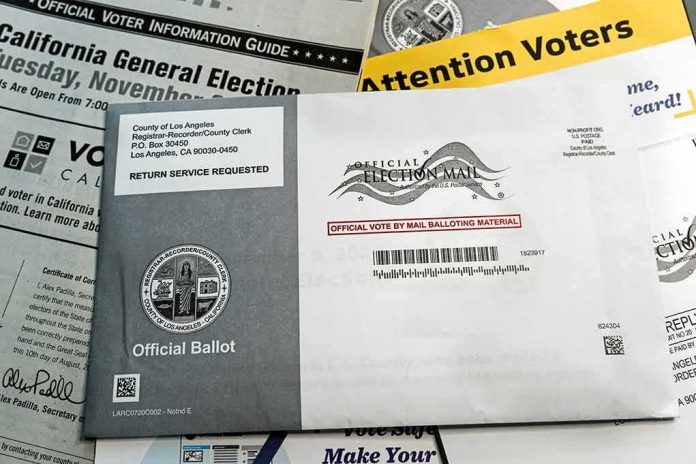
The real lesson of Spencer Pratt’s collapse is not that celebrity campaigns are impossible; it is that Los Angeles vote counting can turn an election-night storyline into a mirage, and that is exactly the kind of volatility that unsettles a Bass-vs.-Raman contest.[1][2]
Key Points
- Pratt’s early election-night lead over Nithya Raman was real, but it was not durable once outstanding mail ballots were counted.[1]
- The official outcome did not produce a Pratt runoff upset; Karen Bass and Nithya Raman advanced, and Pratt was eliminated.[2][3][6]
- The race’s drama came from the mechanics of vote-by-mail counting, not from any lasting breakthrough in Pratt’s underlying coalition.[1][6]
- What looked like momentum was mostly a counting artifact: late ballots shifted the picture, as they often do in large California elections.[1][2]
Why the Pratt story matters beyond one improbable candidacy
Spencer Pratt’s mayoral run is worth studying because it exposes a recurrent weakness in how modern elections are read in real time: people confuse the first available count with the final electorate. In a city like Los Angeles, where mail ballots dominate and canvassing takes days, election night often measures who showed up first, not who actually won. Pratt briefly benefited from that illusion. Then the slower, broader ballot pool arrived, and the race reasserted itself around the better-positioned finalists.[1][6]
That is the deeper significance here. The headline-grabbing question was never whether a reality television figure could generate attention. He already did that. The serious question was whether that attention could survive contact with the ordinary machinery of California election administration. It did not. PBS reported that the Associated Press confirmed Pratt failed to qualify for the November runoff against Karen Bass, while ABC7 reported that he was eliminated after failing to secure enough votes to advance.[2][3]
How the late-count dynamic worked
The mechanism is straightforward, though it is frequently misunderstood. Los Angeles counts a large volume of mail ballots after election night, and that delayed tally can materially alter the order of candidates. Wikipedia’s election summary, reflecting the reported count shifts, says Pratt initially led Nithya Raman by more than eight percentage points on election night, but the race remained too close to call because of outstanding mail ballots; Raman overtook him seven days later after accumulating roughly 43,000 more votes over Pratt.[1] That is not a trivial fluctuation. It is a reminder that first returns and final returns are often separated by a very different electorate.
Once you understand that mechanism, the apparent mystery dissolves. Early counts tend to overrepresent in-person voters and underrepresent ballots that arrive later by mail; the later-count electorate can therefore lean differently, especially in large urban counties with heavy absentee participation.[1][6] Pratt’s initial lead was real, but it was provisional. The final tabulation showed that his support was not broad enough or stable enough to survive the full count.[1][2]
What the official result actually says
The official endpoint matters more than the viral moment. Ballotpedia states that Karen Bass and Nithya Raman advanced after no candidate received more than 50 percent of the vote in the nonpartisan primary.[6] PBS likewise reported that Pratt did not make the November runoff.[2] Those two facts settle the central dispute: whatever the election-night chatter suggested, Pratt did not create a three-way shake-up that displaced the expected Bass-vs.-Raman structure of the race.
That does not mean his campaign was meaningless. It means its influence was bounded. Pratt’s candidacy had enough novelty, fundraising energy, and anti-establishment rhetoric to attract attention, and coverage from ABC News described his evolution from reality television figure to mayoral candidate.[8] Yet attention is not the same thing as durable vote share. Once ballots were fully counted, the structure of the race reverted to type: the major political actors remained Bass and Raman, not Pratt.[2][6]
Why Bass and Raman were always the true center of gravity
Even before election day, the contest had a conventional backbone. A Los Angeles Times poll found Bass leading Raman by one point, with Pratt close behind. That is the key to understanding why Pratt’s burst of visibility mattered less than the early narrative implied. He was competitive enough to intrude into the conversation, but not obviously capable of dislodging the two candidates with the deepest institutional presence. In other words, he was a disruptive presence inside the poll; he was not the polling structure itself.
That distinction matters because it separates media excitement from governing reality. Los Angeles mayoral races are built on turnout, organization, and the slow accumulation of trust across dense, heterogeneous constituencies. A viral persona can compress the conversation for a news cycle, and Pratt did exactly that. But when the count expanded beyond the first tranche of ballots, the race sorted itself into the more familiar hierarchy. The result was not a revolution; it was a correction.[1][2][6]
The broader lesson for California politics
Pratt’s loss also illustrates why premature narratives about “surges” should be treated with caution in California. The state’s vote-by-mail system routinely creates a gap between the public drama of election night and the administrative reality of the canvass. That gap invites overreading. It rewards the candidate whose early returns are strongest, then punishes anyone who mistakes those returns for permanence.[1][6]
For Bass and Raman, that dynamic is not merely academic. It is the difference between a noisy, uncertain first impression and a manageable general-election field. For Pratt, it meant that a candidacy built on disruption, grievance, and attention could briefly look more consequential than it ultimately was. The campaign’s loudest moment was also its least reliable one. Once the ballots finished moving, so did the story.[1][2][3]
🇺🇸 Spencer Pratt may have lost the LA mayoral primary, but he's NOT done.
He claims to have recordings of a candidate damaging enough to force a resignation:
"If you want to stop me, you're going to have to f*cking kill me."
The crusade against the corrupt continues.… https://t.co/Hljsl3UQlj
— Mario Nawfal (@MarioNawfal) June 12, 2026
Sources:
[1] Web – Be Careful What You Wish For: Spencer Pratt’s Loss May Be Karen Bass …
[2] Web – Spencer Pratt – Wikipedia
[3] Web – Spencer Pratt’s evolution from reality star to LA mayoral candidate
[6] YouTube – Nithya Raman takes narrow lead over Spencer Pratt in LA mayoral …
[8] Web – Spencer Pratt for Mayor | Official Campaign Website