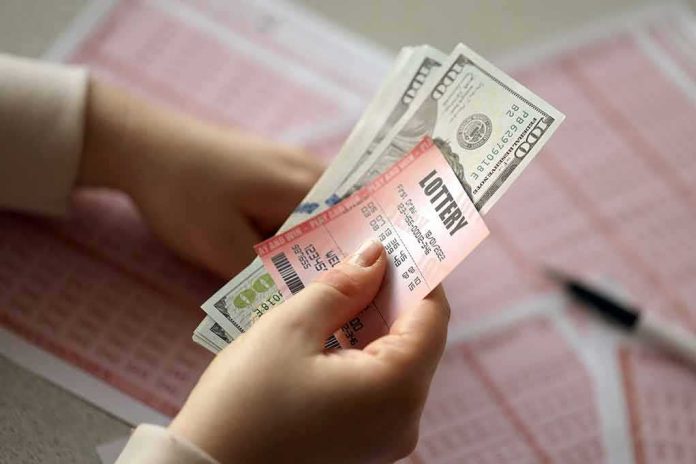
The core lesson of this Queens scam is simple and uncomfortable: the old lottery pitch still works because it exploits reciprocity, urgency, and trust in a single move, then converts that confusion into instantly portable value like jewelry.
Intro
- Two men allegedly approached a Queens woman with a supposed winning lottery ticket and persuaded her to hand over jewelry worth about $5,000.
- Police said the men claimed they could not claim the prize because of their immigration status, a detail that fits a familiar scam script.
- The handoff was followed by a brief distraction at a pharmacy, after which the suspects fled with the jewelry.
- The case echoes other New York lottery scams in which suspects use a fake windfall to lure victims into surrendering cash or valuables.
How the Queens scam worked
According to police reporting cited by the New York Post, the victim was a 69-year-old woman approached in Queens by two men in a BMW near 86th Street and 78th Avenue in Ozone Park around 10 a.m. The men told her they had a winning lottery ticket but could not cash it because of their immigration status; they then persuaded her to trade jewelry valued at roughly $5,000 for the ticket. The ruse did not end there. After taking the jewelry, the suspects asked her to buy pain medication at a nearby pharmacy, and while she went inside, they drove off with her valuables.
That structure matters. The scam is not built on a single lie, but on a sequence of pressure points: first a seemingly generous offer, then a plausible obstacle, then a small errand that removes the victim from the scene long enough for the thieves to vanish. In fraud terms, it is a classic confidence operation disguised as a friendly favor. The ticket is the bait; the jewelry is the fast-cash collateral; the pharmacy stop is the exit ramp.
Why lottery scams are so durable
This Queens episode fits a pattern that law enforcement and consumer-protection agencies have been warning about for years. The FTC says prize and lottery scams typically begin with a claim that you have won something, then demand money or personal information to claim it; if payment is required, it is a scam. The Better Business Bureau’s scam study describes the same basic mechanism: victims are told they have won a lottery or sweepstakes and must send money for taxes, fees, or other costs before receiving the prize. The New York Lottery is even blunter: if you are told you have won and are asked to pay to claim it, the message is fraudulent.
The psychology is obvious once you see it, but in the moment it can be remarkably effective. A “winning ticket” creates a fantasy of upside; an invented obstacle, such as an immigration problem or a need for legal help, gives the scammer an explanation for why the prize is not yet accessible; and a request for help flatters the target by making them feel chosen, useful, or trusted. That mix lowers suspicion precisely because it looks social rather than criminal. The victim is not being mugged in the ordinary sense. She is being recruited into what appears to be a mutually beneficial arrangement.
New York has seen the same playbook over and over, which is one reason the Queens case reads less like an isolated oddity than a local variation on a well-worn fraud. CBS New York previously reported on a Queens lottery scam in which suspects told a 70-year-old woman they had a winning ticket and convinced her to hand over cash and jewelry. ABC7 has also documented a broader lottery-scam ring operating across multiple boroughs and even beyond New York, with an NYPD detective describing the scheme as asking for “collateral” in exchange for a claimed return. The details shift from case to case, but the logic remains constant.
The real-world damage is small in amount and large in effect
The dollar figure in this Queens case, about $5,000 in jewelry, is not the sort of sum that makes national headlines on its own. Yet that is exactly why these scams matter. They are calibrated to ordinary life: modest enough to seem believable, large enough to hurt, and often targeted at older adults who may be more likely to stop, converse, or try to be helpful. The Bronx and Williamsburg cases in New York show the same pattern at larger scale, with victims losing thousands in cash and jewelry after being drawn into a supposed chance to share lottery winnings. The harm is financial, but the deeper injury is the deliberate exploitation of decency.
There is also a practical reason scammers favor jewelry over cash. Jewelry is compact, portable, and often psychologically underestimated by the person wearing it. People do not always know the resale value of what they own, especially if the item carries sentimental weight as well as monetary value. That makes it easier for a con artist to frame a trade as fair, especially when the victim is distracted by the promise of a windfall. In that sense, the jewelry itself is part of the scam architecture: it is easy to remove, easy to conceal, and hard to recover once the suspects disappear.
What this case says about prevention
The prevention message is not complicated, but it has to be repeated because these schemes are built to defeat common sense under conversational pressure. Real lotteries do not require you to hand over jewelry, cash, or “collateral” to claim a prize; they do not need you to help a stranger cash a ticket; and they do not become legitimate because the scammer adds a sympathetic personal story. The moment a supposed prize depends on you parting with money or valuables, the transaction has already crossed into fraud.
What makes the Queens incident worth remembering is not that it is unusual, but that it is so representative. The pitch is old, the mechanics are simple, and the emotional leverage is timeless. A stranger offers luck; the victim offers trust; the thief converts both into stolen property. That is the whole machine.
Sources:
nypost.com, cbsnews.com, youtube.com, dnyuz.com, queenspost.com, miamiherald.com, abc7ny.com, stockmanbank.com