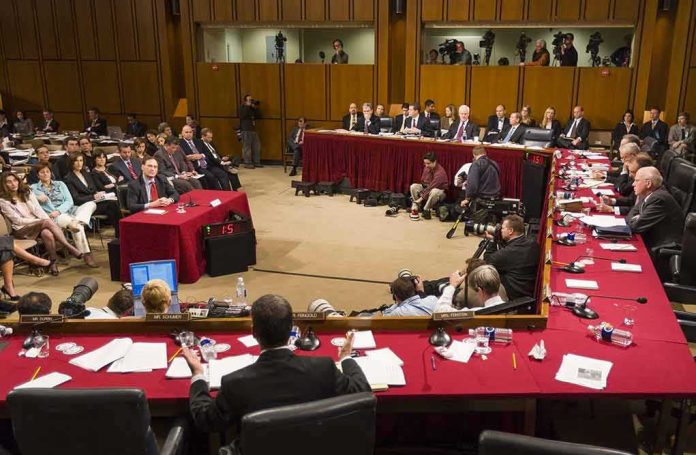
The fight over Todd Blanche’s attorney general nomination distills a deeper reality about modern confirmations: the fate of a president’s pick can hinge less on qualifications than on whether one or two senators are satisfied with symbolic acts and written guarantees in a politically charged controversy.
Key Points
- President Trump’s nominee, Acting Attorney General Todd Blanche, faced decisive Republican resistance over a $1.7+ billion “anti-weaponization” fund and an IRS settlement tied to Trump, with senators demanding binding written assurances that both were truly dead.
- Senator Thom Tillis conditioned his support on Blanche personally meeting Jeffrey Epstein survivors, turning victim engagement into a procedural gatekeeper for the nomination.
- Blanche and the Department of Justice did hold a meeting with survivors, which DOJ lauded as “productive,” but survivors publicly described it as condescending, performative, and emotionally damaging.
- The Judiciary Committee process was structurally fragile: a single Republican “no” could bottle up the nomination, giving holdouts outsized leverage over Trump’s choice.
- Trump’s reported willingness to pause and potentially resubmit Blanche’s nomination reflects a familiar strategy in contentious confirmations—buying time to resolve intra‑party disputes without abandoning the nominee.
Trump, Blanche, and a Nomination in GOP Crosshairs
President Trump’s nomination of Todd Blanche to serve as attorney general placed a loyalist and sitting acting AG at the center of one of the most intricate confirmation fights in recent memory. Blanche had already been confirmed as deputy attorney general in 2025 and was running the department in an acting capacity, yet elevation to the top job triggered a very different level of scrutiny. The controversy did not turn primarily on Blanche’s résumé; instead, it coalesced around two politically radioactive issues: a $1.776 billion “anti‑weaponization” fund embedded in an IRS settlement of Trump’s tax dispute, and the Justice Department’s handling of the Jeffrey Epstein files.
Within that context, Trump’s suggestion that he might pause Blanche’s confirmation in response to Republican pushback reflects an attempt to manage coalition risk. Pausing a nomination—rather than forcing a vote and risking formal rejection—has become a standard tool for presidents facing resistance inside their own party. It keeps the nominee in play, often in an acting capacity, while the White House tries to resolve discrete objections, shore up votes, or reframe the fight. In Blanche’s case, the evidence shows the core friction came from Republican senators who were not prepared to accept verbal assurances on matters they viewed as structural protections for Trump himself.
The “Anti‑Weaponization” Fund and IRS Settlement: Why Paper, Not Promises, Was the Battleground
At the center of the GOP resistance was a contested settlement between the Justice Department and the IRS that established a roughly $1.7 billion pool often described by critics as an “anti‑weaponization fund.” Senators John Cornyn and Thom Tillis argued that the settlement created both a financial mechanism and an immunity structure that could insulate Trump and his family from significant tax exposure, while also funding payouts that could be steered toward politically sympathetic claimants—including some January 6 defendants, via the Federal Tort Claims Act.
Cornyn’s position was strikingly concrete: he demanded a “piece of paper” that would formally extinguish the fund and narrow the immunity provisions, rejecting Blanche’s requests that senators “take my word for it” that the fund was effectively dead. DOJ officials responded by sending written proposal language to Cornyn’s office, but reporting indicates he found it insufficient, canceling a 10:30 a.m. meeting with Blanche and publicly stating he was “not prepared to vote yes” if the settlement remained as is. This dispute was not about whether the fund existed—it did—but whether Blanche, as attorney general, would lock in binding changes that could not quietly be reversed later.
Democrats on the committee sharpened the stakes. Senator Cory Booker framed the fund as a vehicle for “immunity on [Trump’s] tax cheating,” alleging that Trump had made over a billion dollars as president and was seeking protection for foreign business deals through the settlement structure. Booker highlighted that more than 200 FTCA claims had been filed, some by January 6 defendants, and pressed Blanche on whether taxpayers might end up subsidizing people who assaulted law enforcement officers. Blanche’s refusal to give unambiguous, on‑the‑record assurances fed the perception that the fund and settlement were not merely technical disputes but central tests of whether DOJ would operate independently of Trump’s personal interests.
One Republican “No” as a Structural Veto
Beneath the surface arguments, the arithmetic of the Judiciary Committee gave Cornyn and Tillis unusual leverage. With a narrowly divided committee, coverage repeatedly emphasized that “one Republican no vote” could stall Blanche’s advancement, effectively blocking the nomination from reaching the full Senate. This dynamic is not unique to Blanche; controversial executive‑branch nominees frequently see their fate hinge on a small number of majority‑party members who use procedural choke points to extract assurances or concessions.
In Blanche’s case, that leverage was deployed in a way that blurred substantive and tactical motives. Cornyn, a senior Republican facing the end of his own political runway, and Tillis, set to retire, became focal points for intra‑party resistance to Trump’s DOJ posture. Analysts noted that the fight could be read as a vehicle for broader concerns about Trump’s influence and priorities ahead of the 2026 midterms, even as the senators themselves grounded their objections in specific documents, funds, and settlement language. The procedural rule—that a single defection can freeze a nomination—thus amplified what might otherwise have been narrower policy disagreements into a full‑scale test of Trump’s hold on his caucus.
Epstein Survivors, Symbolic Meetings, and the Question of Performative Engagement
Parallel to the fund dispute, Blanche’s handling of the Epstein files and survivor engagement became another axis of pressure, driven largely by Tillis. The North Carolina senator publicly conditioned his vote to advance Blanche’s nomination on Blanche holding a direct meeting with Jeffrey Epstein survivors and their legal counsel, describing the meeting as “a very important part of getting to yes.” Tillis stated on the record that he had a “positive predisposition” toward Blanche but would not move him out of committee until that meeting occurred, noting that the Senate schedule afforded Blanche roughly two weeks to arrange it before a markup.
Initially, Blanche balked. During the hearing, he told senators he could not meet survivors directly if they were represented by counsel, suggesting that a deputy or aide could meet instead. After pushback, he corrected himself, acknowledging that as acting attorney general he could indeed meet with them and expressing willingness to do so. That willingness quickly translated into scheduling: reports show Blanche arranging a meeting at DOJ for 4:30 p.m. on July 16, 2026, with a small group of survivors and relatives arriving at the department.
The Department of Justice later characterized the session as a “productive, initial discussion,” noting Blanche’s presence alongside senior officials, FBI agents, and victim‑services personnel. DOJ said Blanche answered questions, outlined investigative steps, and encouraged survivors to connect directly with FBI agents in the room to pursue potential cases. From the department’s vantage point, the meeting satisfied Tillis’s condition and demonstrated engagement.
Survivors told a very different story. Multiple accounts portray the meeting as “abrasive,” “condescending,” “gaslighting,” and a “box‑checking exercise” rather than a genuine effort to address longstanding grievances over DOJ’s handling of the Epstein matter. One survivor said Blanche told them to “get to the point,” while others criticized him for focusing on procedural explanations rather than acknowledging failures in prior investigations. In subsequent testimony and public statements, survivors argued Blanche had misrepresented prior contacts, even accusing him of lying under oath when he claimed to have met with them and their lawyers at an earlier stage.
This clash over the meeting’s meaning illustrates a recurring dynamic in high‑stakes confirmations: symbolic acts—meetings with victims, letters of reassurance, pledges made under oath—are interpreted very differently by institutions and affected communities. For DOJ and Blanche, the session offered evidence of responsiveness; for survivors, it confirmed a pattern of evasion and minimization. For senators like Tillis, who explicitly tied their vote to the occurrence of the meeting rather than its outcome, the episode functioned more as a procedural trigger than a substantive evaluation of Blanche’s stewardship of the Epstein investigation.
Trump’s Pause-and-Resubmit Calculus
Against this backdrop, reports that Trump is open to pausing Blanche’s confirmation rather than forcing an immediate committee vote are best understood as a strategic calculation, not a retreat from the nominee. A pause offers several advantages. First, it allows the White House and DOJ additional time to craft, negotiate, and potentially toughen written language addressing the anti‑weaponization fund and IRS settlement, increasing the odds that Cornyn and Tillis can eventually declare victory and vote yes. Second, it gives space for the political temperature around Epstein to cool, or at least for Blanche and DOJ to demonstrate continued engagement with survivors beyond a single fraught meeting.
Third, as long as Blanche remains acting attorney general, Trump retains de facto control over the department even without Senate confirmation. The acting role circumvents the immediate consequences of a failed floor vote, which would be a far more public rebuke. That structural reality is one reason some analysts predict that Blanche could either be renominated after modifications to the disputed settlement or quietly maintained as acting AG without a new push, depending on how the internal GOP negotiations resolve.
From the senators’ perspective, however, a pause is also leverage. Every week without confirmation keeps Blanche’s authority and legitimacy in question and sustains public scrutiny of the fund, the settlement, and the Epstein files. Cornyn and Tillis can point to the delay as proof that their concerns are serious, not merely symbolic, while avoiding the optics of directly killing a president’s nominee from their own party.
𝗠𝗼𝗿𝗻𝗶𝗻𝗴 𝗡𝗲𝘄𝘀
Here's what's developing right now across our top stories 🧵
━━━━━━━━━━
🔥 𝗧𝗿𝘂𝗺𝗽'𝘀 𝗔𝗚 𝗡𝗼𝗺𝗶𝗻𝗲𝗲 𝗧𝗼𝗱𝗱 𝗕𝗹𝗮𝗻𝗰𝗵𝗲 𝗙𝗮𝗰𝗲𝘀 𝗣𝗼𝘀𝘀𝗶𝗯𝗹𝗲 𝗥𝗲𝗽𝘂𝗯𝗹𝗶𝗰𝗮𝗻 𝗥𝗼𝗮𝗱𝗯𝗹𝗼𝗰𝗸
President Donald Trump has nominated Todd…
— OvertheFenceNews.com (@OvertheFencePub) July 30, 2026
What This Fight Reveals About Modern Confirmations
Strip away the names and the headlines, and the Blanche saga reveals a system where confirmation battles are increasingly decided by intra‑party coalition management rather than bipartisan evaluation of competence. Blanche’s underlying credentials—prior DOJ experience, his acting role, prior Senate confirmation as deputy—received comparatively little attention in coverage compared with the anti‑weaponization fund and Epstein survivors. His fate turned on whether two Republican senators felt they had airtight documentation and sufficiently respectful victim engagement, not on a comprehensive assessment of his legal judgment or administrative record.
That pattern has broader implications. When the decisive questions in a confirmation are “Is the fund definitively dead on paper?” and “Has the nominee met with this specific group under these conditions?” the process becomes a negotiation over discrete, high‑salience controversies. Symbolic concessions—meetings, written assurances, delayed votes—can keep a nomination technically alive while leaving underlying disputes unresolved. For the public, the result is confusing: a nominee may survive procedurally despite unresolved allegations about politicization or mishandled investigations, or fail despite substantive qualifications, because the coalition math fails.
For presidents, the lesson is straightforward. In a closely divided Senate, especially when their own party is fractured, they must treat a handful of senators as veto players whose specific demands will shape the fate of major appointments. For departments like DOJ, the lesson is more uncomfortable: institutional assurances about independence and victim engagement may not carry weight unless they are backed by clear, enforceable documents and by survivor communities who believe those promises are real.
Sources:
cbsnews.com, cnn.com, youtube.com, abcnews.com, cnbc.com, c-span.org, yahoo.com, pbs.org, facebook.com, politico.com, instagram.com, congress.gov