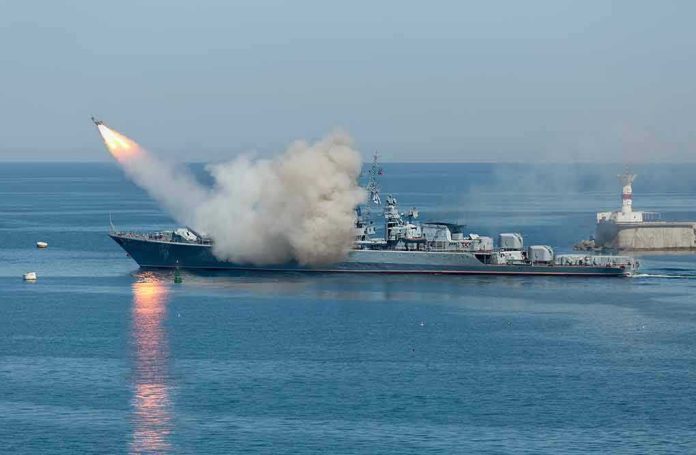
Iran has launched hundreds of missiles and drones at U.S. military bases and civilian infrastructure across the Gulf region, killing at least 19 people and dragging America’s closest Arab allies into a war they never asked to join.
Story Highlights
- Iran struck U.S. military bases in Qatar, Kuwait, the United Arab Emirates, and Bahrain following coordinated U.S.-Israeli strikes on Iranian territory.
- A drone strike on Kuwait International Airport’s passenger terminal killed one person and injured 63 others, hitting purely civilian infrastructure.
- All six Gulf Cooperation Council states have now been struck by Iranian missiles or drones, with over 2,100 total attacks recorded across the region.
- Gulf states are refusing to retaliate directly against Iran, choosing instead to urge de-escalation while hardening their rhetoric and cooperating more closely with U.S. forces.
Iran Strikes U.S. Bases Across the Gulf
Following coordinated U.S. and Israeli strikes on Iranian military and leadership targets — including the killing of Supreme Leader Ayatollah Ali Khamenei — Iran launched a massive retaliatory campaign across the Gulf region. [8] Iranian ballistic missiles and drones targeted Al Udeid Air Base in Qatar, Ali Al Salem Air Base in Kuwait, and Al Dhafra Air Base in the United Arab Emirates, along with installations in Bahrain. [2] U.S. Central Command reported that American and allied defenses intercepted the majority of incoming projectiles, but not all attacks were stopped.
The scale of Iran’s response has been staggering. Data shows Iran launched 2,171 attacks targeting Gulf states, with 1,138 of those strikes directed at Gulf Cooperation Council territory rather than at Israel itself. [5] That means America’s Gulf partners — nations that did not initiate this conflict — absorbed the largest share of Iranian firepower. The Islamic Revolutionary Guard Corps, Iran’s elite military force, claimed the strikes were defensive responses to U.S. permission for operations launched from Gulf soil. [7]
Civilians Pay the Price for Iran’s Retaliation
Whatever Iran’s stated justification, the strike on Kuwait International Airport made the civilian cost impossible to ignore. A drone hit the airport’s passenger terminal, killing one person and wounding 63 others. [3] The European Union condemned Iran’s deliberate targeting of civilian sites, including hotels and airports. At least 19 people have been killed across the region in strikes that Iran labels defensive. The gap between Iran’s framing and the reality on the ground — bodies in airport terminals — tells the real story.
All six Gulf Cooperation Council states have now been struck by Iranian missiles or drones, hitting both military facilities and civilian infrastructure. [6] These are sovereign nations that host U.S. forces as treaty partners, not combatants who chose this fight. Gulf states became what analysts describe as “bypass” targets — locations Iran strikes precisely because American forces operate from their soil. [7] The burden of a conflict driven by Iran, Israel, and the United States is falling hardest on nations that simply chose to be U.S. allies.
Gulf Nations Walk a Dangerous Diplomatic Tightrope
Gulf states have responded to the attacks with notable restraint, refusing to retaliate militarily against Iran while publicly calling for de-escalation. [9] That restraint is both strategic and calculated. By not striking back, Gulf governments avoid being drawn deeper into the conflict and simultaneously undercut Iran’s legal argument at the United Nations that its strikes constitute legitimate self-defense against regional aggressors. [9] Analysts note that Gulf states have hardened their anti-Iran rhetoric as attacks intensified, while quietly deepening cooperation with U.S. military forces. [10]
Iran is showing it can strike U.S. allies in the Gulf in retaliation but the U.S. and allied defenses largely neutralized the attacks.
Both sides are trading blows while insisting they want to preserve some form of ceasefire.
At least 1 person, and injured 60+ others.… pic.twitter.com/blyuFVPGxv
— Holyhead Chronicles (@Holyhead12345) June 3, 2026
The broader picture is one of a region being reshaped by a war its smaller players did not choose. Iran’s decision to concentrate the majority of its retaliatory firepower on Gulf states rather than Israel reveals a strategic calculation: punish the infrastructure that enables U.S. operations rather than confront American and Israeli forces directly. [5] For the Trump administration, that calculation presents a direct challenge — protecting Gulf allies who host American troops while managing a conflict that shows no clear off-ramp. Iranian Foreign Minister Abbas Araghchi stated publicly that no progress has been made in indirect negotiations, signaling that the cease-fire remains deeply fragile and that further escalation remains a live threat to American personnel and regional stability alike. [11]
Sources:
[2] YouTube – Iran retaliatory strikes on US bases in the UAE, Bahrain …
[3] Web – Iran’s Strikes on the Gulf States | Alhurra
[5] YouTube – Are Iran’s retaliatory strikes across the Gulf region affecting the US …
[6] Web – Iran appears to have hit Gulf states more than it targeted Israel
[7] Web – The US-Israel War on Iran: Analyses and Perspectives
[8] Web – Gulf States Caught in the Crossfire of War with Iran
[9] YouTube – Gulf states prepared for Iran response but urge de-escalation: …
[10] Web – The Gulf Stays Out Amid Rising Tensions in the Iran War
[11] Web – The War with Iran from the Perspective of the Gulf States | INSS