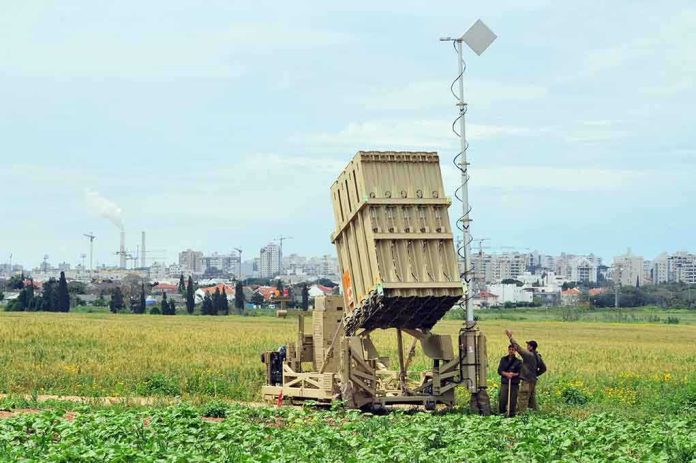
Iran’s latest missile barrage against Israel is a stark warning to Americans about what happens when radical regimes are appeased and our allies are left to face incoming rockets alone.
Story Snapshot
- Iran launched multiple ballistic missiles toward Israel, the first direct strike since an April ceasefire.
- Israeli defenses intercepted many missiles, but some salvos in the wider war have penetrated, killing civilians and hitting key infrastructure.
- Tehran justifies the launches as “retaliation,” while using advanced and possibly cluster-armed missiles that endanger populated areas.
- The attacks highlight why a strong U.S.–Israel partnership and robust missile defenses remain vital under the Trump administration.
Iran’s Direct Missile Strike Shatters the Ceasefire Illusion
Israeli reports confirm that Iran fired ballistic missiles at northern Israel, marking Tehran’s first direct strike on the country since a ceasefire took effect in April.[1][2] The Israel Defense Forces reported that at least two missiles in the first wave were intercepted by air defense systems, with no immediate injuries or damage recorded.[1] Follow-on updates described around ten ballistic missiles fired toward the north, again with no early reports of casualties as missiles were intercepted or fell in open areas.[2] This opening salvo signaled that Iran was prepared to break the truce and test Israel’s defenses once more.
Coverage from Israeli and regional outlets framed the attack as a response to Israeli strikes on targets in Beirut, underscoring how Tehran cloaks its aggression in the language of “retaliation.”[2][3][8] The Israel Defense Forces warned civilians to brace for additional missiles and rocket fire in the coming hours, preemptively canceling schools across the country as sirens sounded across northern Israel.[2] While early reports suggested limited physical damage, the disruption to daily life—families rushing to shelters, children at home instead of class—shows how Iran’s rulers routinely hold ordinary people hostage to their regional power games.
From “No Damage” to Dead Civilians: What Later Strikes Revealed
As the broader conflict unfolded beyond this initial incident, detailed analysis shows the cost when even a fraction of Iranian missiles slip through Israel’s layered defenses.[4] The Long War Journal reports that Iran launched more than 370 ballistic missiles at Israel over four days, with roughly 30 projectiles penetrating air defenses and striking inside the country.[4] By the morning of June 16, at least 24 people in Israel had been killed and approximately 600 wounded, with missiles hitting cities including Tel Aviv, Petah Tikva, Bnei Brak, Haifa, and other urban areas.[4] These figures expose the gap between Tehran’s “retaliation” narrative and the reality of civilians bearing the brunt.
Specific incidents illustrate how serious the threat becomes when a single missile gets through. One projectile directly struck a safe room on the fourth floor of a home in Petah Tikva, killing two people sheltering inside.[4] Another missile hit a tall residential building, where 180 people in bomb shelters survived, but nine others outside the shelters were killed and around 200 injured in and around the structure.[4] In Haifa, a missile hit the Bazan oil refinery complex, killing three people and demonstrating the risk to critical energy infrastructure.[4] These are not harmless “messages” or symbolic shots; they are high-explosive warheads landing where families live and work.
Advanced Missiles, Cluster Warheads, and Expanding Battlefields
Open-source reporting and broadcast analysis describe Iran increasingly using complex missile technology designed to challenge Israeli and American missile defenses.[4][5] Long War Journal notes that Israel has relied on advanced systems such as Arrow and David’s Sling, supplemented by United States Terminal High Altitude Area Defense batteries, to intercept around 90 percent of incoming Iranian ballistic missiles.[4] Even with that high success rate, the remaining ten percent has been enough to kill dozens, wound hundreds, and damage city blocks when missiles hit residential neighborhoods and key facilities.[4] For Americans who value strong borders and secure communities, this is a sobering reminder of what happens when hostile regimes obtain long-range precision weapons.
Broadcast coverage of the wider war reports that Israeli officials accuse Iran of equipping a significant share of its ballistic missiles with cluster warheads, which scatter many smaller bomblets over wide areas.[5] Such weapons drastically increase the risk to civilians, especially in dense urban environments, because each warhead effectively becomes dozens of mini-explosives spread across streets, vehicles, and apartment buildings.[5] Analysts also describe Iran using advanced systems like the Kheibar Shekan, Emad, and Qadr ballistic missiles, designed for greater range, speed, and accuracy.[5] When those capabilities are aimed at cities, the line between “military response” and terror against civilians narrows to almost nothing.
Retaliation Narrative vs. Responsibility to Protect Civilians
Iran and sympathetic outlets consistently describe these strikes as retaliation for Israeli operations, including air attacks on Iranian-linked targets in Lebanon and inside Iran itself.[2][3][6][8] That context is real: this is a shooting war, not a single isolated incident. However, the fact that a strike is retaliatory does not erase the obligation to avoid killing civilians. Reports from Long War Journal and others show missiles landing in major cities, hitting homes, high-rise buildings, a scientific institute, and an oil refinery.[4] Whatever Iran’s stated aims, the practical outcome in many cases has been civilian fear, casualties, and blown-out neighborhoods rather than limited, purely military effects.
Hezbollah has now entered the chat. Iran's attack on Israel is now a joint attack.
In the video, Iranian missiles bypass air defenses#Iran / #Lebanon / #Iraq /#Tunisia / #Jordan / #Syria / #Yemen / #SaudiArabia / #Qatar / #UAE / #USA / #Canada / #Trump / #MAGA#WakeUpAmerica # https://t.co/2TyssVIWJi— Lotfi BEN SALEM🇹🇳 (@lotfi4461) June 7, 2026
Media coverage during such crises often moves faster than forensic confirmation, and much of what the public sees comes from official briefings and live blogs rather than detailed targeting data.[1][2][4][7] Israeli institutions control most of the radar tracks and impact maps, while Iranian authorities provide little transparent information about their target selection.[4][7] Even so, the consistent pattern—hundreds of missiles launched, dozens landing in or near heavily populated areas, and civilians killed or maimed—gives ordinary Americans enough evidence to draw core conclusions. Free nations that value life, borders, and constitutional government cannot treat this behavior as normal “politics by other means”; it is a warning that peace through strength and reliable missile defenses are not luxuries but necessities.
Sources:
[1] Web – Iran Fires Ballistic Missiles at Israel; IDF Intercepts
[2] Web – Two Iranian ballistic missiles shot down, in first attack since April …
[3] Web – Iran fired around 10 ballistic missiles at north; no reports of …
[4] Web – Iran launches missiles at northern Israel in first since April after …
[5] Web – Iran fires ballistic missiles at Israel, air defenses intercept …
[6] YouTube – Iran Launches Ballistic Missiles At Israel in Retaliatory Attack
[7] Web – More than 30 Iranian ballistic missiles strike Israel in 4 days of war …
[8] Web – October 2024 Iranian strikes on Israel – Wikipedia