
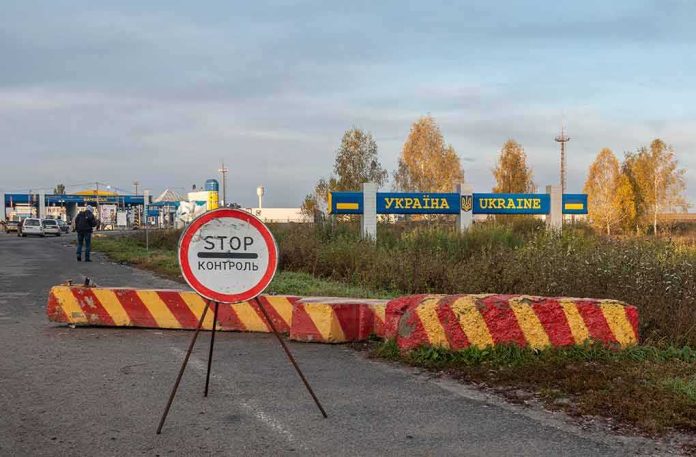
Border closures are blunt tools, but in an era of state-directed sabotage that deliberately blurs the line between espionage and crime, Estonia’s move to shut its road crossings with Russia is best understood as counterintelligence by other means — a targeted attempt to constrict an adversary’s operating environment rather than a symbolic act of defiance.
At a Glance
- Estonia tied a specific foiled arson attempt on a drone manufacturer to Russia’s GRU and detained eight suspects; senior officials put their names behind the attribution.
- The government announced a six-month closure of road border crossings with Russia to reduce hostile operations, a measure with defined scope and start date.
- Moscow’s response is rhetorical escalation — “new Iron Curtain,” “hostile actions” — without presenting specific evidence that rebuts Estonia’s case.
- The episode sits inside Europe’s broader shift: treating sabotage, espionage, cyber, and border pressure as one hybrid campaign requiring defensive measures beyond routine policing.
What Estonia says happened — and why that matters
Estonian authorities describe a concrete plot with a time, place, and target: an attempted arson at 03:06 on 14 November 2026 against Threod Systems, an Estonian firm producing reconnaissance and combat drones for Ukraine. According to public statements, the operatives tried to break windows, introduce accelerants, and trigger an explosion at the company’s Viimsi facility outside Tallinn. No injuries or significant damage occurred; eight suspects were detained in a coordinated police response. Crucially, political and security leaders — not unnamed sources — asserted the plot was ordered by Russia’s military intelligence service (the GRU). Prime Minister Kristen Michal, Foreign Minister Margus Tsahkna, and the Internal Security Service’s director general each framed it as part of an ongoing campaign targeting defense-linked assets that support Ukraine.
Two elements elevate this beyond a routine criminal case. First, the target: a defense-industry node supplying a wartime partner. Second, the attribution: senior, accountable officials making an on-record claim of state direction. Estonia then paired the case with policy — announcing that from 1 December, road border crossings with Russia, including Narva-1, Narva-2, Koidula, Luhamaa, and Saatse, would be closed for at least six months to constrain hostile activity spillover. The government’s own statements present the closure as an operational step, not a gesture: cut recruitment opportunities, complicate logistics, and slow cross-border facilitation that intelligence services rely on when they weaponize criminal networks.
Russia’s counter-narrative relies on rhetoric, not refutation
Moscow’s response centers on denunciation rather than disproof. The Foreign Ministry called Estonia’s actions hostile and “on the verge of triggering open war”; spokesperson Maria Zakharova labeled the closure a “new Iron Curtain” erected under a false pretext and threatened political and diplomatic countermeasures. Russia also accused Estonia of tacitly allowing its airspace to be used for Ukrainian drone attacks — an emphatic claim presented without disclosed evidence in this exchange.
For a reader weighing credibility, the asymmetry is plain. Estonia put forward a discrete criminal event, arrests, and named officials staking their reputations on an attribution they say is grounded in counterintelligence reporting. Russia offered sweeping counter-allegations but did not surface case-specific evidence that the Threod episode was misattributed or fabricated. Absent competing facts — a court record, technical forensics, or even identified suspects with a different story — Moscow’s broad rhetoric does little to puncture the core Estonian account.
Hybrid operations — the logic behind a border tool
Hybrid campaigns exploit seams: jurisdictional gaps between police and intelligence, legal thresholds that slow action, and the permeability of open borders. European assessments increasingly treat sabotage, cyber intrusions, industrial espionage, and border pressure as facets of one problem, not separate categories for separate toolkits. That framing matters because prevention becomes as much about reducing adversary freedom of action as it is about prosecuting completed crimes. Where services identify recruitment pipelines that run through cross-border travel — “rent-a-crew” sabotage using deniable intermediaries — hardening the crossing itself can be a proportionate way to shrink the attack surface while investigations mature.
Estonia’s public rationale fits that pattern. Officials and analysts describe recent plots in Europe featuring recruited petty criminals rather than declared officers, attacks calibrated to damage logistics and defense nodes supporting Ukraine, and operational use of cross-border movement to compartmentalize tasks. In that environment, a temporary shutdown at named road checkpoints is not a cure-all, but it is a coherent method to complicate hostile service tradecraft: fewer walk-ins to recruit, more friction for cash couriers and drivers, and fewer low-visibility entries under the guise of routine travel.
The evidentiary gap — and what would strengthen the case
There is, however, a difference between an operationally sensible measure and a publicly proven one. Estonia has not, for understandable reasons, released the classified intelligence it says underpins the GRU attribution; nor are there publicly available charging documents detailing command-and-control, payment trails, or communications. That does not mean the attribution is wrong — intelligence rarely survives sunlight intact — but it does mean outside observers must hold two thoughts at once: the policy logic can be sound even as the public proof remains thin.
What would bring greater clarity? Prosecutorial filings that describe the conspiracy; admissible forensics from the site; and, if feasible, declassified excerpts that document tasking or facilitation. Even a redacted chronology aligning suspect movements with border crossings would improve the public’s ability to judge whether shutting all road checkpoints, rather than intensifying screening, is calibrated to the actual tradecraft used. Those disclosures need not reveal sources and methods; they can still test the necessity and proportionality of a six-month, all-crossings measure.
Costs, alternatives, and the test of effectiveness
Closing road crossings is not costless. Border communities lose lawful access; trade and family ties fray; and a generalized restriction may be read — and exploited — as ethnic or political hostility, especially in locales with large Russian-speaking populations. Policymakers typically weigh narrower options first: visa tightening, targeted refusals, enhanced screening, pattern-of-life analytics, and joint operations with neighbors. Estonia’s choice to close all road checkpoints suggests its services judged those measures insufficient against the specific threat model at hand. The test, then, is empirical: do attempted incursions fall; do recruitment pipelines wither; are there fewer sabotage-preparatory acts after the closure window begins, relative to peers who stay open?
Measuring that requires discipline: track interdictions, suspicious travel patterns, intelligence referrals, and arrests pre- and post-closure; compare with Latvia and Lithuania; and be willing to adjust the aperture as evidence accumulates. A security control that demonstrably reduces hostile activity without outsized social and economic harm builds legitimacy. One that cannot show results invites skepticism and, over time, erodes political support.
The bottom line
Estonia did not reach for a border closure in a vacuum. It paired a specific, on-record attribution for an attempted attack on a defense firm with a defined, time-bound measure designed to reduce the operational room for hostile services. Russia’s rebuttal — sweeping accusations and threats of retaliation — has not, in the public domain, engaged the particulars of the Threod case. In the modern European security environment, where hybrid operations thrive on openness and ambiguity, closing a road border is neither a panacea nor mere theater; it is a way to force an adversary to spend more and risk more to achieve less. The strategic question is whether, over six months, that tradeoff becomes visible in the data. If it does, the policy will look prudent. If it does not, Estonia will need to recalibrate — and publish enough to let its citizens see why.
Sources:
redstate.com, kyiv.mfa.ee, afp.com, pravda.com.ua, aerotime.aero, theins.press, bbc.com, breakingdefense.com, thedefensepost.com