
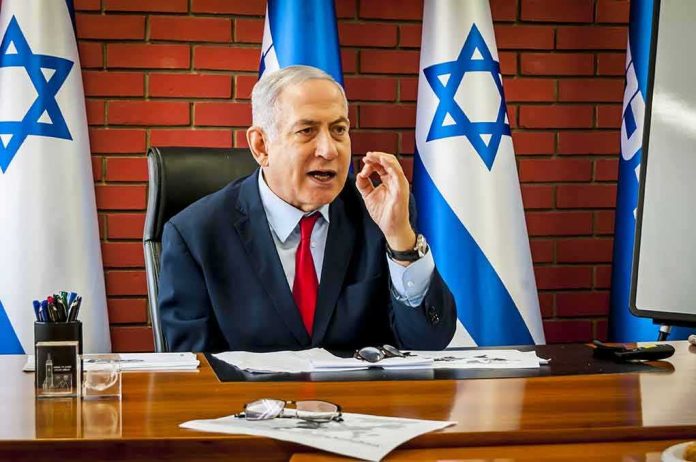
Allies can agree on ends and still clash—intensely—over means. The recurring U.S.–Israeli divergence on Iran is not a personality spat; it’s a structural split over sequencing force and diplomacy. The latest reporting places that divide in sharp relief: Prime Minister Benjamin Netanyahu pressed for rapid, extensive post-election strikes on Iran, while President Trump signaled negotiations should run before any return to combat.
At a Glance
- Multiple outlets report Netanyahu urged Trump to restart strikes on Iran immediately after U.S. midterms, pushing a quick but extensive air campaign.
- Trump’s stated posture: keep negotiating now, retain military options as leverage later, and avoid additional casualties if diplomacy can work.
- The dispute fits a durable pattern: shared strategic aims, friction over timing, escalation risk, and how to balance coercion with talks.
- Public records lack a call transcript; the best evidence is consistent but anonymous sourcing, plus Trump’s on-record preference for talks over immediate strikes.
What the strongest reporting actually supports
Across several contemporaneous accounts, the most specific through-line is this: Netanyahu pressed Washington to resume strikes on Iran promptly after the midterm elections, and not as a pinprick—an official cited by the Associated Press called it a quick but extensive air campaign. The logic attributed to Jerusalem was straightforward coercive diplomacy: negotiations, especially those mediated by Qatar, risked easing pressure on Tehran unless backed by an imminent, credible threat of force. Channel 12’s reporting, echoed by other outlets, places the request in a weekend call with Trump; the AP’s independent sourcing similarly describes a post-election push, with Trump declining to commit.
Two constraints matter. First, there is no public transcript or readout of the conversation; the accounts rely on officials speaking without names attached. Second, the reporting does not reveal the operational core of the ask—no target sets, legal basis, force-protection plan, or escalation assumptions are documented. Those gaps do not negate the claim of a request; they do bound what can be said with certainty about the plan’s contours.
Trump’s stated posture: let talks run, keep the hammer in reserve
Trump’s own public line offers the clearest counterweight to immediate action: he said talks with Iran were ongoing, that he was not in a hurry, and that the point of restraint was to spare lives if a negotiated outcome could be reached. Simultaneously, he emphasized that military options remained; if diplomacy failed, force would follow—his “hammer” formulation that recurred in remarks and coverage. This dual-track—pressure plus engagement—has been the hallmark of many U.S. approaches to Iran. What is notable here is the sequencing: the President prioritized the diplomatic runway first, with force positioned as a credible backstop rather than a near-term step.
Reports also describe active mediation, with Qatari channels working to test whether negotiations could produce concrete trade-offs. That context strengthens the internal logic of the White House’s pacing: if talks were “going fine,” accelerating into a new air campaign could squander emerging concessions or fracture fragile de-escalation mechanics.
Why close allies diverge on timing and risk
U.S.–Israeli friction on Iran is cyclical: strategic aims largely align—containing Tehran’s nuclear and regional power—while assessments differ on how much pressure is enough, how long to wait for talks, and what escalation ladders look like in practice. Historically, Israeli leaders have argued that only vivid, near-term military costs alter Iran’s calculus; American administrations, balancing global equities and force-protection burdens, often prefer to let diplomacy mature before crossing major kinetic thresholds. That is the same script here: Netanyahu urging immediate coercion to lock in leverage, Washington prioritizing negotiated sequencing with force in reserve.
This pattern is not academic. Strikes on Iran reverberate across maritime security in the Strait of Hormuz, trigger proxy reprisals from Lebanon to Yemen, and draw U.S. bases and shipping into the target set. Congress’s analysts and conflict trackers map precisely these spillovers, capturing why American pacing can differ from Israel’s even when objectives rhyme.
How much weight to put on anonymous-source accounts
On the evidentiary scale, the most credible piece is the consistency across independent outlets attributing the post-election strike request to Netanyahu, coupled with specific phrasing—“quick but extensive”—consistent with serious operational intent rather than mere rhetoric. That said, the chain remains anonymized; repetition across outlets can reflect a common source base as much as separate confirmation. Trump’s public characterization of the call as a “very good” conversation provides little corroboration either way, keeping the substance ambiguous in the on-the-record file.
For readers trained by decades of Middle East reporting, that ambiguity is familiar. High-stakes allied disagreements often surface through leaks precisely because leaders desire strategic ambiguity in public; it keeps adversaries guessing and preserves maneuver space with domestic constituencies. The correct inference here is not that the claim is shaky, but that its granularity—specific targets, redlines, and escalation planning—cannot be responsibly asserted beyond what the best-sourced reporting supports.
Netanyahu pushes for Trump administration to carry out new strikes on Iran, officials tell AP https://t.co/CLE0XapsNj pic.twitter.com/H7wbQhH7ZG
— Eyewitness News (@ABC7NY) November 3, 2026
Mechanics and consequences: what each path implies
Immediate air operations, if launched, would aim to reset coercive leverage quickly by destroying high-value assets and reimposing shock. The upside: negotiating from a position of palpable force. The risks are familiar and nontrivial: Iranian retaliation against U.S. forces and partners, maritime disruption, and rapid escalation ladders that outrun diplomatic off-ramps. By contrast, extending talks while keeping strike packages warm preserves options and may secure verifiable limits—if Tehran calculates that a deal is better than awaiting the hammer. The hazard of patience is attrition of pressure: as the memory of prior strikes fades, Iran can hedge, compartment, and harden.
Choosing between those trade-offs is not a binary of resolve versus weakness; it is a judgment about timing, sequencing, and alliance management. That judgment will always look different from Jerusalem and Washington because the risk envelopes are different. Israel lives under shorter warning times and local saturation threats; the United States carries global commitments and bears disproportionate escalation costs across theaters.
Where the real dispute sits—and what to watch
The substantive disagreement is not whether to retain force as an option; both sides do. It is about when to cash that option in. Netanyahu’s reported ask sought to narrow the gap between threat and action to keep Tehran off balance. Trump’s public posture widened that gap to test if diplomacy could close the file without further bloodshed. Future clarity hinges on three files: whether any declassified readouts confirm the call’s substance; whether Qatari-mediated talks produce verifiable constraints that satisfy core U.S.–Israeli objectives; and whether operational preparations—should talks stall—reflect the “quick but extensive” concept described by AP’s sources.
Bottom line
Strip away the leak-by-leak theater and the shape of the disagreement is straightforward. Multiple credible reports indicate Netanyahu pressed for a rapid resumption of strikes after the midterms; Trump, on the record, chose to keep negotiations in the lead while holding force in reserve. That is the classic allied dilemma on Iran, updated for the present crisis: how to blend coercion and diplomacy to produce durable limits at an acceptable cost. The strategy that prevails will be the one that best aligns leverage with timing—backed by capabilities the other side believes, and constrained by risks the allies can actually carry.
Sources:
zerohedge.com, www3.nhk.or.jp, post-gazette.com, spectrumlocalnews.com, ibtimes.com, biz.heraldcorp.com, rferl.org, congress.gov, academia.edu