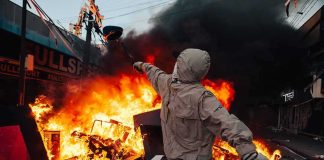
A man in a wheelchair was set on fire outside a police headquarters, and the video shows every brutal second.
Story Snapshot
- Surveillance video shows a suspect hurling a Molotov cocktail at a wheelchair user and shoving him into the flames.
- Police arrested 38-year-old Alexander Emery at the scene and say he had a second firebomb on him.
- Prosecutors charged Emery with serious felonies, including assault with intent to kill and first-degree arson.
- This attack fits a growing pattern of firebombing and ideologically charged violence across the United States.
A targeted firebombing outside police headquarters
Police in Oklahoma City say the attack happened around 8 a.m. outside their own headquarters, with traffic cameras capturing the entire scene. Surveillance video shows a man later identified as Alexander Emery walking up to a stranger in a wheelchair, holding what police describe as a Molotov cocktail. He appears calm and focused, not rushed or panicked, which suggests planning rather than sudden rage. The choice of location, right outside a police building, sends a clear message of defiance.
The video then shows Emery hurling the lit device at the victim, engulfing the wheelchair and the man in fire. As the victim struggles to move away, Emery closes the distance and shoves him back into the flames, intensifying the harm instead of stopping it. That shove matters for how a jury may see intent. Throwing a firebomb is already violent; pushing a burning man back into fire looks a lot like a deliberate effort to kill or seriously injure, which supports the “intent to kill” charge.
What police and prosecutors say they found
Officers and at least one bystander rushed toward the burning victim, beat down the flames, and took Emery into custody right on the sidewalk. Investigators later told reporters that Emery had a second Molotov cocktail on him when they detained him, which suggests this was not a single impulsive act but part of a larger plan. That second device strengthens the case for arson and explosive charges, because it points to preparation and the ability to repeat the attack.
Court records and local coverage say Emery now faces several felony counts, including assault with intent to kill, first-degree arson, and assault and battery with a deadly weapon. Police and television reports also say authorities set his bond at $200,000, a figure that signals how seriously the system views the risk he poses. For many Americans, that high bond also feels like a quiet verdict before trial, nudging public opinion toward assuming guilt and harsh punishment.
What we know, and what we still do not
Local television reporter Chantelle Navarro spoke with the victim, who described recovering after being hit with the Molotov cocktail and said he expects to heal. News outlets report the victim’s injuries as “minor” or not life-threatening, and that he was treated at a hospital and is expected to recover. That is good news, but it also creates a tension in the legal story: prosecutors are talking about intent to kill while the medical outcome, at least as reported so far, is less severe than many viewers imagine after watching the video.
Police say Emery admitted he chose the victim at random, a detail reported by a local ABC affiliate but not yet backed by a public transcript or full incident report. That matters because motive is still murky. National coverage mentions that police say Emery used a Nazi-associated German phrase during the incident, yet they have not released the exact words or any audio. Without those key details, we are left with a strong hint of ideological hate but not enough data to pin down whether this was classic antisemitism, general extremism, or some unhinged rant.
A violent act in a year of rising Molotov attacks
This case does not stand alone. A Wall Street Journal report describes 2026 as the “year of the Molotov cocktail,” with firebombing and antigovernment attacks hitting a thirty-year high across the United States. Data in that work show that extreme-left violence has, for the first time in twenty years, surpassed extreme-right incidents, driven in part by anger over immigration and other political fights. That shift challenges the simple talk-show script that only one side of the spectrum is dangerous.
🇺🇸A man in a wheelchair was set on fire outside the Oklahoma City Police Department headquarters after a suspect threw a Molotov cocktail at him.
38-year-old Alexander James Emery was arrested after the attack.
He reportedly told the victim “Don’t talk to me,” had a second…
— NewsForce (@Newsforce) July 9, 2026
In Boulder, Colorado, a man hurled Molotov cocktails at a Jewish crowd in 2025 while shouting “Free Palestine,” injuring a dozen older Americans and sparking a federal investigation that treated the assault as suspected terrorism. The Oklahoma City attack, with a wheelchair user set on fire outside police headquarters and a suspect allegedly using Nazi language, fits this pattern: vulnerable targets, symbolic locations, and fire used as a weapon of fear and pain. Conservative common sense says we should call this what it looks like on video: evil, targeted violence, not a protest.
How institutions frame the story for the public
Mainstream outlets such as Law&Crime and major broadcasters have largely repeated the police narrative as settled fact, focusing on the shocking video and the “random victim” detail without digging hard into the gaps in evidence. That approach lines up with a broader trend where graphic footage acts as both proof and emotional fuel, making skepticism feel almost immoral. Yet there is still no released audio of the Nazi phrase, no public forensic report on the device composition, and no detailed medical record to match the “intent to kill” charge.
From a conservative point of view, two truths can sit side by side. First, the video and charges show a brutal attack on a disabled man that deserves strong punishment and moral outrage. Second, we should still demand full evidence from police and prosecutors, not simply trust edited clips and press releases. When violence, ideology, and public fear collide, the stakes are high: our justice system must punish evil without turning shocking crime footage into a shortcut around serious proof.
Sources:
facebook.com, lawandcrime.com, instagram.com, yahoo.com, youtube.com, justice.gov, amuedge.com