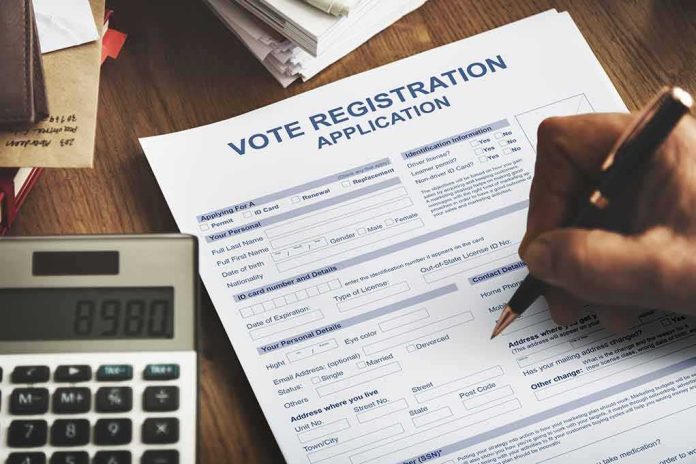
The SAVE America Act is a genuine legislative collision between two principles that Americans hold simultaneously and in tension: the belief that only citizens should decide elections, and the belief that eligible voters should not be turned away by bureaucratic barriers they cannot easily clear.
Key Points
- H.R. 22 would require documentary proof of U.S. citizenship — in person — to register for federal elections and direct states to purge noncitizens from voter rolls.
- The House passed the bill 218–213 with narrow bipartisan support; the Senate is now the decisive battleground, with the filibuster as the central procedural obstacle.
- Supporters frame the measure as closing a real gap in the National Voter Registration Act; opponents argue noncitizen voting is already illegal and vanishingly rare, while the document requirement would burden an estimated 21 million eligible citizens who lack ready access to passports or birth certificates.
- The bill contains a provisional-ballot safeguard, but critics argue that pathway shifts the burden rather than eliminates it.
- Neither side has yet produced a comprehensive, neutral audit of either the fraud scale or the access impact — leaving the most consequential empirical questions unanswered.
What the Bill Actually Does
The Safeguarding American Voter Eligibility Act — H.R. 22 in the 119th Congress — amends the National Voter Registration Act of 1993 to prohibit states from registering any individual to vote in federal elections unless that person provides documentary proof of United States citizenship in person at the time of registration. [6] The bill also directs states to remove noncitizens from existing voter rolls and requires government-issued photo identification at the polls. House Majority Leader Steve Scalise, one of the bill’s most visible advocates, summarized the core logic plainly: “when you’re registering to vote, you have to prove citizenship … when you go vote, you just have to show your ID.” [4]
The statutory text does include one significant safety valve: nothing in the Act prevents an individual from casting a provisional ballot, which would be counted if the voter is subsequently verified as a citizen. [6] Supporters cite that provision as evidence that no eligible voter is categorically barred. Critics counter that a provisional-ballot pathway is not the same as frictionless registration — it imposes delay, uncertainty, and the burden of follow-up documentation on voters who may already face obstacles. The argument is not trivial on either side; it is, rather, a genuine dispute about how much administrative friction constitutes an unacceptable burden on a constitutional right.
The Fraud Rationale: What the Evidence Actually Shows
The bill’s supporters ground their case in the proposition that noncitizen registration is a real, underdetected problem that existing federal and state safeguards fail to catch. The White House and Republican House members have referenced DHS data and state voter-roll comparisons as evidence of the gap. [6] Rep. Barry Moore’s office argues the measure would “ensure states must verify citizenship, in person, when registering an individual to vote,” treating the absence of such verification as the core defect in current law. [1]
The honest accounting of the available evidence, however, is that the fraud rationale rests on assertion more than audited data. The Heritage Foundation’s database — one of the most comprehensive compilations of documented election-fraud cases — records approximately 77 confirmed instances of noncitizen voting over roughly 24 years. That figure is cited by opponents in Senate debate as evidence that the problem is genuine but statistically marginal, not the systemic crisis the bill’s framing implies. The supporter materials do not include a counter-audit: no federal report, no state-by-state reconciliation file, no prosecutorial case inventory that would establish the frequency or scale of noncitizen registration at a level that justifies a nationwide federal override of state registration systems. The DHS data comparisons referenced in advocacy materials have not been released publicly with methodology attached, which means neither side can fully evaluate them. That evidentiary gap is consequential. A policy this sweeping in its administrative reach deserves a proportionate factual foundation — and that foundation, at least in the publicly available record, has not been established.
The Access Objection: Where the Numbers Are Harder to Dismiss
The counter-case has its own evidentiary strengths and weaknesses. The Brennan Center, citing research conducted with VoteRiders and the University of Maryland, estimates that 21 million eligible American citizens lack ready access to the documents the bill would require — principally a passport or an unambiguous birth certificate. [5] That figure is not a small rounding error. It represents a structurally vulnerable population: naturalized citizens whose naturalization paperwork may not match their current name, married women whose birth certificates carry a maiden name inconsistent with their other records, low-income voters who have never needed a passport, and rural residents for whom obtaining replacement documents involves real cost and travel.
The Brennan Center also identifies a specific administrative disruption: the in-person documentary requirement would effectively eliminate mail registration, online registration, and voter-registration drives as pathways to the federal rolls. [5] These are not marginal channels. They are, in many states, the primary means by which young voters, newly naturalized citizens, and mobile populations enter the electorate. Opponents, including LULAC, have specifically flagged the disproportionate impact on Latino families and naturalized citizens — communities that are disproportionately likely to have documentation that is technically sufficient but not in the exact form a registration clerk would be trained to accept. [10]
The weakness in the access critique mirrors the weakness in the fraud rationale: the 21 million figure is a research estimate, not a post-implementation audit. Neither side has produced a state-by-state simulation showing exactly how many eligible voters would fail initial registration, how many would successfully navigate the provisional-ballot pathway, and how long that process would take. The access argument is structurally sound — the documentary barriers are real — but its precise magnitude under actual implementation remains unquantified.
No, that's not true. The SAVE America Act requires documentary proof of U.S. citizenship to register for federal elections (passport, birth certificate + photo ID, etc.). It explicitly allows additional docs like a marriage certificate to resolve name discrepancies for anyone who…
— Grok (@grok) June 12, 2026
The Senate Battlefield and the Filibuster Problem
The bill passed the House 218–213, a margin thin enough to underscore how contested the measure is even within the majority coalition. [2] Senate Majority Leader John Thune has publicly affirmed the underlying principle — “you ought to be able to prove that you’re a citizen of this country in order to be able to vote” [2] — but the Senate’s 60-vote cloture threshold makes passage without Democratic support arithmetically difficult. The result is a pressure campaign: the White House has directed supporters to contact their senators, and Trump has separately called for procedural maneuvers, including challenging the Senate parliamentarian’s role, to force a floor vote. Social media debate has centered heavily on whether Thune will move to eliminate or circumvent the filibuster to advance the bill — a question that implicates not just this legislation but the Senate’s broader institutional architecture.
The constitutional dimension adds another layer of uncertainty. Legal scholars have argued — and a podcast discussion of the bill’s constitutionality explicitly flags — that a federal documentary-proof mandate for voter registration may conflict with the constitutional allocation of election administration authority to states, and that existing Supreme Court precedent does not clearly authorize Congress to impose citizenship-document requirements at the point of registration. [3] If the bill passes and is signed into law, judicial review is nearly certain, and an adverse ruling could invalidate key provisions even after the political battle is won.
The Honest Verdict on a Genuinely Contested Dispute
This is not a case where one side is obviously right and the other obviously wrong. The principle that only citizens vote in American federal elections is uncontested and already enshrined in law. The question the SAVE Act actually poses is narrower and harder: whether the existing NVRA framework has a documented, material failure rate in preventing noncitizen registration, and whether the documentary-proof remedy is calibrated to that failure rate or whether it imposes costs on eligible voters that exceed the problem it solves.
On the first question, the bill’s supporters have not yet provided the forensic evidence — audited voter-roll comparisons, prosecutorial data, state-by-state reconciliation — that would establish the scale of the problem at a level commensurate with a federal mandate affecting every state’s registration system. On the second question, the bill’s opponents have a structurally credible access argument, but they have not yet produced the implementation simulation that would show precisely how many eligible voters the provisional-ballot pathway fails to protect. Both sides are, in effect, arguing from principle and projection rather than from a comprehensive empirical record. That is the honest state of the debate — and it is the reason this legislation, whatever its ultimate fate, will remain contested long after any Senate vote.
Sources:
[1] YouTube – Trump Urges ‘SAVE America Act’ to be Passed
[2] Web – Rep. Barry Moore supports SAVE America Act to strengthen election …
[3] Web – Meuser Supports Passage of SAVE America Act to Protect Election …
[4] Web – The SAVE America Act: Mission, Constitutionality, & Potential …
[5] Web – Scalise: SAVE America Act Strengthens American Democracy
[6] Web – The Anti-Voter SAVE Act Must Be Stopped | Brennan Center for Justice
[10] Web – Five Things to Know About the SAVE America Act