
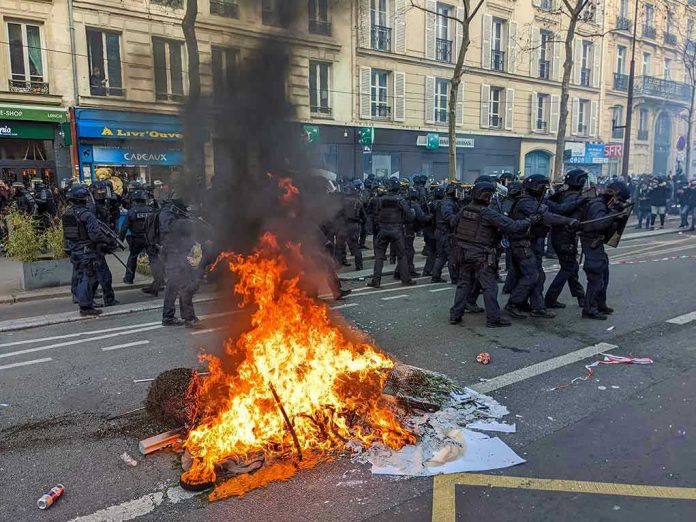
When disorder surges, the boundary between protection and provocation compresses into seconds; in Paris, one restaurant owner’s decision to lean out over his frontage and spray a crowd was not an anomaly but a textbook response pattern in nights defined by looting, arson, and improvised defense.
At a Glance
- Widespread rioting in Paris featured looted shops and gutted restaurants; thousands of commercial premises were damaged.
- Amid that backdrop, a Paris restaurant owner sprayed people gathered outside his premises from an upper level, an act other shopkeepers echoed with their own improvised defenses.
- Contemporaneous reporting captured business owners describing forced entries, smashed interiors, and theft—conditions that shaped decisions to intervene directly.
- The incident illustrates a recurring riot dynamic: opportunistic attacks on commerce, rapid community self-help, and post hoc debate over proportionality and law.
What happened and why it matters
Across several nights of unrest in Paris, commercial districts absorbed the shock. News footage and on-the-ground reporting showed shops looted, restaurants gutted, and streets alternately deserted and then swarmed by fast-moving groups. Business owners emerged the morning after to inventory damage and, in some cases, to explain decisions made in the moment: locking shutters, calling police, and—when those measures felt insufficient—taking direct action against people gathered at their doors. In that climate, a Chinese restaurant owner spraying a cluster below his balcony sits squarely in the observable pattern, not on the fringes of it. Video reporting documented the scale of damage to food venues and retail; it also captured shopkeepers who chose to fight back, whether with hand tools, scalding liquids, or deterrent sprays, each an effort to create space and time until order returned.
The specific clip that ricocheted across social feeds is visually simple and narratively charged: a proprietor above; a crowd below; aerosol plumes arcing into the frame; shouts and retreat. A separate report described a similar Paris incident in which an owner used pepper spray against people gathered in front, only to face a volley of stones and debris in response—an escalation cascade that riot researchers and police commanders know too well. Claims of “perfume” aside, the common thread is tactical: break up a formation at the threshold, deny momentum, and protect the door. The strategic objective is not to win a street fight; it is to prevent entry. That is what the week’s most harrowing business-owner testimonies were about—doors forced open, interiors smashed, goods carried out, and in some cases premises set ablaze.
Mechanism: how improvised defense plays out at street level
In riot conditions, the first defense is mechanical—shutters, locks, grills. When a group tests those barriers, seconds matter. A defender above street level enjoys elevation, cover, and visibility, and can deploy a spray or liquid deterrent without entering grappling range. The aerosolized approach seeks to create a sensory block—irritation, confusion, or simply surprise—so a group abandons the attempt and moves. Even where the substance is non-caustic, the psychological effect can be decisive because crowd dynamics at a threshold are fragile: once a few step back, the collective push loses force. That logic was visible not only in the balcony spray but in other protective acts the same week—an iron bar swung from a doorway; scalding water poured from above to break up an attack on an optician’s shop. Each measure, however crude, served the same aim: keep the frame of the entrance intact.
For proprietors, these are not abstract tactics. A broken entrance turns a defended space into open terrain; the inventory becomes loot, the cash drawer a target, and—most dangerously—the staff and family inside become vulnerable. Accounts from Paris that week make the stakes explicit: owners walked into wreckage, boiled down in one sentence by one shopkeeper—“they forced the door open,” “smashed everything,” “stole things”. That is why a split-second choice to deter a cluster at the door reads less like bravado and more like risk management in a city where cameras captured restaurants set alight and retail bays gutted.
Context: the scale and cadence of the unrest
Unrest that damages thousands of businesses is not a random flurry; it is an opportunistic wave that rides thin police lines and predictable vulnerabilities in commercial streets. Reporting established a pattern of looting, arson, and vandalism that cut across neighborhoods and retail categories. This breadth matters because it raises the base rate of threat: when multiple blocks report forced entries, every cluster outside a shutter after dark reads differently to a proprietor inside. That is also why some residents moved from passive observation to active interventions, physically contesting attacks on nearby storefronts or water-blasting would-be entrants. This is not unique to Paris; across riots globally, communities improvise “hold the line” tactics, but the French episodes that week were unusually concentrated in commercial zones, with visible damage to restaurants—a high-visibility, high-victim category that sharpened tempers and accelerated defensive instincts.
Social video amplified the dynamic. Clips of youths bragging about looting circulated alongside owner testimonies and CCTV montages of smash-and-grab sequences. The effect is reinforcing: fear and anger combine to produce both tougher barricading and readier use of deterrents at the threshold. In parallel, even one balcony spray that provokes a hail of thrown objects, as described in a Paris account, becomes cautionary—deterrents can succeed in dispersing a group, or they can trigger a rapid escalation loop, inviting counter-violence from the street.
Law and proportionality: what frames the judgment after the fact
France’s legal frame for defending property draws a hard line around necessity and proportionality. In plain terms: the act must be strictly necessary to interrupt an offense and calibrated to the threat; intentional lethal force to protect property is off the table, and even nonlethal force is judged by whether a reasonable person would deem it necessary in that moment. That is why the details matter—what substance was deployed, at what distance, against what conduct. But in riot conditions, the real-time standard that owners use is simpler: prevent entry and preserve life until police regain control. The reporting offers no courtroom disposition on the balcony spray, and it does not need one to explain the behavior; the narrative logic is situational, not ideological.
From an expert’s vantage, two truths can coexist without contradiction. First, the week’s record of looting and attacks on restaurants and shops is robust—video, eyewitnesses, and next-day inventories all align. Second, each contested doorway produces a distinct fact pattern, and the downstream assessment of a proprietor’s choices will hinge on granular particulars: crowd behavior at the threshold, warnings given, substance used, and whether the response stopped an offense or sparked a reciprocal attack. Both truths are visible in the Paris accounts that describe successful deterrence on some blocks and counter-barrages of stones on others.
*🇫🇷WATCH: Paris Restaurant Owner Reportedly Sprays Looters With Perfume “Because They Stink”*
A third-generation Chinese immigrant barricaded himself inside his Paris restaurant and sprayed perfume at looters trying to break in because they stink, according to the post… pic.twitter.com/2Hr2BNbowR
— (((IsraelMatzav))) (@IsraelMatzav) October 20, 2026
What it means going forward
For businesses in cities that periodically absorb unrest, the operational lesson is clear. Harden the entrance and plan the seconds—not just the hours—of a disturbance: layered shutters, tamper-resistant locks, and lighting that preserves interior visibility while complicating exterior approach. Establish communications with neighboring shops and residents; small, rapid collective actions—lights flipped on in unison, coordinated calls to police, synchronized deterrents—change crowd calculus. Train staff on threshold management: where to stand, what to say, when to retreat deeper inside, and how to avoid escalation traps that turn a deterrent into a duel.
For policymakers, the week offered its own brief: surge capacity for commercial corridors, fast cleanup to deny looters the optics of impunity, and plain-language guidance to proprietors on what constitutes proportionate defense of property. The goal is to shorten the window in which owners feel alone at the door. Because once that window opens, balcony sprays, iron bars, and boiling pots reappear—predictably, repeatedly, and, in the heat of a Paris night, inevitably.
Sources:
scmp.com, am730.com.hk, bbc.com, euronews.com, yahoo.com