
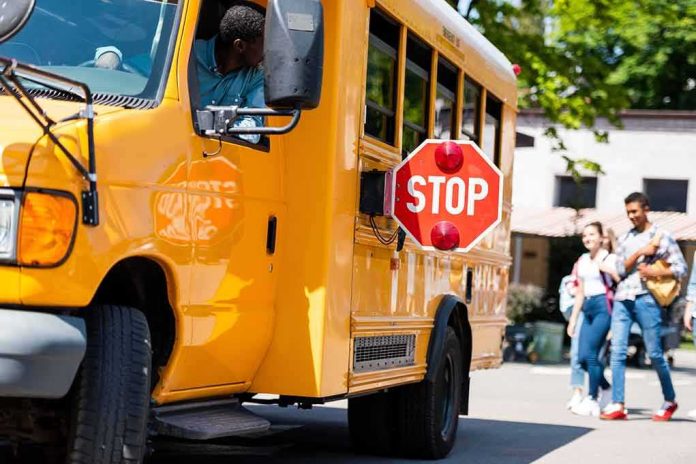
Heroism gets the headlines, but what mattered on that St. Paul sidewalk was mechanics and presence of mind: a bystander sprinted, boarded a moving school bus, and—through a sequence of gear selections and a pulled parking brake—brought a vehicle full of children to a controlled stop.
The Short Version
- A 27-year-old bystander, Ebro Ahmed, jumped onto a moving school bus in St. Paul after the driver suffered a medical emergency and stopped it by manipulating the transmission and parking brake.
- Roughly 19 Battle Creek Middle School students were aboard; officials and police reported no student injuries. The driver was transported for medical care.
- Nearby security cameras captured Ahmed sprinting to the bus and boarding; multiple outlets carried clips and interviews that align on the core sequence.
- School-bus travel remains among the safest modes; incidents where civilians intervene during driver incapacitation are rare but consequential when they occur.
What Happened: A bystander’s intervention, captured and corroborated
The essential facts are straightforward and consistent across reputable reporting: in St. Paul’s Dayton’s Bluff neighborhood, a school bus carrying middle-schoolers began rolling when its driver experienced a medical emergency. From the sidewalk outside his family’s shop, Ya Bricks Snacks & Tobacco, 27-year-old Ebro Ahmed ran to the moving bus, boarded through the open door, and tried to secure the vehicle. By his account, he mistakenly selected reverse first, then found neutral, then pulled the parking brake—actions that, together, arrested the bus’s motion. Ahmed then helped the driver and told students to call 911; responders later transported the driver for treatment, and police reported no injuries among the children.
This is not a story held together by a single quote after the fact. Local and national outlets cited security-camera footage showing Ahmed sprinting and jumping onto the bus, while his televised description of the control sequence—reverse, neutral, parking brake—tracks with how a conventional automatic-transmission school bus behaves when shifted without throttle input and when the mechanical parking brake is engaged. Saint Paul Public Schools confirmed the underlying emergency occurred on a contracted route serving Battle Creek Middle School, which matches student accounts of a second bus continuing the trip after the stop.
How It Worked: The mechanics of stopping a moving school bus
Stopping a bus you did not start driving begins with stabilizing the drivetrain. On a typical automatic, pulling the selector to “R” at crawl speed can create an immediate alarm and, depending on safeguards, a lurch or increased drag—hardly ideal. The safer intermediate is neutral: it decouples engine torque from the wheels, converting the bus into a free-rolling mass. With propulsion removed, the parking brake—a spring-applied, air-released system on many heavy buses—can hold if engaged before momentum builds. Ahmed’s path, as he recounted it, amounts to an improvised version of that logic: neutral to stop the power, then a mechanical hold to keep the bus stationary while attention shifts to the incapacitated driver and the students.
That sequence also explains the “we started going backwards” moment he described. If the bus was on even a mild grade, neutral makes roll-back possible. Only a firm, positive application of the parking brake or service brake will arrest that motion. In real time, under stress, those are choices made in seconds—by feel, not flowchart—which is why calm, simple actions usually beat clever but uncertain ones in vehicle emergencies.
What We Know—And What We Don’t Need to Speculate About
Three points are well-supported and sufficient to understand the event. First, students were aboard in roughly the numbers reported—nineteen in most accounts—and none were reported injured; both school district statements and police feedback align on that outcome. Second, a medical emergency affected the driver; the district acknowledged it plainly, and paramedics’ response and transport are documented in coverage. Third, video corroborates that Ahmed boarded a moving bus and brought it to a stop using the controls he described, after which normal response protocols—911 calls, a replacement bus—followed.
One caveat belongs in the frame and no more: the precise diagnosis of the driver’s condition has not been publicly disclosed; “seizure” appears in Ahmed’s eyewitness description rather than in a medical report. That does not change what the bystander saw—a driver losing control—and what he did about it.
Where This Fits in the Larger Safety Picture
School-bus travel, by any serious measure, is exceptionally safe. Across a decade of national data, school-transportation-related crashes account for a tiny fraction of roadway fatalities, and the majority of those who die in such crashes are not bus occupants but people in other vehicles or nonoccupants near the crash scene. That base rate matters: the rarity of catastrophic outcomes on school buses is the product of design (compartmentalized seating, high visibility, regulated construction) and operations (licensed drivers, route planning, inspection regimes).
Within that overall safety record, however, a recurring hazard sits largely outside crash tallies: driver incapacitation. The National Transportation Safety Board has investigated serious crashes precipitated by sudden medical events, and its broader findings have pushed districts and contractors to tighten fitness-for-duty screening, performance monitoring, and response protocols. None of that eliminates medical risk; it reduces exposure and improves resilience when something does go wrong.
Risk, Response, and the Role of the Bystander
Incidents like St. Paul’s do not form a robust statistical category; there is no national ledger of “bystander-stopped buses.” What we do have are occasional, well-documented episodes where someone outside the driver’s seat interrupts a dangerous sequence decisively. The logic mirrors successful layperson interventions in other domains: eliminate immediate energy (cut power, immobilize movement), call professional help, and stabilize people until responders arrive. In transportation, those are the right priorities, because momentum is the adversary and seconds matter.
Institutions are properly cautious about prescribing civilian tactics; climbing onto a moving vehicle can create new hazards. But when a vehicle carrying children is moving without control, passivity is not safety—interruption is. Ahmed’s choices followed the hierarchy that professionals teach: stop the motion, alert responders, tend to people in harm’s way. The outcome speaks for itself: students uninjured, a driver receiving care, and a bus secured without collision.
‼️ Imagine 19 children aboard a moving school bus when their driver suddenly suffers a medical emergency. The doors are wide open, the bus keeps rolling, and the children are frightened.
Then a 27-year-old stranger comes running toward them, risking his own life to save theirs.… pic.twitter.com/Q3bYtbDAN6
— Good News Victoria ☠️ (@Goodnewsviki1) October 23, 2026
Lessons That Travel: Simple rules for rare but high-consequence moments
Three practical takeaways emerge. First, if you are inside a vehicle when a driver becomes incapacitated, shifting to neutral is often the fastest way to remove power without wrestling the wheel; on heavy vehicles with air brakes, a clearly labeled parking brake can hold the stop if engaged decisively. Second, phones are part of the safety system: delegate a 911 call immediately and keep one line open for dispatcher instructions—Ahmed’s prompts to students fit that pattern. Third, calm is a tactic, not a temperament; rehearsing simple actions in your head pays off in those compressed seconds when fine motor skills and judgment are under stress. The bystander here credited familiar television dramas for modeling composure; whatever the source, the habit of not panicking was operationally valuable.
Sources:
facebook.com, people.com, mprnews.org, northernnewsnow.com, abcnews.com, whio.com, kare11.com, cbsnews.com