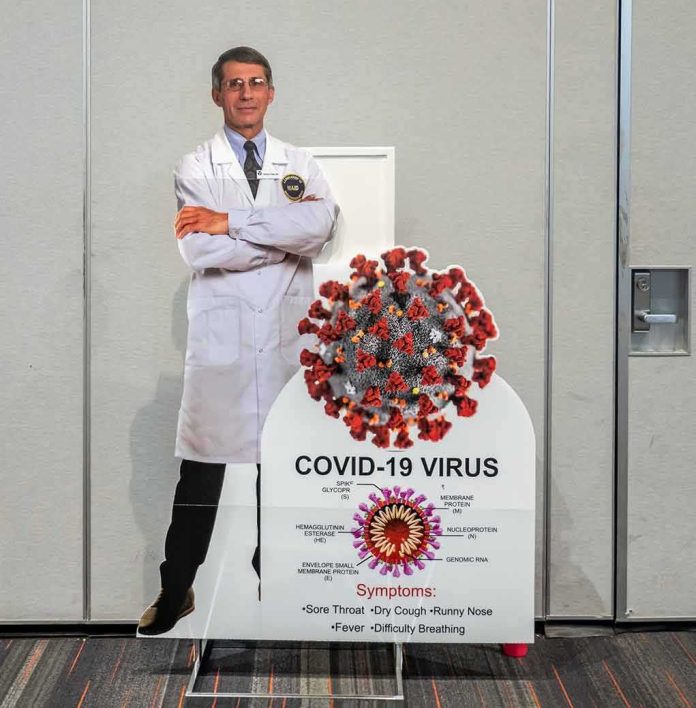
Who leads NIAID determines how the United States reads microbial risk, funds the next generation of vaccines and therapeutics, and arbitrates scientific disputes that spill into politics; choosing a director who built a career in industry and publicly pressed the COVID-19 lab-origin case would align the institute with a reformist, outsider model that has recurred at fragile moments in U.S. biomedical governance.
At a Glance
- Published reporting says physician–pathologist and biotech CEO Steven Quay is in line to direct NIAID, the post long associated with Anthony Fauci’s public leadership during pandemics.
- Quay’s résumé is unconventional for the role: deep industry experience, public advocacy for the lab-leak hypothesis, and congressional testimony on pandemic-origin science.
- NIAID has been under acting leadership and institutional churn, heightening scrutiny of how and why its next leader is selected.
- The appointment would test two competing philosophies for scientific agencies: traditional domain-insider stewardship versus outsider-led reform with tighter biosecurity guardrails.
What the job is now: an institute that sets the tempo of infectious-disease science
NIAID is the NIH institute that funds and conducts research on infectious, immunologic, and allergic diseases; in practice, it functions as the federal government’s nerve center for pandemic preparedness, vaccine platform development, and clinical trial networks. Its director manages a large intramural science enterprise and a far larger extramural grant portfolio—decisions that shape which pathogens are prioritized, which technologies mature, and how academic, industry, and international partners coordinate. Since Anthony Fauci’s long tenure, the role has carried an unusual level of public visibility; the director becomes the de facto explainer-in-chief during outbreaks and the arbiter of contentious scientific questions that carry political charge.
That weight has only grown amid turnover and interim stewardship. NIAID has cycled through acting leadership while the broader NIH retools its pandemic-era processes. Senators have publicly flagged leadership changes; watchdogs and media have documented realignment within the institute’s upper tiers. This background is why any credible report of a new director—especially one with a nontraditional pedigree—triggers immediate debate about institutional direction and governance culture.
The candidate: a physician–pathologist who built in biotech and argued lab-origin in public
Reporting identifies Steven Quay as the prospective appointee. He is described as a physician and pathologist who spent much of his career in the pharmaceutical and biotechnology sector, notably as CEO of Atossa Therapeutics. He has engaged the COVID-19 origins debate in books and public forums, positioning himself as an early proponent of a lab-associated origin. He has also testified before Congress, staking out views on biosafety risks and scientific transparency in pathogen research.
This résumé differs from the quintessential NIAID director profile, which typically features decades of NIH intramural service, principal-investigator credentials in infectious diseases, and a long record of federal program management. Quay’s record emphasizes translational development, company-building, and risk framing around high-consequence research. Whether that divergence is a liability or an asset depends on the strategic problems one believes NIAID must solve over the next decade.
Why this pick resonates: the fault line between institutional fit and outsider reform
Leadership choices at NIAID now function as proxy battles over three enduring questions. First, what constitutes legitimate expertise for governing complex science—deep, tenure-like immersion in a subfield or breadth across adjacent domains plus executive judgment. Second, who should set the guardrails for risky research—longstanding peer networks and advisory councils or leaders with independence from intramural incentives. Third, how should COVID-19 memory inform policy—by doubling down on established processes or by installing skeptics who promise to audit assumptions that failed under stress.
Each side has plausible claims. Insiders emphasize continuity, grantmaking craft, and the tacit knowledge of NIH culture that prevents unforced errors. Reformers counter that pandemic-era blind spots—around global supply chains, clinical-trial speed, pathogen surveillance, and biosafety dispute resolution—require leadership with the authority and appetite to rewire incentives, not merely tune them. Those disagreements are not academic; they dictate which programs get scaled and which are starved.
Mechanics that would change under outsider leadership
Day to day, a director from industry tends to stress measurable milestones, portfolio pruning, and cross-sector collaboration. Expect greater emphasis on late-stage translation, including adaptive platform trials that compress timelines between basic insight and licensable candidate; tighter integration with manufacturing partners to ensure scale-up pathways exist before emergencies; and performance dashboards that tie grants to deliverables rather than diffuse aims. An outsider is also more likely to mandate biosafety and biosecurity audits that are independent of program offices, and to formalize escalation paths when research-of-concern disputes arise—particularly in domains adjacent to so-called gain-of-function research, the umbrella used in policy debates for experiments that may enhance transmissibility or virulence in pathogens.
Those moves can create friction. Grantmaking communities accustomed to discovery-driven funding may resist sharper go/no-go gates. Intramural labs may bristle at compliance layers they view as duplicative. But the upside, if executed with real scientific literacy, is a system that retains exploratory science while better insulating society from low-probability, high-impact biohazards.
The origins question will shadow the office—here is how to keep it productive
Quay’s public advocacy for a lab-associated origin of SARS-CoV-2 will follow him into any leadership role. The field remains divided across a spectrum from natural spillover to lab-associated scenarios, with varying confidence and evidence bases. For a NIAID director, the operative task is not to relitigate on social media but to professionalize how the government funds, audits, and communicates origins research. That means standardizing evidence thresholds, requiring preregistration of relevant analyses, and making data availability—genomic, environmental, and laboratory records—a condition of cooperative agreements with foreign and domestic partners. It also means insulating programmatic decisions from culture-war theatrics while ensuring biosafety concerns are not dismissed as rhetorical cudgels. A leader who has argued one side publicly must demonstrate procedural neutrality in funding and review.
Congressional oversight will be intense regardless of who holds the job; a director who has already testified on related issues will be expected to provide consistent, document-backed accounts under oath and to accept audits graciously. That is survivable—and potentially healthy—if the institute’s processes are tightened in advance.
Institutional realities that will shape any director’s agenda
First, NIAID’s statutory mission and NIH governance architecture constrain the director’s room to maneuver. Advisory councils, peer-review processes, and HHS policy guardrails are not optional; they channel and sometimes slow reform. Second, the institute’s staff and networks hold the institutional memory that keeps core programs—like vaccine research centers and clinical trial consortia—functional through leadership transitions. A successful outsider learns that cadence quickly and co-opts it rather than fighting it.
Third, the recent period of acting leadership and leadership exits has left both opportunity and fragility. There is scope to reset priorities; there is also fatigue from serial reorganizations. Sequencing matters: start with biosafety governance and transparent conflict-of-interest standards; then tune portfolios in respiratory pathogens, antimicrobial resistance, and immunology platforms; finally, invest in scalable trial infrastructure and data systems that shorten time-to-evidence in crises. That order builds trust before asking scientists to accept sharper accountability.
Dr. Steven Quay Expected to Succeed Fauci as NIAID Director https://t.co/phM9kCY185
— Policy Wire (@policy_wire) August 4, 2026
What success would look like over a five-year horizon
Measured properly, success for a reform-leaning NIAID director would not be a set of press hits or a single thesis about pandemic origins prevailing. It would be demonstrated readiness: a standing network of platform trials that can spin up in weeks; pre-negotiated manufacturing and fill–finish capacity tied to prototype pathogens; a biosafety oversight system with independent teeth and clear lines of authority; transparent, public data repositories that accelerate external replication; and a grant portfolio whose risk is barbelled—more true blue-sky immunology on one end, more milestone-driven translational bets on the other.
The bottom line
The reporting that Steven Quay is in line for NIAID director signals a deliberate tilt toward outsider reform in an institute that has defined U.S. infectious-disease policy for decades. His background will attract both support and skepticism; the test is whether he can convert a provocative public profile into fair, procedurally rigorous governance that raises NIAID’s scientific tempo without eroding its credibility. Given the institute’s recent churn and the unsparing lessons of COVID-19, a director who can marry biosafety seriousness with translational speed would be a defensible bet. The burden will be on him to show, quickly, that independence need not mean partisanship—and that accountability and ambition can coexist inside the nation’s most scrutinized science agency.
Sources:
independent.co.uk, politico.com, finance.yahoo.com, hudson.org, niaid.nih.gov, en.wikipedia.org, facebook.com, govinfo.gov