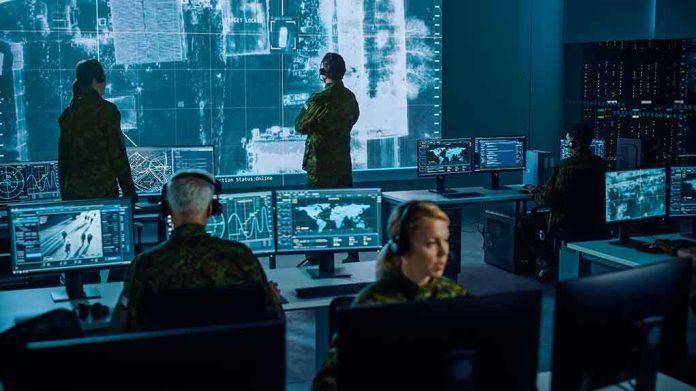
Space is no longer a sanctuary for navigation and timing; it is a contested domain where jamming, spoofing, and targeted interference can quietly neutralize GPS, disrupt targeting, and complicate the protection of U.S. troops long before the first shot is fired.
The Short Version
- GPS’s vulnerability to jamming and spoofing is established, not hypothetical; adversaries treat it as an operational lever against U.S. forces.
- Electronic warfare now reaches from ground stations into orbit, with credible evidence of satellite-borne interference capable of affecting entire regions.
- The U.S. is hardening GPS and deploying layered alternatives, but OCX/M‑code delays and uneven fielding keep risk high.
- The practical hazard already touches civilians: aviation advisories, mishaps under investigation, and routine interference reporting.
What “contested space” means for GPS and why it matters to troops on the ground
GPS underwrites modern American warfare: blue-force tracking, precision fires, synchronized communications, and the timing that glues digital systems together. That dependency is the center of gravity adversaries aim to disturb. The physics invites it: GPS signals arrive at Earth weaker than background noise and are recovered by correlation, which makes them exquisitely accurate yet comparatively easy to drown out (jamming) or counterfeit (spoofing). The Department of Defense has acknowledged this weakness for decades; by 2011, practical spoofing technologies were already in circulation, and by now both techniques are in routine operational use around conflict zones. Attackers do not need to kill satellites to create battlefield confusion; they only need to manipulate the RF environment where receivers live.
For U.S. troops, the consequence is friction across the kill chain. If a platoon’s handheld receivers lose lock or accept falsified coordinates, fires deconfliction, ISR cueing, and time-on-target arithmetic unravel. At larger scale, SATCOM-dependent command-and-control can degrade just when a joint force needs precise timing most. Adversaries understand this asymmetry: denying a few watts from orbit and showers of milliwatts on the ground can neutralize billion-dollar precision and make forces revert to dead reckoning, line-of-bearing tactics, and voice control—all slower, more error-prone, and easier to exploit.
How jamming and spoofing actually work
Jamming is brute-force denial. An emitter—on a truck, a drone, a ship, or even a satellite—radiates noise centered on GPS bands (primarily L1/L2/L5). GPS receivers, which integrate weak spread-spectrum signals, cannot acquire or track amid the higher-power interference and drop to inertial or nothing. Spoofing is more insidious: an adversary synthesizes pseudo-satellite signals with plausible timing, power, and Doppler, then gradually overpowers authentic signals to pull the victim onto a false solution. Researchers have shown that fix continuity is not a reliable indicator of integrity; multi-band, multi-constellation receivers delay but do not prevent spoof acceptance when crafted well. In aviation and unmanned systems, both modalities can force reversionary modes, strip away geofencing and ADS‑B dependencies, and create navigational drift large enough to jeopardize separation and approach minima.
Attribution complicates defense planning. A jammed cockpit in the eastern Mediterranean or Baltic might reflect a local ground emitter behind a hill, a shipboard system, atmospheric effects, or a test pulse from far overhead. Analysts have documented narrowband, regionally focused disruptions consistent with satellite-borne interference—signals far too coherent and large-area to be terrestrial, with timing that suggests human intent rather than solar phenonema—underscoring that “from space” is no longer speculation but a credible operational avenue.
From acknowledged vulnerability to fielded resilience—where the U.S. stands
The U.S. has not ignored the problem. GPS III/IIIF satellites introduce higher-power, more accurate signals and features designed for anti-jam robustness, while the M‑code military waveform raises the bar on both resistance and authentication. At the enterprise level, the next-generation control segment (OCX) is essential to fully unlock these protections; however, delays in OCX and uneven deployment of M‑code–capable user equipment have created a multi-year window where the constellation’s potential outruns fielded receivers. To narrow that gap, the Space Force continues to contract for resilient GPS IIIF production and regional military protection capabilities that can concentrate signal energy to punch through dense jamming near the point of need.
Resilience is not just better GPS. The joint force is layering alternatives: anti-jam antennas and digital beamforming, inertial navigation improvements, visual/terrain-referenced navigation on small UAS, and diverse timing sources. Industry has moved rapidly—software-only vision-based navigation aligned to high-fidelity digital twins, certified coordinate extraction from full-motion video, and post-mission geo-registration now give small drones and ISR teams a PNT backbone even when satellites go dark. These approaches do not replace GPS; they make it one of several corroborating references rather than a single point of failure.
Civil-military spillover: contested space shows up in the flight levels
When the military trains electronic warfare on U.S. ranges or adversaries light up their borders, civilians feel the edges. The FAA now treats GNSS interference as an operational reality and has standing guidance to crews: detect symptoms, revert to terrestrial NAVAIDs and inertial, report details to ATC, and expect degraded ADS‑B or RNP capability in affected sectors. Investigators have begun to scrutinize GNSS anomalies in mishaps; one recent probe examines whether range jamming contributed to a fatal civilian medevac crash near a U.S. Army range—an early, sober reminder that “contested space” is not cordoned off from national airspace. The lesson is not to halt training, but to bound it, communicate clearly, and equip civil fleets with procedures and equipment that fail safe.
What the counter-narratives really contest—and what they don’t
Official statements from Beijing frame satellite jamming as escalation and object to “militarization” of space; domestic technical associations have attributed some Chinese-region outages to temporary, civilian-band-only suppression for event security, with claims that military bands were unaffected. Those positions contest motive and narrative ownership more than they debunk capability. Chinese aviation authorities themselves documented GNSS interference a decade ago and described standing methods to detect and locate sources, which implicitly accepts the phenomenon’s operational salience. In short, the public counter-record does not refute that state actors can jam or spoof GNSS; it argues over who is to blame, what frequencies were targeted, and why.
Implications for targeting, deterrence, and force protection
Targeting depends on common geodetic truth. In a GPS-degraded fight, the bottleneck is not simply getting a weapon to the right coordinate; it is establishing that all participants—sensors, shooters, and command nodes—share the same reference frame at the same moment. That is why precision timing and authentication matter as much as navigation. As layered PNT matures, expect joint doctrine to emphasize cross-checking disparate sources (GPS/M‑code, inertial, celestial/visual/terrain, LEO signals of opportunity, and resilient time distribution) and to push more decision authority closer to the edge with systems that can hold accuracy through comms outages. Deterrence calculus will shift as well: a credible, measured ability to ride out GNSS attacks—and to localize and attribute them—blunts adversaries’ incentive to “soft kill” early. Conversely, persistent OCX/user-equipment gaps invite timed exploitation.
What to do now: practical lines of effort that pay off
Three categories deliver near-term resilience. First, finish the plumbing: accelerate OCX milestones, field M‑code receivers broadly, and standardize anti-jam front ends across priority platforms to convert space-segment investments into user-segment survivability. Second, diversify PNT: harden inertial with better calibration and alignment routines; integrate vision/terrain/magnetic updates where feasible; and build timing architectures that survive GNSS loss through holdover oscillators and cross-domain time transfer. Third, train for denial: normalize EW-threat TTPs, rehearse target mensuration and fires in GPS-denied modes, and instrument ranges to provide realistic jamming/spoofing with precise boundaries and transparent NOTAMs for civil users. These are not moonshots; they are disciplined engineering and fielding choices aligned to the threat we already see.
Bottom line
Contested space turns GPS from a quiet superpower into a brittle dependency. The evidence base—decades of DoD warning, live interference in multiple theaters, enterprise modernization still catching up—argues for urgency without panic. Harden what we must, diversify what we can, and train as if the satellite signal might vanish at the worst possible time. Because one day, it will.
Sources:
radionavlab.ae.utexas.edu, usace.army.mil, satnews.com, dote.osd.mil, strikeorbit.com, faa.gov, cnmoc.usff.navy.mil, spectrum.ieee.org, spacenews.com, ground.news, scmp.com, eng.chinamil.com.cn, en.taibo.cn, icao.int, uscc.gov