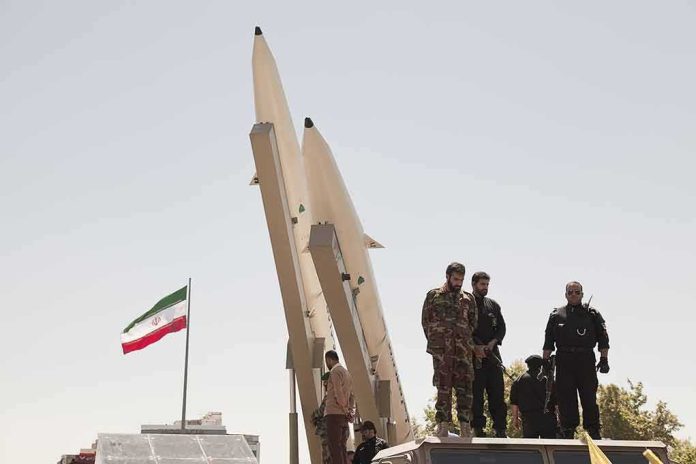
Iran’s nuclear story is no longer just about centrifuges and inspectors; it is about whether rhetoric is drifting toward deterrence doctrine, and whether that drift ever crosses the line into policy. The evidence shows a real escalation in public language, but not a verified crossing into nuclear weaponization.
Key Points
- An IRGC-linked outlet has openly argued that Iran has “no choice” but to build a bomb, which is a significant rhetorical shift, not a formal state declaration.[1]
- Iranian broadcasting and official commentary now mix deterrence language with public denial, revealing a system trying to signal strength without fully abandoning ambiguity.[15][16]
- Technical proximity matters: Iran’s advanced enrichment program, long-running knowledge base, and 60% enrichment level keep the weaponization question permanently live.[6][17][18]
- But the strongest counterweight remains institutional and strategic: official commitments against nuclear weapons, inspectors’ return, and U.S. intelligence judgments that Iran is not currently conducting weaponization-related research.[1][13][18]
What the Rhetoric Really Signals
The most important fact in this dispute is that Iranian nuclear language has become more explicit, more public, and more deterrence-oriented without yet becoming a clean, government-wide declaration of intent. That distinction matters. An IRGC-linked media outlet can publish a headline like “No choice but to build the atomic bomb,” but that is not the same thing as a cabinet decision, a Supreme Leader directive, or a verified change in nuclear doctrine.[1] It is pressure signaling: a way of telling adversaries that threat perception inside Iran has intensified and that the old taboo against discussing the bomb is weakening.
That shift fits a broader pattern. Research on Iran’s nuclear discourse shows that repeated shocks — sanctions, sabotage, assassinations, direct strikes, and regional war — have expanded the range of arguments that can be aired publicly in conservative and semi-official outlets.[15][17] In other words, the rhetorical center of gravity has moved. What was once marginal talk about deterrence is now close enough to the mainstream to appear on state-adjacent channels and in commentary that clearly expects an audience beyond the domestic faithful.[16] This is not yet proof of weaponization; it is proof that the debate has become more permissive and more strategic.
How Iran Preserves Ambiguity While Raising the Stakes
Iran has long used nuclear ambiguity as a diplomatic instrument. The logic is straightforward: maintain enough technical progress to create fear of breakout, but stop short of a bomb that would trigger overwhelming retaliation. That posture has economic value, bargaining value, and military value. It lets Tehran demand relief, extract concessions, and complicate the calculations of Washington, Israel, and Gulf states without paying the immediate costs of crossing the threshold. The current rhetoric suggests that some Iranian actors still see this as the best available leverage, especially when conventional deterrence is strained.
The mechanism behind that leverage is technical capability. Iran’s enrichment program has advanced far beyond the point of symbolic science. Public analyses cited in the research package describe 60% enrichment, a level just below weapons-grade, alongside claims of substantial sunk cost and hardened infrastructure.[6][18] Those facts do not prove a bomb, but they do explain why this issue recurs so persistently: the closer a state gets to the threshold, the easier it is for political language to sound like a weapons program even when the formal line remains civilian. Capability changes the credibility of rhetoric.
The Evidence That Cuts Against a Bomb Decision
The strongest evidence against an immediate weaponization claim is that the official line still points the other way. The U.S.-backed framework referenced in the reporting includes a pledge by Tehran not to develop nuclear weapons, and Iran has also publicly framed its program as civilian.[1][2] That matters because state behavior in nuclear affairs is usually clearest when commitments become legal, diplomatic, or inspection-based. Openly violating them would impose costs Iran has historically tried to avoid. Rhetoric can harden faster than policy; policy is slower, more bureaucratic, and more dangerous to reverse.
The inspection story also cuts against the most dramatic interpretation. Vice President JD Vance said Iran agreed to let international inspectors back in, even as public statements from Tehran and Washington continued to clash over timing and scope.[13] Meanwhile, the Times of India report on the simulated nuclear explosion footage says IRIB later described the broadcast as an editing mistake, with an anchor denying hacking.[12][19] That episode produced headlines because it looked like a test. The correction mattered more than the spectacle: a real test leaves signatures, verification problems, and strategic consequences. A mistaken broadcast leaves confusion and propaganda residue, not evidence of detonation.
Why Intelligence and Doctrine Still Matter
For all the noise, the most consequential institutional constraint is that U.S. intelligence has not judged Iran to be conducting weaponization-related research.[18] That assessment does not mean the program is benign. It means the burden of proof for a bomb decision remains unmet. The research package also notes the long-standing view that Iran halted pursuit of a weapon in 2003, which remains a central reference point in mainstream intelligence analysis.[4] Anyone arguing that Iran has already crossed the line must show more than enraged commentary, ambiguous broadcasts, or an enrichment program that has grown too advanced for comfort.
Doctrine also still matters. The research package points to a Supreme Leader fatwa against nuclear weapons as a political barrier that has mattered for years.[17][18] Fatwas are not immutable physics; they are binding within a political-religious order only as long as the order sustains them. But until there is evidence of formal reversal, they remain an obstacle to a weapon decision, especially when combined with the regime’s long habit of using nuclear capability as leverage rather than making the irreversible leap into open weaponization. That is why the current moment is best understood as escalation in signaling, not confirmation of a bomb sprint.
What Changed After 2018, and Why It Still Has Not Settled the Question
The post-JCPOA era is the hinge on which the entire debate turns. After the U.S. withdrawal in 2018, Iran expanded enrichment and hardened its bargaining posture, using nuclear progress as a reply to sanctions pressure and regional coercion.[6][17][18] That is the most plausible reading of the recent rhetoric: a regime telling domestic and foreign audiences that the threshold option is still available if pressure keeps rising. Yet the existence of a threshold option is not the same as choosing it. States often preserve options for years because uncertainty is itself power.
This is why the current media cycle can mislead. Headlines that flatten every militant phrase into imminent weaponization miss the strategic logic of threshold behavior; headlines that dismiss the rhetoric as empty bravado miss how much public language can shift before formal doctrine does. The deeper truth sits between those poles. Iran’s nuclear discourse is genuinely hardening, and it is doing so in response to external threat perception.[15][17] But the available evidence still supports a more restrained conclusion: the country is closer to weapon-capable ambiguity than to a verified decision to build and field an atomic bomb.
What to Watch Next
The next real signals will not come from slogans. They will come from inspection access, stockpile accounting, procurement patterns, and whether official spokespeople continue to defend civilian intent while semi-official outlets normalize bomb talk. If inspectors return with meaningful access, the world gets more visibility, not less. If enrichment continues upward, if monitoring weakens, or if public rhetoric shifts from conditional deterrence to explicit operationalization, the balance changes. For now, the evidence supports a sober reading: Iran is expanding the political acceptability of nuclear deterrence, but the leap from deterrent rhetoric to actual weaponization has not been demonstrated.[1][18]
🔥DEFENSE BREAKING
Iranian state media says it has now "no choice but to obtain the atomic bomb" to remove "the military option for the occupation and partitioning of Iran" from the table, arguing Iran must "absolutely reach nuclear deterrence" before current negotiations (…)
— Global Defense Analysis (@GlobalDefenseAn) June 28, 2026
Sources:
[1] Web – Iranian Media Calls for Atomic Bombs as Official Says ‘We Are at War’
[2] Web – IRGC-linked media says Iran has ‘no choice’ but to build nuclear bomb …
[4] Web – The Iranian Nuclear Threat: Why it Matters | ADL
[6] Web – March 7, 2026 – nuclear-news
[12] Web – Documenting 25 Years Of Media Fearmongering On …
[13] Web – Iran’s nuclear gamble leaves America one choice — and it can’t be a …
[15] Web – Media Bias in English language newspapers about Iran’s …
[16] Web – Iran’s Shifting Discourse on Nuclear Weaponization
[17] Web – The Evolving Role of Nuclear Rhetoric in Iran’s Strategic Calculus | …
[18] Web – [PDF] 2026-Ozebk-Weaponizing the Word – Institute for Middle East …
[19] Web – The Limited Options for Managing the Iranian Nuclear Question – RUSI