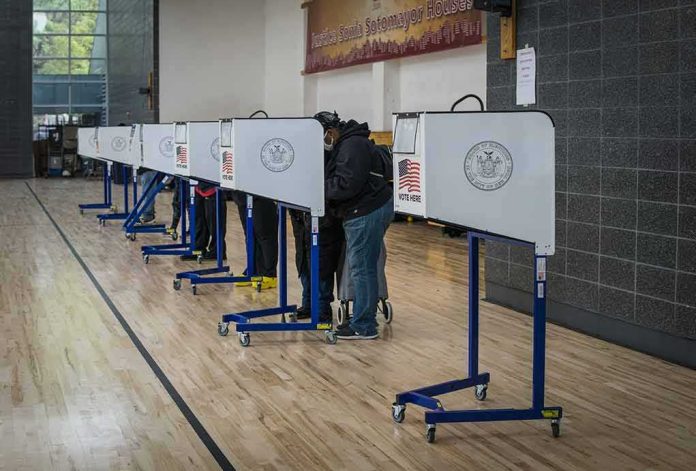
Ohio lawmakers just turned a routine voter ID rule into a full-blown constitutional showdown with Trump cheering from the sidelines.
Story Snapshot
- Ohio Senate passed a resolution to put a voter photo ID amendment on the November ballot.
- The amendment mostly locks in rules Ohio already uses, rather than creating a new system.
- Backers say it protects elections from fraud and future rollbacks; critics call it needless and political.
- Donald Trump’s support turns a state rules debate into a 2026 national test on election trust.
Ohio moves from simple law to hard-to-undo constitutional rule
Ohio already requires voters to show a valid photo ID when they vote in person, a rule that took effect in 2023 after lawmakers tightened election laws.[2][5] Now the Ohio Senate has passed Senate Joint Resolution 10 to put a constitutional amendment on the November ballot that would “enshrine” those voter ID rules in the state constitution.[1][3][5] That step matters because normal laws can be changed by a future legislature, but constitutional rules are far harder to unwind and usually require another vote of the people.[1][3][5]
Supporters in Columbus say this is about long-term security, not a brand-new crackdown. The Senate’s own release calls it a way to “make voter identification and photo ID a constitutional requirement for Ohio elections” and prevent some future majority from weakening those protections.[5] Republican sponsors point to other states where photo ID rules were scaled back and argue Ohio cannot take that risk if it wants people to believe election results, win or lose.[3][5] From a conservative view, that fits a “trust but verify” approach to voting.
What the amendment actually does — and does not do
The text tied to Senate Joint Resolution 10 says electors “shall provide identification” to vote, and then ties that requirement to laws passed by the General Assembly.[3][6] The specific examples of valid photo ID match what Ohio already uses: a driver’s license or state ID, a United States passport, a United States military ID, an Ohio National Guard card, or an identification card from the United States Department of Veterans Affairs.[3][5] Lawmakers would still be able to approve other forms of photo ID in the future if technology changes.[3]
For voters who cast ballots by mail, the picture is murkier. Current law treats mail voting differently and does not demand the same kind of photo ID as in-person voting.[2] Reporting on the Senate plan says the effort “does not alter mail-in voting,” which keeps that channel under less strict rules.[2] Even some Republicans have complained that if you truly want airtight elections, you cannot leave one in five votes with softer checks than the rest.[1][2]
Security push or political signal in a low-fraud state?
Statehouse Republicans argue that putting voter ID into the constitution “elevates the security and integrity” of Ohio elections.[3][5] They frame it as simple common sense: you show ID to fly, to buy certain products, to enter many workplaces, so why should voting be looser than that. They also raise a new concern: fake documents created with artificial intelligence, such as phony utility bills and bank statements, which they say make non-photo forms of ID easier to forge.[3] From that angle, photo ID becomes a basic guardrail, not a barrier.
Critics, including Democrats and some skeptical Republicans, stress that Ohio already uses photo ID and has not seen widespread voter fraud even under older, softer rules.[1][2] Local news coverage states flatly there is “no evidence of widespread voter fraud in Ohio,” and audits have backed that up.[1] For them, this is not a safety upgrade but a political signal. They argue that if fraud is rare, then turning an existing law into constitutional text is more about firing up Republican turnout and locking in power than about fixing a real problem.[1][2]
Why conservatives still see value in a “redundant” amendment
On paper, both sides are right about one thing: the amendment would not change much about how most Ohioans vote tomorrow morning. Photo ID is already required at the polls.[2][5] The real fight is about the future. Supporters want to cut off the path where a new majority chips away at ID rules in the name of “access,” the same way some states have rolled back earlier protections.[5][6] That instinct lines up with a core conservative idea: build guardrails while you still can, not after a crisis hits.
Ohio State Senate Passes Bill to Put Voter ID Amendment on November Ballot – Trump Responds
— Major Anthony Jones (@majorbrainpain) June 9, 2026
Opponents say that kind of entrenchment has a cost. Once you bake specific rules into a constitution, you make it harder to adapt to new facts or fix mistakes. They worry that even small groups of voters who struggle with paperwork or lack easy access to IDs could be frozen out with no fast way to adjust the rules.[2] That is the heart of the debate: is this a wise long-term safeguard that protects faith in the system, or is it a rigid, partisan fix in search of a problem that Ohio does not actually have.
Sources:
[1] Web – JUST IN: Ohio State Senate Passes Bill to Put Voter ID Amendment on …
[2] Web – Ohio Legislators Introduce Joint Resolutions Enshrining Voter ID …
[3] Web – Ohio’s New Election Laws | LWV Ohio
[5] Web – [PDF] Secure And Fair Elections – Ohio Attorney General
[6] Web – Voter ID Laws – National Conference of State Legislatures