
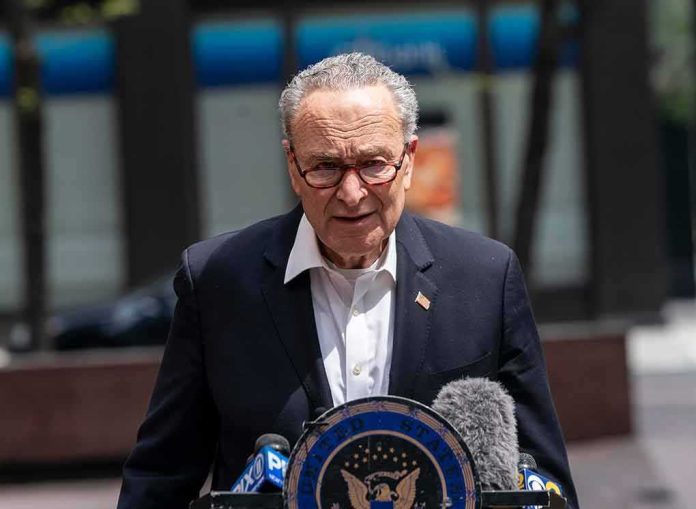
Whether Congress imposes a true ban on trading individual stocks or settles for disclosure-and-notice rules turns on a definitional knife-edge — and that edge decides if reform meaningfully removes conflicts of interest or merely reshuffles them.
The Short Version
- Senate Democratic Leader Chuck Schumer has publicly committed to a stock-trading ban for Members of Congress and White House officials; the pledge names the goal, not the bill text.
- On the Senate floor, Schumer drew a bright line between a genuine ban and proposals that still allow lawmakers to keep or transact in individual stocks.
- A competing Republican framework would bar new purchases of publicly traded stocks but allow retention of existing holdings, advance-notice sales, and private-company purchases — limits, not a prohibition.
- The fight reprises a decade-old policy divide exposed by the STOCK Act: disclosure and insider-trading prohibitions do not, by themselves, remove structural conflicts.
What counts as a real “ban” — and why that definition drives the whole debate
Most Americans hear “ban congressional stock trading” and assume it means no buying or selling of individual stocks by lawmakers, period. In Congress, the term is more elastic. On September 30, 2026, Schumer put a pin in that elasticity, arguing on the Senate floor that a bill letting members “continue to own, sell, and in some instances buy stocks” is not a ban at all. He pressed for a rule set under which members cannot buy stocks after entering Congress and faced tight constraints on disposing of existing holdings; he also criticized carve-outs that would exclude the presidency or the White House from comparable limits. The specificity matters: it sets a verifiable standard against which any “ban” can be tested.
That standard collides with designs that prefer restrictions to outright prohibitions. Republican drafters assembled a package that would block new purchases of publicly traded stocks by members, spouses, and dependent children, require advance notice of sales, but still permit lawmakers to retain existing portfolios and buy into private companies — a structure that still contemplates substantial individual-stock exposure and the ability to time divestitures under public notice. Calling that a “ban” stretches the plain meaning; it is closer to a procurement of constraints.
Schumer’s pledge and its scope: clear aspiration, missing text
In November 2026, Schumer publicly said Senate Democrats would ban stock trading by all Members of Congress and White House officials. The commitment, while unambiguous in intention, was not paired with bill text, defined coverage of asset classes, enforcement mechanics, or effective dates. Without legislative language, it remains impossible to answer operational questions: Are diversified mutual funds allowed? What about private-company interests, SPAC warrants, or sector ETFs? How are blind trusts treated? Do spouse and dependent accounts fall under the same rule set? These are not implementation trivia; they determine whether the rule extinguishes exposure to issuer-specific risks or simply changes how that exposure is held.
The backdrop to Schumer’s pledge is his floor argument for an inclusive scope. He faulted rival proposals for exempting “the most powerful elected official of all — the President of the United States,” and his public promise separately referenced White House officials, signaling an intent to reach beyond Congress into the executive policy apparatus. The logic is straightforward: where information advantage and policy leverage are greatest, the risk of real or perceived conflict is highest.
Mechanics: prohibition versus disclosure-and-notice regimes
Experienced ethics lawyers draw a stark line between three architectures. First, disclosure regimes (exemplified by the STOCK Act) accept ownership and trading but force timely public reporting and clarify that insider-trading laws apply to Congress. Second, restriction-and-notice regimes bar some transactions (often new purchases), allow continued holdings, and impose notice periods before a sale. Third, prohibitory regimes bar ownership and trading of individual securities altogether, often with divestiture windows and narrow exceptions for diversified vehicles. Schumer’s floor remarks reject the first two as insufficient if the goal is to eradicate the conflict, not just publicize it.
The competing Republican framework falls in the middle category: it blocks one pipeline for new conflicts — fresh purchases of public equities — while keeping others open via legacy holdings, private-company buys, and publicized divestitures. That design reduces some risk but preserves issuer-specific exposure and the signaling and timing dynamics around sales that advance notice can create. By Schumer’s stated benchmark, that is not a ban.
History and why reform stalls
Congress has circled this question for a decade. The STOCK Act’s passage in 2012 was rightly celebrated for clarifying insider-trading prohibitions and pushing transactions into the open, but its shortcomings are now well documented: disclosures arrive late or incomplete, enforcement is opaque, and none of it prevents lawmakers from holding or trading stocks affected by their committees’ work. Subsequent attempts to move from disclosure to prohibition have struggled. The House bill to prohibit ownership and trading of covered securities by members and spouses — the Bipartisan Ban on Congressional Stock Ownership Act of 2023 — was referred to multiple committees and did not become law; the Senate’s Ban Congressional Stock Trading Act likewise stalled at committee in that Congress.
There has been real movement, but not closure. A Senate committee advanced a bipartisan compromise in 2024, a first-of-its-kind step but not a floor-passed bill. The recurring pattern is instructive: cross-party agreement in principle, intense disagreement in drafting, and a legislative bottleneck when reform would force sitting members to divest or relinquish trading latitude.
The live fault line: credibility, scope, and enforceability
Schumer’s critics argue that promises should be judged against process control — specifically whether prior opportunities reached the floor. The political thrust is familiar; the evidentiary core is narrower and ultimately secondary to the definitional issue above. What matters for an ethics architecture is not who blinks first but whether the enacted text actually extinguishes individual-stock exposure and the appearance it creates. On that, the Congressional Record is plain: a measure that allows continued ownership and structured selling is a restriction, not a ban.
Enforcement architecture will determine whether any ban is durable. A meaningful regime needs: a divestiture clock with limited exceptions; bright-line definitions of “covered securities” that foreclose private-company workarounds; coverage of spouses and dependents; permissible diversified vehicles; blind-trust standards; an independent enforcement channel with penalty teeth; and audited disclosure pipelines for permitted assets. Absent those, even a broadly worded “ban” collapses into the same disclosure morass that has frustrated the STOCK Act’s bite.
Remember 2024 when Schumer killed the bipartisan Stock Trading ban? I do. Worthless liar. https://t.co/CByox1AXVM
— First Noel (@FirstNoel357) November 13, 2026
What to watch for in any bill text
Five elements separate rhetoric from reform. One, the handling of legacy holdings: is there a fixed divestiture deadline and are proceeds limited to diversified funds or Treasury securities? Two, private-company equity: is it barred or merely disclosed? Three, executive-branch scope: which “White House officials” are covered — President, Vice President, cabinet officers, senior staff, detailees — and are agency heads included via OGE-administered rules? Four, family coverage and control: are spouses and dependents in scope, and how are trusts treated? Five, enforcement: who investigates, who adjudicates, and what are the penalties for breach? Schumer’s line-drawing invites these tests; the Republican framework, by allowing retention and private-company purchases, would fail several of them on its face.
The bottom line
In ethics law, definition is destiny. A true stock-trading ban eliminates individual-issuer exposure by lawmakers and, if extended, by senior executive officials; a disclosure-and-notice regime does not. Schumer has planted the flag on the former and criticized exceptions that puncture it. Opponents prefer a design that constrains but does not prohibit. Until text appears and passes both chambers, this remains a contest of architectures rather than headlines. Judge any forthcoming bill by the clarity of its prohibitions and the credibility of its enforcement — not by what its sponsors call it.
Sources:
twitchy.com, theepochtimes.com, newsable.asianetnews.com, tribuneindia.com, dailypost.ng, congress.gov