
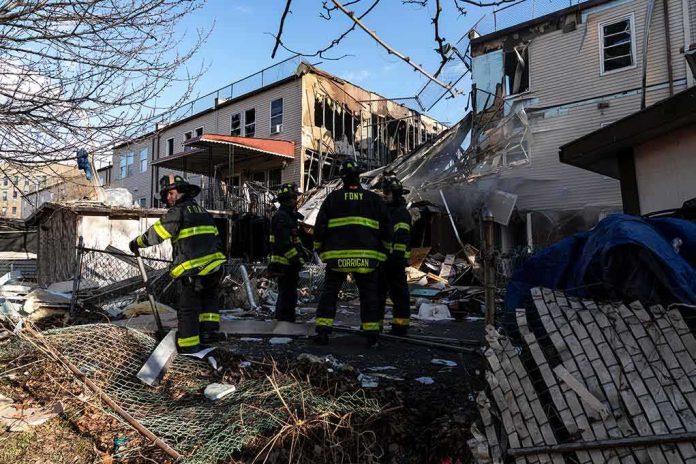
In a city built shoulder-to-shoulder, a building doesn’t fail in isolation; when a three-story structure in Flatbush collapsed into an adjacent excavation, killing at least one person and injuring many others, it exposed the high-stakes interface between urban construction and the lives unfolding inches away.
At a Glance
- FDNY led a large-scale technical rescue after a three-story building collapsed into an adjacent construction site in Flatbush, with people trapped and multiple victims extricated alive.
- Officials reported at least one death and 10 injuries early on; later updates cited two fatalities and 17 or more injuries as the rescue progressed and information clarified.
- The precise street address varied across early reports, but outlets consistently described a mixed-use building abutting a deep excavation where an eight-story development was planned.
- The cause was not immediately known; the Department of Buildings opened an investigation, consistent with standard practice after major structural failures.
What Happened: A collapse into a construction excavation, with a rapid rescue that saved lives
Shortly after 4 p.m. on November 11, 2026, a three-story mixed-use building at the junction of Flatbush and Bedford avenues in Brooklyn partially failed, with significant portions dropping into an adjacent open construction pit. FDNY units mounted a full technical-rescue operation, deploying ladder access to upper floors, tunneling within the debris field, and entering the pit to reach entrapped occupants. Crews removed survivors from the rubble; television feeds documented a trapped woman being extricated in the early evening as operations continued under floodlights and shoring. Early casualty figures cited by officials described one fatality and at least 10 injured, several critically; later briefings increased the toll to two dead and at least 17 injured as additional victims were located and patients were reclassified at receiving hospitals.
Competing descriptors of the structure’s address—1321 or 1325 Flatbush Avenue, and references to 2625 Bedford Avenue—reflected the geometry of a corner lot and the excavation’s footprint; what was consistent was the physical relationship: a building immediately adjacent to a deep construction site suffered a catastrophic loss of stability and collapsed toward the void. The Department of Buildings (DOB) initiated an investigation on scene, standard in any structural failure with casualties.
Mechanics and risks at the excavation edge
Urban excavation is unforgiving. Digging next to existing foundations transfers soil pressures, can cause lateral movement, and exposes bearing strata; without appropriate underpinning, shoring, and real-time monitoring, a neighbor’s wall can rotate, settle, or shear. New York City’s code anticipates this: developers must safeguard adjoining structures during excavation and often underpin party walls or install soldier piles and lagging, internal bracing, or tiebacks to restrain the cut. Where buildings share masonry bearing walls—common in older mixed-use stock—the margin for error narrows further; old brick and rubble foundations lack the ductility of modern reinforced concrete. In Flatbush, onlookers and aerial footage showed a collapse vector into the open pit, the signature of lost lateral or vertical support at an excavation face. While the precise chain of failure awaits DOB’s engineering analysis, the risk pathway is familiar to anyone who has managed a deep cut against an occupied structure.
Excavation hazards are not outliers in the city’s risk profile. DOB’s construction safety reporting shows an agency on constant patrol: roughly 395,000 inspections in FY2025, with more than 201,000 devoted to enforcement—site-safety compliance rather than routine project sign-offs. Stop-work orders rose year-over-year, reflecting inspectors using the most forceful administrative lever when they see conditions that could imperil workers or neighbors. Enforcement bulletins repeatedly cite failures to safeguard excavation work—absent site-safety plans, inadequate shoring, and work commencing without required notifications—illustrating the recurrent nature of the problem class rather than any verdict on this specific site.
How the response unfolded and why casualty numbers change
Large-casualty rescues are dynamic by design. Commanders structure operations in operational periods: primary search for survivable voids, secondary search with more deliberate debris removal, and structural stabilization throughout to protect rescuers and victims alike. As patients are triaged, re-triaged, and transported, counts move. Fatality numbers, in particular, harden only after medical confirmation and scene clearance. In Flatbush, early official tallies reported one death and at least 10 injuries; as the evening progressed and the rubble yielded more victims, authorities moved the count to two dead and 17 or more injured, including a firefighter with minor injuries. Such revisions are not inconsistency; they are the anatomy of a major incident as information matures.
The rescue itself was demanding. Crews used ground ladders, search cameras, and confined-space techniques to navigate compromised interiors and the construction pit. The visible strategy—attacking from above and from within the excavation simultaneously—suggests incident command balanced the imperative to reach void spaces quickly with the need to avoid inducing secondary collapse, a risk when load paths have been scrambled by partial structural loss. That strategy, and the evident success in pulling multiple survivors, is consistent with FDNY’s mature technical-rescue doctrine honed over decades of collapses, fires, and explosions in a dense urban fabric.
The site and the project next door
The adjacent lot was permitted for an eight-story mixed-use development, reportedly on a scale of tens of thousands of square feet, with retail at grade and residences above. Pre- and post-event imagery described by local coverage underscored the proximity: a storefront awning once contiguous with a green construction fence; afterward, a void where the end-lot structure had stood. NYC rules require builders to notify adjoining owners before excavation and to implement protective measures tailored by a licensed engineer; compliance paperwork and monitoring records—settlement markers, crack gauges, inclinometer readings—typically form the backbone of any post-incident analysis. The presence of a deep pit tight against a legacy structure is precisely the condition the code contemplates—and the reason DOB’s engineers scour plans, inspection logs, and contractor methods after a collapse.
None of this, on its own, assigns blame. Excavations can be designed and executed to standard and still encounter unexpected subsurface conditions; conversely, corners cut on underpinning or sequencing can turn a routine dig into a destabilization. The investigation’s job is to separate those possibilities with engineering evidence—soil data, shoring design calculations, field changes, and instrument readings—rather than surface impressions.
One person is confirmed dead and an unknown number of people remain trapped after a building collapses in Brooklyn.
Two people have been pulled to safety as first responders search the rubble for survivors. The cause of the collapse remains under investigation.
— nikikatful (@nikikatful) November 12, 2026
What comes next: engineering answers and policy guardrails
Expect a multi-agency probe anchored by DOB’s forensic engineers. The key questions are predictable and dispositive: Was the neighboring foundation underpinned to a competent bearing stratum? Were temporary works—soldier piles, lagging, rakers, or tiebacks—installed and maintained per plan? Did monitoring show movement before the event, and if so, how did the project team respond? Were required notifications and protections for adjoining properties executed as filed? Answers to those questions determine whether the collapse was a product of design or execution failure, unforeseen geotechnical behavior, or damage originating within the collapsed building itself.
At the policy level, New York has steadily tightened construction-safety enforcement—more unannounced inspections, targeted crackdowns on excavation safeguards, and higher penalties for failure to protect the public way and adjoining structures. Agency testimony and annual safety reports make clear the priorities: stop-work orders the moment a condition threatens life safety, and disciplinary action for repeat violators. If the Flatbush collapse traces to protective-measure lapses, it will reinforce those tools; if it reflects unanticipated ground behavior, it may prompt refinements to monitoring thresholds and contingency protocols.
Why this matters beyond one corner in Flatbush
New York is mid-reinvention: older low-rise parcels are giving way to larger mixed-use buildings, often shoehorned beside legacy structures with undocumented foundations. That redevelopment arc is healthy for housing supply and neighborhood vitality, but it compresses risk at the lot line. The Flatbush collapse, and the lives altered in a minute, argue for sustained rigor where it counts most: engineering that treats the neighbor’s wall as a first-class design constraint, contractors that sequence work to stability rather than speed, and inspectors empowered to shut a site the moment the ground or the structure starts to move. Those are not abstractions; they are the difference between a storefront that opens next year and a building that does not stand through the week.
Sources:
abc13.com, abc7ny.com, amny.com, cbsnews.com, brooklyn.news12.com, upi.com, nbcphiladelphia.com, home4.nyc.gov, nyc.gov