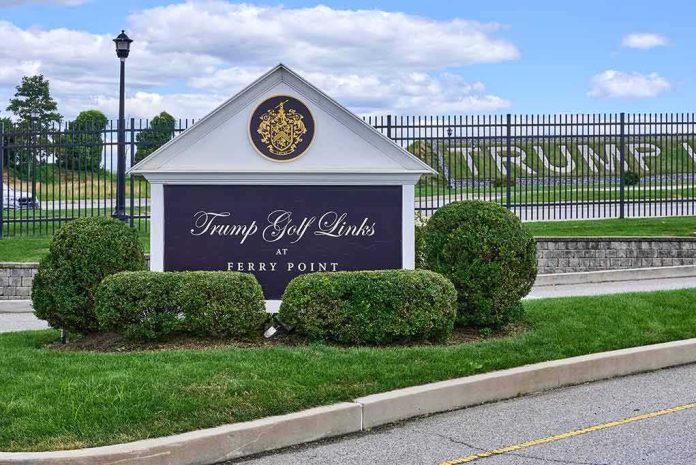
Presidential infrastructure is usually made, not inherited—but President Trump has proposed a notable exception: designating part of his West Palm Beach golf club as a standing presidential retreat, modeled on Camp David, and open to future presidents of either party and visiting foreign leaders. The idea blends public function with private real estate in a way that has precedents, clear logistical upsides, and predictable governance tradeoffs.
At a Glance
- Trump proposed designating Trump International Golf Club in Palm Beach County as a U.S. Presidential Golf Course for use by current and future presidents and foreign heads of state.
- Palm Beach County owns the land; the Trump Organization leases it under a long-running settlement, creating a public–private framework any retreat would have to navigate.
- Security and logistics are the selling points: controlled perimeter, no overlooking structures, minutes from the airport—attributes Trump and allies highlight.
- The core policy question is structural: whether a private venue should serve a recurring official role, given recurring concerns about public cost, control, and private benefit.
What the proposal is—and what it is not
The proposal centers on a formal designation: a portion of Trump International Golf Club in suburban West Palm Beach would be set aside as a “U.S. Presidential Golf Course,” open to all past, current, and future presidents, as well as visiting foreign heads of state. The concept was transmitted to Palm Beach County commissioners via a September 3 letter from attorney Harvey Oyer, acting on Trump’s behalf, and reported by regional outlets with the document in hand. The plan’s promise is straightforward: an already-secure, purpose-built environment that can host presidential weekends and diplomatic interactions, with the trappings—and privacy—of a golf venue that the modern presidency uses routinely.
Crucially, this is not a bid to replicate Camp David’s federal ownership model in Maryland’s Catoctin Mountains. The land beneath Trump International belongs to Palm Beach County, not the Trump family; the Trump Organization leases more than 200 acres under a 99-year arrangement born of a 1990s lawsuit over airport noise, and pays fixed monthly rent to the county. Any “presidential retreat” function would be layered on top of that leasehold through agreements among the county, the federal government, and Trump’s operating entity—an institutional Rubik’s Cube, but not an unprecedented one in American local–federal relations.
Why this site: mechanism and logistics
Presidential retreats serve a purpose that is simultaneously practical and theatrical. They provide secure space where principals can work and unwind; they also set a stage for diplomacy that signals both informality and seriousness. Trump’s pitch emphasizes hard security features and speed of movement. In public remarks, he cited the absence of tall, overlooking buildings and residential sightlines, and the course’s proximity to Palm Beach International Airport—“only about 2 minutes away”—as material advantages for the Secret Service and military protection teams. Distance to wheels-down matters: helicopter or short-motorcade transit reduces exposure and planning complexity, while a controlled perimeter simplifies counter-surveillance sweeps.
From an operational standpoint, golf venues have long been presidential habitats—Eisenhower to Obama to Biden—because they are expansive, access-controlled, and culturally legible as downtime without surrendering staff support or secure communications. Trump International fits that profile and has functioned as an extension of presidential life for years; earlier reporting documented extensive time spent by Trump at Mar-a-Lago and the West Palm club during his tenure, which helped entrench the area as a presidential logistics hub. The question is not whether the site can host presidents; it already has. It is whether formalizing that use as a durable institution improves the functioning of the office enough to justify the structure around it.
The ownership structure: how we got here and what must be solved
Unlike Camp David, which sits on federally controlled land, the West Palm property is nested in a layered governance model. Palm Beach County owns the acreage and leases it to a Trump-affiliated entity; the lease, scrutinized at various political flashpoints, contains no “bad boy” clause and has withstood attempts to dislodge it on moral or reputational grounds. Rent is fixed monthly—reported at $88,338 for the 214-acre footprint—under terms that descend from the 1990s settlement.
Attorney Oyer’s letter sketched an approach in which the county could lease a defined parcel onward to a federal agency, effectively standing as landlord for a federally purposed area inside the club. That kind of tri-party structure is not exotic in public facilities law; stadiums, ports, and airports often layer concessions and subleases to align control with function. The sensitive wrinkle here is the identity of the master tenant—an entity controlled by the sitting President—and how that intersects with public obligations, federal security requirements, and political optics.
The governance question: benefit, burden, and control
Even when a proposal is framed as nonpartisan and open to successors, embedding a recurring official function in a privately run venue raises recurring questions. Three are paramount. First, who bears which costs? County commissioners have been explicit that local taxpayers should not shoulder federal security or disruption burdens; nearby airport operations and airspace management were flagged as practical concerns requiring mitigation. Second, what are the rules of access and priority—both for federal users and the paying members of a private club—when presidential needs arise? That must be specified in any sublease and operational plan. Third, how is private benefit contained? The emoluments debates of Trump’s first term established that routing official business through branded properties can trigger litigation and skepticism, even if legal theories are contested; clarity on pricing, reimbursement, and restrictions helps de-risk that terrain.
Supporters of the designation point to the obvious upside: security and speed at a site already integrated into presidential routines, with no need to build from scratch. Skeptics of the model—often institutional rather than partisan—focus less on the individual figure and more on the structure: whenever government function meets private venue, deal terms do the work of ensuring there is no hidden subsidy or leverage. That means concrete rate cards, indemnities, and oversight. The county’s landlord role and the federal government’s security imperatives give both leverage to insist on those guardrails.
What a workable path forward would require
A durable arrangement would hinge on five elements. Define the footprint: carve out the precise parcel subject to federal use and specify ingress, egress, and airspace coordination to insulate nearby airport operations. Clarify financials: set transparent, non-preferential rent or use fees for federal occupancy, with explicit allocations for security build-out and restoration. Lock in access and precedence: codify that presidential and diplomatic uses take priority under defined notice windows, with compensation for displaced private events if needed. Impose usage rules: restrict branding exploitation tied to official events and govern member access during secure periods to prevent commingling. Create oversight: establish a joint county–federal operational committee with audit authority to monitor compliance and costs. None of this is conceptually difficult; all of it is paperwork and discipline.
If those conditions are met, a designated presidential venue in West Palm could function as a complementary asset to Camp David rather than a replacement—an air-bridge retreat optimized for quick-turn weekends and light diplomacy in a security-friendly layout. If they are not, the arrangement would import familiar controversies about public cost burdens and private advantage, amplified by the identity of the landlord-operator. The structure, not the sales pitch, will decide which way it skews.
Trump Wants to Transform His West Palm Beach Golf Club into a Presidential Retreat https://t.co/gduqBpOTNf
— People (@people) October 7, 2026
The bottom line
The facts are clear: President Trump, through counsel, asked Palm Beach County to partner on designating a portion of Trump International as a presidential retreat; the county owns the land, the Trump Organization holds the leasehold, and reporters have reviewed the letter spelling out the concept. The idea promises operational convenience and security that professionals value. It also sits at the junction where official needs and private assets intersect—a junction that demands rigorous terms to work in the public interest. A year from now, the merits will not turn on the rhetoric surrounding it; they will turn on whether the governing documents reflect the clarity and constraints that presidential infrastructure, wherever it lives, always requires.
Sources:
mediaite.com, palmbeachpost.com, therealdeal.com, politicalwire.com, traded.co, ajc.com, sun-sentinel.com, vinnews.com