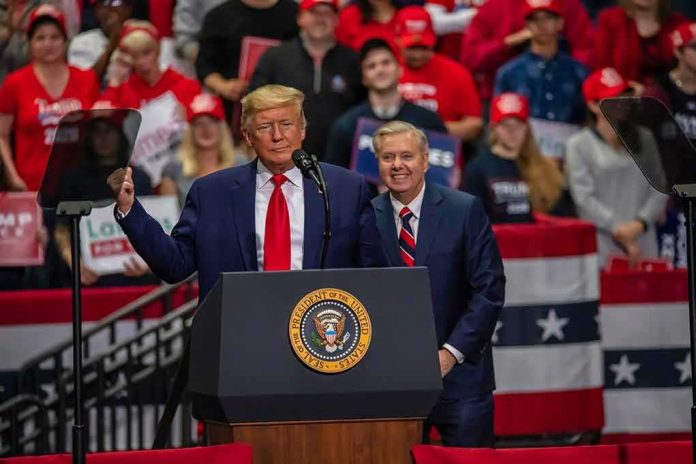
The most revealing thing about President Trump’s roast at the rescheduled White House Correspondents’ Dinner is not whether the jokes “killed,” but how sharply the room split into two realities: allies saw a triumphant skewering of a hostile press; much of the press corps experienced an hour-long reminder of how fragile their professional standing is when they are the butt of power’s jokes.
Key Points
- Trump deliberately approached the 2026 White House Correspondents’ Dinner as a televised roast of journalists and political opponents, not as a conventional unity or policy speech.
- The dinner itself was structurally unusual: rescheduled after a shooting, pared down in attendance, and staged without the traditional counterbalancing comedian, which magnified the asymmetry between president and press.
- Mainstream coverage and many journalists in the room described the set as awkward, hostile, and largely unfunny, even as pro-Trump outlets and supporters portrayed the night as a successful, crowd-pleasing takedown.
- The episode illustrates a broader pattern in polarized media politics: the same rhetoric is read as either sharp truth-telling or authoritarian bullying, depending on the observer’s priors and professional stake.
How Trump Turned WHCD Into a Presidential Roast
The White House Correspondents’ Dinner has traditionally been a night of stylized mutual humiliation: a professional comedian roasts the president and the press, and the president responds with self-conscious jokes, reaffirming a basic respect for the First Amendment while acknowledging the tension inherent in press scrutiny. Trump’s return as a sitting president after years of boycotts broke that choreography. According to his daughter‑in‑law Lara Trump, he actively “worked with joke writers” and warned journalists to “get ready” for a roast, signaling in advance that he would treat the evening as a comedic offensive rather than a ritual of shared civility.
The material he delivered in that spirit tracked his familiar repertoire: riffs on “fake news,” polls and ratings, derisive nicknames for politicians, and pointed personal comments about individual journalists’ demeanor and work. Broadcast descriptions emphasize that he “mixed humour with political commentary” and “roasted multiple people,” from CNN’s Kaitlan Collins to Bruce Springsteen, Chris Christie, and assorted Democratic figures. The New York Post, reflecting an aligned editorial stance, described Trump as “comedian‑in‑chief” who “had the room roaring” with quips about a third term, Robert F. Kennedy Jr., and even “roadkill,” framing the night as an entertaining, if sharp‑edged, performance.
That framing matters because it underscores Trump’s long‑running strategy: reframing direct attacks on the press and opponents as “jokes,” thereby normalizing aggressive rhetoric under the cover of levity. The WHCD setting, historically designed for reciprocal mockery, offered an unusually high‑profile stage to test that strategy.
A Dinner Already Tilted Off Its Normal Axis
To understand why perceptions of the speech diverged so sharply, you have to look at the context. This was not a standard “nerd prom” at the Washington Hilton. The original 2026 dinner had been violently disrupted when a gunman opened fire, leading to a rescheduling at a different venue with dramatically tighter security and a smaller guest list. Reports describe the rescheduled event at the Waldorf Astoria as pared down from roughly 2,600 guests to about 680, stripping away much of the celebrity‑studded optics and leaving a room dominated by journalists, officials, and security.
On top of that, the White House Correspondents’ Association broke with decades of tradition by hiring mentalist Oz Pearlman instead of a comedian, meaning there would be no professional comic roasting the president in return. Only after learning he would not face a live roast did Trump reverse years of boycotts and accept the invitation. That decision alone tells you how sensitive he was to the power dynamic: this year, the president would hold the microphone at length, without a comedic counterweight sanctioned by the association.
Layer in the physical trauma of the April shooting, ongoing arguments about boycotts and journalistic opposition, and an administration widely seen as hostile to the press, and the rescheduled gala becomes less a lighthearted banquet than a stress test for norms. In that atmosphere, the question “did he kill?” becomes less about laugh counts and more about whether the president used a traditional press‑freedom celebration to reassert dominance over the people whose job it is to scrutinize him.
Inside the Room: Two Clashing Readings of the Same Night
Contemporaneous coverage from outlets like CNN, The Independent, and Variety framed Trump’s performance as a failure on its own comedic terms. CNN’s media analysis said he “bombed” and struggled through a meandering hour‑long speech that relied heavily on recycled nicknames and jokes about body weight, with self‑referential attempts to salvage the awkwardness falling flat. The Independent described “crude, often poorly received jokes” aimed at critics and Democrats, more reminiscent of a grievance‑driven rally than a well‑crafted roast.
Journalists who were in the room offered similarly bleak descriptions. A segment on MS NOW collected reactions from Vanity Fair’s Aidan McLaughlin and others, who spoke of “minimal laughter” from the press corps and an atmosphere that “felt like a hostage situation,” with applause mostly coming from Trump‑aligned officials rather than mainstream reporters. Their account reinforces the sense that many in the core journalistic audience experienced the performance less as comedy, more as a prolonged targeting of their profession.
By contrast, several aligned outlets and pro‑Trump commentators seized on the same speech as proof of his comedic prowess and courage. The New York Post highlighted loud laughter at various quips and cast the president as someone willing to walk into a room full of adversaries and “roast the room.” Pre‑event commentary in conservative media framed the dinner as a “test of strength” between a president long caricatured by the press and a press corps suddenly forced to face him on their own turf, without the usual comedic intermediary.
These two readings—awkward grievance monologue versus triumphant roast—are less a dispute about the literal words spoken than a reflection of audience identity. Journalists who see themselves as institutional defenders of press freedom interpret direct, personalized ridicule from the president as an attack on their role. Supporters who view the press as partisan and hostile see the same lines as long‑overdue payback cloaked in humor.
What Counts as “Success” at a Polarized Roast?
Much of the disagreement collapses once you ask a more precise question: success for whom, and on what metrics? As a traditional comedy set—one intended to win over a skeptical room and build shared goodwill—the available evidence suggests Trump’s remarks underperformed. Descriptions emphasize uneven pacing, jokes that drew scattered laughs or silence, and a pervasive sense of discomfort among journalists and mainstream commentators. There is no forensic laugh‑track analysis in the public record, but the convergence of multiple independent accounts points toward a room that was at best divided, not broadly amused.
As a political communication exercise, however, the speech arguably did what Trump intended. He reinforced his narrative that the media is biased and hostile, showcased his willingness to confront journalists to their faces, and produced a stream of viral clips—attacks on individual reporters, jokes about seeking a third or fourth term, riffs on “Trump derangement syndrome”—that traveled widely on social media and partisan channels. The very headlines declaring that he “bombed” or turned the dinner into an “awkward rant” feed the storyline that the “fake news” press cannot take a joke and is stacked against him.
For aligned audiences watching on television or online, the visible discomfort of certain journalists and the lack of a comedian pushing back could easily read as victory: the president walked into enemy territory, took the microphone, mocked his critics, and walked out unscathed. For many journalists in the ballroom, the same sequence underscored how vulnerable press‑freedom rituals are to being repurposed into stages for elite scorn.
The Deeper Pattern: Comedy as a Weapon in Media Politics
What happened at this dinner is part of a broader trend in modern political communication. In an era of partisan media and social platforms, “roasts” are no longer just entertainment; they are tools for coalition‑building and boundary‑setting. When Trump wraps criticism of the press in jokes, he signals to supporters that mockery of journalists is not only acceptable but enjoyable, while giving himself plausible deniability—after all, it was “just comedy.”
That dynamic has precedent. Presidents and comedians at past dinners have targeted both politicians and reporters, sometimes sharply; but the underlying norm assumed a kind of mutual consent and rough symmetry. By stripping out the professional comic and inviting a president who has spent years attacking the press to deliver an extended roast of journalists with no comparable counter‑roast, the 2026 WHCD altered that balance. The institution that exists to honor press freedom effectively ceded its prime stage to a speaker whose message, at core, is that much of the press cannot be trusted.
For a 40‑plus audience that has watched the media landscape fracture over decades, this episode is a reminder of how quickly civic rituals can be weaponized in the culture wars. To one camp, the images of smiling faces—even those smiling through discomfort—are proof that the press can be mocked without consequence. To another, those same images look like professionals absorbing public humiliation in order to protect an institution they believe is foundational to democracy.
What This Means Going Forward for the WHCD and the Press
The WHCA now confronts a hard, structural question: what is the dinner for, and for whom? If it remains a showcase night celebrating the First Amendment and funding scholarships, then inviting any sitting president who has made hostility to the press central to his political brand will always carry the risk that the stage becomes a platform for undermining the very values being honored. The 2026 dinner, with its altered format and rescheduled trauma, exposed that vulnerability clearly.
At the same time, refusing to invite the president would feed arguments that the press is closed and partisan, unwilling to face criticism. That tension helps explain why the association made the gamble it did. But the outcome—a highly polarized reception, with mainstream coverage calling the speech a bomb and aligned outlets celebrating it as a roast for the ages—illustrates that neutrality in invitation does not produce neutrality in effect.
For journalists, the lesson many commentators drew afterward is blunt: prestige events and polite rituals do little to deter a political actor who sees the press as an adversary rather than a constitutional partner. For Trump and his supporters, the night demonstrated that cultural institutions built around press esteem can be flipped into stages where the press is the butt of the joke—and that there is an audience, large and enthusiastic, that enjoys watching that flip occur.
Sources:
newsbreak.com, youtube.com, cnn.com, independent.co.uk, variety.com
Brian Stelter calling Trump’s White House Correspondents' Dinner speech “boring” is pure copium. Say what you want about Trump, but he’s never boring. The speech was hysterical—CNN just can’t take a joke. Cope and seethe. https://t.co/rWJKLQ3NLa
— Whiplash (@mr_Whiplash_) July 25, 2026