An active-duty Air Force major with over 20 years of service was arrested on the steps of the U.S. Capitol in uniform — and now faces potential military charges that could end his career.
Story Snapshot
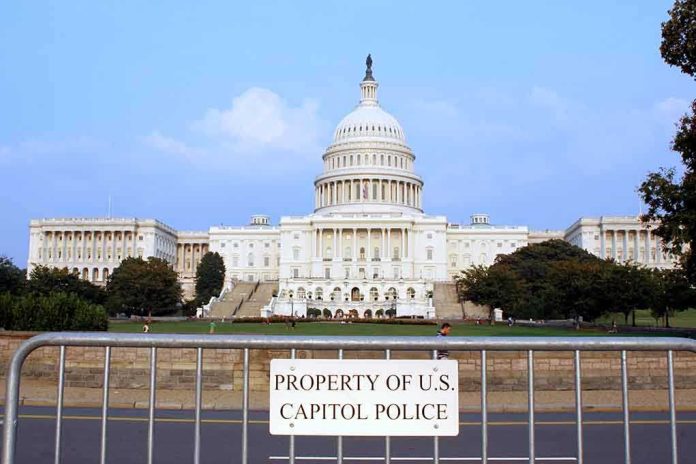
- Major Jason Watson was arrested July 1, 2026, on the House steps of the Capitol while holding a sign reading “Impeach Convict Remove” — in full military uniform.
- Capitol Police charged him under a D.C. law that bans demonstrations on Capitol steps without a sitting member of Congress present. That civilian charge was later dropped.
- Military law experts say protesting in uniform likely violates Department of Defense rules — and could be a felony under the Uniform Code of Military Justice punishable by up to two years in prison.
- No military charges have been filed as of the latest reporting, and the Air Force has not made any public statement about an investigation.
What Happened on the Capitol Steps
Major Jason Watson, an active-duty Air Force officer stationed in Bydgoszcz, Poland, traveled to Washington and stood alone on the House steps on July 1, 2026. He held a sign calling for the impeachment, conviction, and removal of President Trump and Vice President Vance. Capitol Police arrested him at about 1:15 p.m. after the member of Congress accompanying him left the area. Watson is believed to be the first active-duty commissioned officer to publicly protest for Trump’s removal.
The civilian charge — crowding, obstructing, and blocking a public space — was later dropped by the D.C. U.S. Attorney’s Office. Legal experts say that office likely deferred to the military, which has its own justice system for handling misconduct by active-duty service members. Watson has since retained legal counsel. His attorney confirmed he is under a gag order and cannot speak publicly about the case.
What Military Rules Say About Protesting in Uniform
Department of Defense Directive 1344.10 and DoD Instruction 1325.06 both restrict what active-duty troops can do at political events. Service members may attend rallies as private citizens, but they cannot appear in uniform, make public political speeches, or take part in partisan demonstrations. The rules exist to protect the military’s image as a nonpartisan institution that serves all Americans — regardless of political party.
Military law experts say Watson’s actions likely crossed that line. Protesting in uniform suggests the military itself endorses a political position — exactly what the rules are designed to prevent. One expert cited in reporting on the case said the conduct could qualify as a felony under the Uniform Code of Military Justice, punishable by up to two years in prison, dismissal from service — the equivalent of a dishonorable discharge — fines, and loss of pay. After more than 20 years of service, the stakes for Watson are enormous.
No Military Charges Filed — Yet
As of the latest reporting, the Air Force has not confirmed any investigation, issued any charges, or made a public statement about Watson’s conduct. That silence has allowed competing narratives to fill the void. Some media outlets and YouTube channels with hundreds of thousands of views frame Watson as a patriot risking his career to speak truth to power. Others argue he knowingly broke clear military rules and must face the consequences like any other service member would.
Public support and crowdfunding are not proof of innocence or guilt, but they do reflect that many people believe Major Jason Watson deserves a fair legal process. Equally, the fact that no military or civilian authority has filed charges so far means due process is still… https://t.co/nA8jQmbqdj
— Ashok Dadhwal (@ashokdadhwal196) July 20, 2026
There is also a legal wrinkle. Military law experts warn that any public criticism of Watson by President Trump or Defense Secretary Pete Hegseth could be considered unlawful command influence — a legal concept that can get military charges thrown out entirely. That creates a difficult situation: the more politically charged this case becomes, the harder it may be to pursue disciplinary action through proper channels. Whether the Air Force acts — or stays silent — will say a great deal about how military discipline is applied when politics enters the equation.
Sources:
military.com, facebook.com, truthout.org