The important fact is not that a single awkward stage moment happened; it is that modern political audiences now routinely turn fragments like this into instant verdicts about age, cognition, and competence, even when the underlying footage supports only a much narrower claim.
Key Points
- Biden did appear on stage at the Obama Presidential Center opening and was left without immediate accompaniment at the end of the ceremony.[1][2]
- The quoted line “Where’s my granddaughter?” is documented in contemporaneous clip-based reporting, but its meaning is not established by the available material.[1]
- The footage supports a reading of an awkward, briefly isolated moment; it does not, by itself, prove confusion or cognitive decline.[1][2][5]
- The broader event context makes a logistical explanation plausible, because this was a large ceremonial program with multiple speakers and exits in motion.[3][6][7]
What the Clip Actually Shows
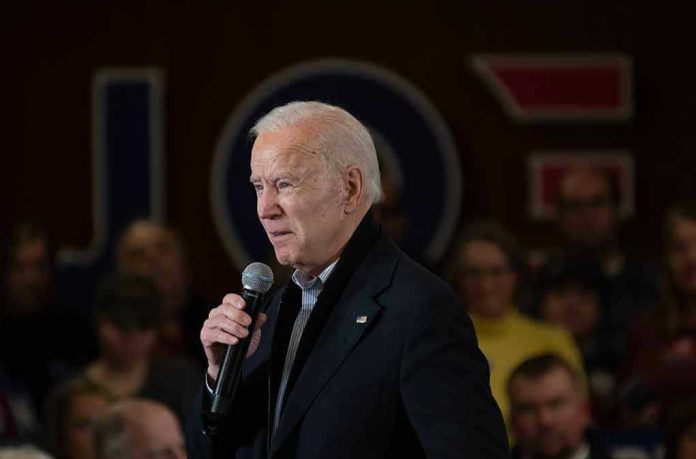
At the center of the dispute is a short visual sequence: Joe Biden standing alone near the close of the Obama Presidential Center opening, looking out toward the crowd, taking off his sunglasses, and speaking the line that was widely quoted in early coverage. That much is real enough. The New York Post’s account says he remained on stage after Barack Obama had departed and Jill Biden had followed behind, then asked, “Where’s my granddaughter?”[1] Other contemporaneous reporting confirms the event itself and places Biden among the dignitaries at the ceremony.[2]
What the clip does not do is settle interpretation. A brief on-stage pause can mean many things: waiting for a cue, searching for family, listening for direction, or simply being momentarily out of sync with the exit flow. The footage, as described in the available reporting, is too short and too context-poor to justify a medicalized conclusion. “Awkward” is a fair descriptor. “Confused” is a higher bar, and the materials provided do not clear it.[1][2][5]
The transcript excerpt circulating with the video also matters. It shows a speaker thanking “President and Dr. Biden” for their “steadfast partnership for eight years,” which confirms that Biden was present in an on-stage ceremonial role before the moment turned into a viral clip.[1] That does not explain the remark, but it does show the scene belonged to the normal choreography of a public program, not to some hidden or suspicious exchange.
Why the Context Points Toward Logistics, Not Diagnosis
The strongest counter-reading is straightforward: this was a large, scheduled public ceremony, not a clinical examination. The Obama Foundation’s own materials frame the day as a grand opening celebration, and the broader coverage emphasizes speeches, performances, and civic symbolism rather than any Biden-specific incident.[6][7][3] That context makes a temporary separation on stage entirely plausible. Large events create dead space, especially when music is playing, principals are leaving in sequence, and camera attention lags behind the human choreography.
That matters because public clips are often judged as if they were laboratory evidence. They are not. They are compressions. A camera catches one angle, one second, one posture; an audience supplies the rest from priors. In this case, the dominant prior is obvious: Biden’s age is already a standing subject of political scrutiny, so an ambiguous moment is primed to be read as proof of decline. Research on aging, misinformation, and political cognition shows how easily people convert incomplete cues into confidence when the subject fits an existing narrative.[15][16][19]
That broader pattern does not make every concern illegitimate. It does mean that inference must stay proportional to evidence. The available primary material documents a public event, not a cognitive assessment.[5][6][7] No official source in the packet offers a medical explanation, and no witness statement resolves whether the line referred to a family member, a staging issue, or something else entirely. In other words, the clip establishes ambiguity; it does not resolve it.
Why the “Left Behind” Framing Spread So Fast
The phrasing of the earliest viral coverage did a great deal of work. Calling the moment “gets left behind” or “seemingly gets left behind” turns a visual gap into a narrative of neglect, and once that frame is set, viewers tend to notice whatever reinforces it.[1] This is the mechanics of context collapse: a short excerpt travels farther than the surrounding scene, and the headline outruns the evidence beneath it. The result is that a minor staging hiccup can be recast as a character judgment.
That transformation is especially potent in a polarized media environment. Trust in national news has fallen, and audiences increasingly sort stories through partisan expectation rather than through full-source examination.[18] On top of that, older political figures are routinely evaluated through body-language proxies—gait, posture, verbal slips, pauses, the direction of their gaze—because those are the signals most easily captured and shared. It is a crude method of reading a person, but it is now one of the most common methods in digital politics.[20][21][22]
Still, the burden of proof does not disappear because a clip feels revealing. A remark like “Where’s my granddaughter?” may suggest confusion to some viewers, but it may also reflect a family-oriented search, a misfire in timing, or plain conversational noise amid a ceremony. Without fuller audio, surrounding dialogue, or an eyewitness account, the line cannot bear the weight of a definitive interpretation.[1][5]
What a Responsible Reading Supports
A responsible reading is narrower than the viral framing and more defensible than the reflexive debunk. Biden was on stage, then briefly appeared alone, and the moment looked awkward enough to generate immediate commentary.[1][2] That is the factual core. Beyond that, the evidence becomes interpretive. The clip may show stage confusion; it may also show nothing more than the ordinary messiness of a ceremonial exit. The difference matters because one is a logistical explanation and the other is a claim about mental state.
This is why the dispute will keep recurring whenever short Biden clips circulate. The public has a ready-made template for age-related decline, and the media ecosystem rewards the fastest, most dramatic reading. Yet the materials provided here do not justify treating this moment as proof of cognitive impairment. They justify treating it as a vivid, politically radioactive, but ultimately underdetermined scene. That is a more disciplined conclusion, and it is the one the evidence can actually carry.[1][2][5][6][7]
Sources:
[1] Web – WTH? Biden Shouts “Where’s My Granddaughter?” After Jill Biden Leaves …
[2] Web – Biden gets left behind at Obama Center opening – New York Post
[3] Web – Barack and Michelle Obama deliver remarks at opening ceremony
[5] Web – From the East Wing to Chicago! Every city on this tour has brought …
[6] YouTube – Grand Opening Ceremony at the Obama Presidential Center
[7] YouTube – Obama opens presidential center with ‘unfinished business’
[15] Web – WATCH: Barack and Michelle Obama open Obama Presidential …
[16] Web – Join us for the livestream of the Obama Presidential Center Grand …
[18] Web – Aging in an Era of Fake News – PMC – NIH
[19] Web – Who knowingly shares false political information online?
[20] Web – How trust in info from news outlets and social media has changed …
[21] Web – Cognitive decline and political leadership | Cambridge Core
[22] Web – Cognitive distortions are associated with increasing political … – …