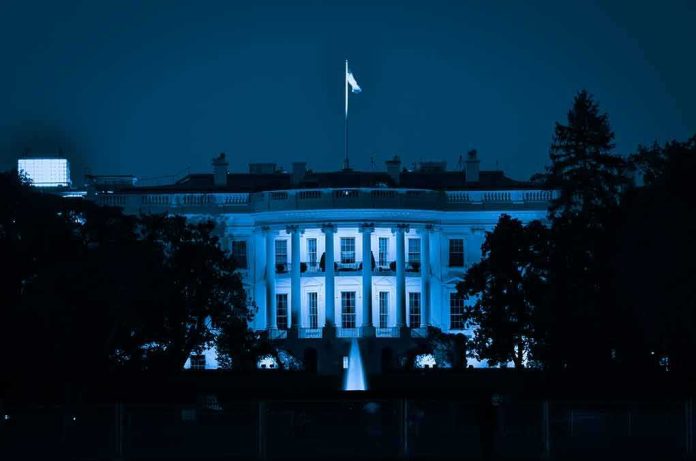
A White House employee who ran President Trump’s teleprompter allegedly used advance knowledge of the president’s speeches to win more than $90,000 betting on prediction markets — and federal regulators are now investigating.
Story Snapshot
- Gabriel Perez, Trump’s teleprompter operator, has been placed on unpaid leave after reports surfaced of suspicious betting tied to the president’s speeches.
- The Commodity Futures Trading Commission (CFTC) is investigating Perez for potential insider trading on Kalshi, a regulated prediction market platform.
- Perez reportedly made over $90,000 in profits from the trades, which have been frozen while the probe continues.
- This is the first reported case of a White House employee being investigated for insider trading involving prediction markets.
What Perez Is Accused of Doing
Gabriel Perez worked as a teleprompter operator for President Trump — a job that gave him access to speech scripts before they were delivered publicly. According to two sources familiar with the matter, Perez placed bets on Kalshi’s “mention markets.” These are wagers on whether a public figure will use specific words or phrases during a speech. If Perez knew what Trump was going to say before anyone else, he could bet on the outcome with near certainty.
Kalshi’s own surveillance team flagged the trades as suspicious and reported them to the CFTC. Sources say Perez made more than $90,000 in profits from these bets. That money has since been frozen. Perez is said to be cooperating fully with investigators. No formal charges have been filed as of this writing, and the CFTC declined to confirm or deny an active investigation.
Trump Called It a Disgrace
White House Press Secretary Karoline Leavitt confirmed that Perez was placed on unpaid administrative leave. She said President Trump made that call himself and described the conduct as a “disgrace.” Leavitt also acknowledged that the White House has no system in place to track whether staff members are placing bets on prediction markets. That admission raises a real question: if no one was watching, how many others may have done the same thing?
The White House had already warned staff about this issue. In March 2026, the White House Management Office sent an email reminding employees that using nonpublic information to bet on prediction market contracts is a federal crime. That memo named Kalshi and Polymarket by name. Despite that warning, the Perez situation reportedly continued — or at least wasn’t caught until Kalshi flagged it from the outside.
A Growing Problem for Prediction Markets
The Perez case is not happening in a vacuum. Regulators have been putting prediction markets on notice for months. In February 2026, the CFTC formally declared it has full authority to police insider trading on these platforms. In April 2026, federal prosecutors charged an active-duty U.S. Army soldier with using classified military information to place winning bets on Polymarket. In May 2026, the Department of Justice (DOJ) and the CFTC brought charges against a Google employee for allegedly using confidential company data to profit on the same platform.
Confirming reports that Trump's longtime teleprompter operator is being investigated by the CFTC for possible insider trading on "mention markets" for Trump speeches. Sources say the WH employee made over $90k in profits and is cooperating with the probe. https://t.co/8HG3fBvoUU
— Marshall Cohen (@MarshallCohen) July 16, 2026
These cases share a common thread: people with access to information the public doesn’t have are using it to win bets on events they already know the outcome of. That’s the core of insider trading, whether it happens on a stock exchange or a prediction market. The CFTC has made clear it views both the same way. For Americans already skeptical of a system that seems to reward insiders over ordinary people, this pattern will feel familiar — and infuriating. The rules appear to be the same for everyone, until you look more closely at who actually gets caught.
Sources:
youtube.com, abcnews.com, cnn.com, money.usnews.com, cftc.gov