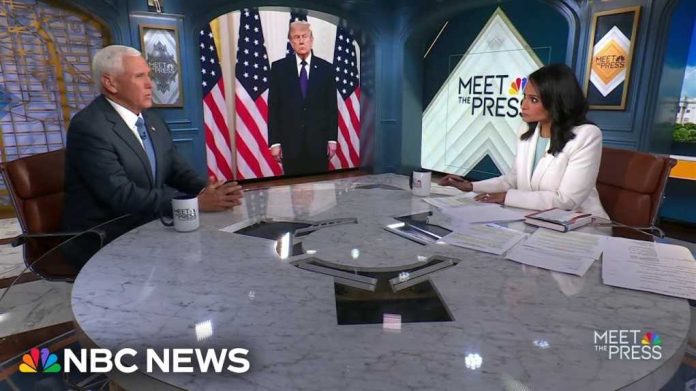
When Mike Pence calls a Trump administration program “deeply offensive” and demands it be scrapped entirely, something more than politics is happening — a $1.776 billion taxpayer-funded question is sitting at the center of it.
Story Snapshot
- Pence publicly called the Department of Justice anti-weaponization fund a “bad idea from the start” on both CBS and NBC, urging the Trump administration to drop it completely.
- His sharpest objection: people who assaulted police officers or vandalized the Capitol on January 6 should not receive “one dime” of taxpayer money from the fund.
- The $1.776 billion fund was established as part of a settlement of a lawsuit President Trump filed against the Internal Revenue Service (IRS).
- A federal judge temporarily barred the Department of Justice (DOJ) from moving forward with the fund while legal challenges work through the courts.
What Pence Actually Said and Why It Cuts Deep
Pence did not hedge. Appearing on CBS’s Face the Nation and NBC’s Meet the Press, he stated plainly that the anti-weaponization fund should be abandoned and that the DOJ already has full authority to settle individual cases without creating a pooled compensation mechanism. His words on CBS were direct: “My hope is the administration will drop it, drop the idea entirely.” That is not the language of a man offering gentle course-correction advice to a former ally — it is a public break on a signature policy vehicle.
The moral center of his argument is hard to dismiss. Pence described the fund as “deeply offensive” if it could reach individuals who attacked police or damaged the Capitol on January 6, 2021. He is right to draw that line. Whatever legitimate grievances exist about politically motivated prosecutions during the Biden years, compensating people who committed documented acts of violence against law enforcement officers is not a conservative value — it is a contradiction of one. The argument that DOJ can and should settle meritorious cases individually, as it did for a pro-life family targeted during the Biden administration, is both principled and practical.
The Fund’s Origins Make the Controversy Harder to Dismiss
The $1.776 billion figure did not emerge from thin air. CBS News reported that the fund was established as part of a settlement resolving Trump’s lawsuit against the Internal Revenue Service (IRS). That legal origin gives the fund a degree of structural legitimacy the administration has leaned on, and the DOJ has stated publicly that it is confident in the fund’s legality despite a handful of court challenges. A federal judge, however, temporarily halted DOJ work on the fund — which is not a verdict on the merits but does signal that the legal architecture is not as airtight as the administration has claimed.
The administration’s public defense frames the fund as compensation for people who allege they were unfairly investigated or prosecuted by the government — a description broader than “January 6 rioters.” That framing is not dishonest on its face. The problem is that no publicly available eligibility document, exclusion list, or claim procedure has been produced to confirm that people convicted of assaulting police officers are actually locked out of the fund. Without that documentation, the administration’s assurances remain assertions, and Pence’s objections remain unanswered at the document level.
Where the Real Accountability Gap Lives
Pence’s position is strongest on ethics and political judgment. It is less developed on legal specifics, and he has acknowledged as much by pointing to existing DOJ settlement authority as the preferred alternative rather than identifying a statute the fund violates. But the burden of proof here does not rest primarily with the critic. When $1.776 billion in taxpayer money is distributed through a settlement mechanism whose eligibility criteria have not been made fully public, the administration owes the public a complete accounting — not a press release and a confidence statement.
Former Vice President Mike Pence slams Trump’s proposed $1.8 billion slush fund for Jan. 6 rioters: A weaponization fund, that could compensate people that assaulted police officers and vandalized the Capitol that day is totally unacceptable. pic.twitter.com/Dmsi8PVf6t
— WEB3 (@WEB3WORLDWAR) May 31, 2026
Congress has also pushed back. Republican opposition to the fund is not confined to Pence, and the fact that it is drawing bipartisan resistance suggests the concern about eligibility and accountability is not simply a loyalty dispute dressed up as policy. The most important unanswered question remains straightforward: can a person convicted of assaulting a Capitol Police officer on January 6 file a claim and receive payment? Until the full settlement agreement, eligibility criteria, and claims administration procedures are released publicly, every defense of the fund is built on incomplete information — and every criticism of it, including Pence’s, is aimed at a target that the administration controls the ability to define.
Sources:
[1] Web – Pence on Trump’s weaponization fund: “My hope is the administration …
[2] Web – Mike Pence says he hopes Trump administration will drop …
[3] YouTube – Mike Pence calls DOJ anti-weaponization fund ‘deeply …