
The fight over who gets a seat inside the White House press workspace is not a skirmish about manners; it is a constitutional dispute about whether the government may ration privileged access based on its appraisal of a newsroom’s viewpoint and still claim it has not “banned” the press.
The Short Version
- The administration argues it withdrew only “special access,” not the right to report; Vice President JD Vance calls that approach totally appropriate.
- Targeted outlets and press-freedom groups counter that confiscating hard passes is a ban in practice and likely unconstitutional viewpoint discrimination.
- Federal precedent allows reasonable, viewpoint-neutral rules for White House press areas and requires due process before revoking credentials.
- Outright exclusion of entire outlets is rare in modern practice, which heightens legal and institutional scrutiny when it happens.
What the administration says it changed—and why that framing matters
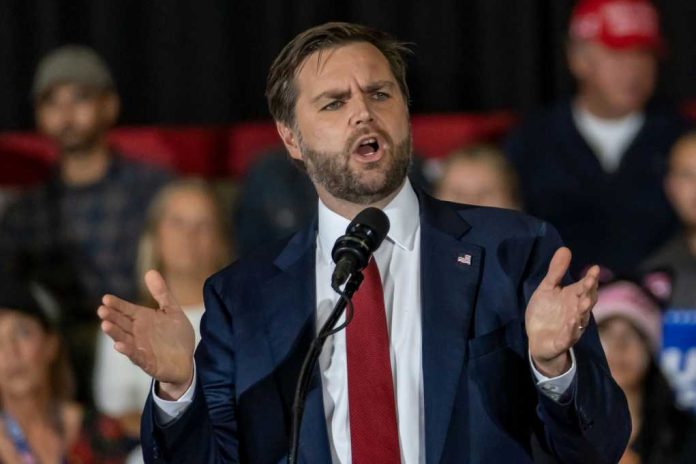
Vice President JD Vance has cast the policy as a denial of privilege rather than a prohibition: the White House will not “give you special access” if it judges an outlet to be engaged in propaganda, but those organizations “can still report,” obtain public information, and speak with officials. Framed this way, the move is a housekeeping adjustment to scarce space, not a suppression of speech; in Vance’s words, “totally appropriate.” The rhetorical move is precise: it separates the right to publish from the right to physical proximity, and it recasts the White House press area as a controlled workspace where discretion is inherent rather than a forum where discretion is constrained by the First Amendment’s neutrality demands.
That distinction is not merely semantic. In First Amendment doctrine, the government has wider latitude to manage nonpublic forums—spaces not traditionally open to the public for expressive activity—so long as restrictions are reasonable and viewpoint-neutral. Administration defenders point to that architecture to argue that withdrawing hard passes or workspace privileges is an operational call about conduct and reliability, not an attempt to favor one side of a debate.
The counter-case: confiscated passes look like a ban, and the law disfavors viewpoint-based exclusion
The affected organizations describe something more than a loss of convenience. CNN, MS NOW, and Politico said their reporters were turned away and their hard passes confiscated at the gate, and each has signaled legal action grounded in free-press guarantees. The White House Correspondents’ Association called for immediate restoration of access, arguing that excluding entire outlets violates the First Amendment; press-freedom litigators have called such a ban flatly or clearly unconstitutional. Taken together, these on-the-record reactions assert the change is not neutral workspace management but a targeted exclusion that burdens newsgathering and chills critical coverage.
Their legal footing is not novel. Since Sherrill v. Knight (D.C. Circuit, 1977), the White House’s press-credential regime has been constrained by two core requirements: no arbitrary or viewpoint-based denials once a press facility is opened, and procedural protections—notice and an opportunity to be heard—before credentials are revoked. More recent decisions treat regularly accessible press areas as nonpublic forums, but even there, the government may not discriminate against a speaker because of viewpoint. In practice, that means the administration can administer rules, but it cannot pick winners and losers because it dislikes their editorial line—and it must follow due process to retract credentials.
How the law actually maps onto a modern White House
Two strands of doctrine define the terrain. First, opening designated spaces for credentialed reporters creates a protected access regime: the government cannot exclude arbitrarily or for content- or viewpoint-based reasons. Second, these spaces are nonpublic forums; within them, restrictions must be reasonable in light of the purpose of the forum and viewpoint-neutral. Courts have also required procedural fairness around suspensions or revocations of hard passes. The D.C. Circuit’s modern press-access cases—building on Sherrill and reaffirmed in subsequent litigation—are unambiguous on these points even as they allow significant administrative control day to day.
Where does that leave a policy that withholds “special access” from named outlets because the White House deems their output “propaganda”? If “propaganda” functions as a proxy for disfavored viewpoint, the policy risks violating the neutrality rule. If, however, the government ties removal to viewpoint-neutral criteria—security breaches, disruptive conduct, published false credentials policies, or objective standards applied uniformly—courts are more accommodating. The factual hinge in any challenge will be the record: what standards were used, how consistently they were applied, and whether affected outlets received notice and an opportunity to contest the action before passes were taken.
History and practice: presidents spar with the press, but blanket outlet bans are uncommon
Administrations have long managed access tightly, and disputes over individual reporters’ conduct or specific events are common. What remains rare is the categorical exclusion of entire national outlets from routine White House coverage. That rarity matters for two reasons. First, it weakens any claim of administrative necessity; second, it amplifies the appearance—and potential reality—of viewpoint targeting. When access management departs from familiar, incident-specific justifications and sweeps in whole organizations, it attracts the very constitutional and institutional scrutiny that prior episodes teach us to expect.
That backdrop also explains why professional associations react quickly. The institutional press is protective of process—clear criteria, stable credentialing, predictable remedies—because that scaffolding lets adversarial journalism function regardless of who holds power. Break the scaffolding and future administrations, of any party, can exploit the precedent.
What “they can still report” does—and does not—solve
The administration’s strongest claim is that speech remains free: no broadcast has been shuttered, no article censored, no prior restraint imposed. In constitutional terms, that mitigates the severity of the burden. Yet courts have repeatedly recognized that newsgathering access, once allocated through a formal credentialing system, cannot be conditioned on a newsroom’s viewpoint. Confiscating a hard pass may not silence a story, but it does handicap the enterprise of timely reporting from inside a building where proximity and pooled logistics shape what the public learns in real time. That is why process and neutrality, not the abstract availability of alternative channels, tend to decide these cases.
It is also why procedural detail will loom large. Were the standards codified beforehand? Were they tied to conduct rather than content? Was there notice, a chance to respond, and written reasons for revocation? An absence of those features typically strengthens a challenger’s hand, even when officials emphasize that publishing itself remains untouched.
The likely path from here: litigation, standards, and the durability test
Expect a federal court to demand clarity: what are the criteria, are they viewpoint-neutral, how were they applied, and were due-process protections honored before passes were seized? If the government substantiates neutral, reasonable standards, it can prevail; if the record shows viewpoint targeting—especially where “propaganda” is applied selectively to disfavored critics—it is vulnerable. Because modern precedent sits in the D.C. Circuit and has been recently elaborated, the law here is not amorphous; it is specific about the government’s leeway and its limits.
Beyond the courtroom, the institutional cost-benefit is straightforward. Administrations that want to re-balance a perceived legacy-media tilt have tools: widen the credential aperture to include new media, enforce conduct rules evenly, and publish transparent criteria. Those moves expand the tent without courting a viewpoint-discrimination fight. By contrast, sweeping outlet-specific exclusions invite exactly that fight—and, if past is prologue, they tend to lose in law or in legitimacy, and sometimes in both.
Bottom line
Calling it “not a ban” does not settle the constitutional question. Under controlling precedent, the White House may manage access to its press areas, but it may not weaponize that discretion to penalize disfavored viewpoints, and it must honor due process when it revokes credentials. The litigation now brewing will turn on evidence, not slogans: the written standards, their neutrality, their application, and the process afforded. That is how courts separate legitimate administration of a nonpublic forum from a government thumb on the editorial scale.
Sources:
aa.com.tr, nbcnews.com, apnews.com, cnbc.com, nbcpalmsprings.com, usatoday.com, bbc.com