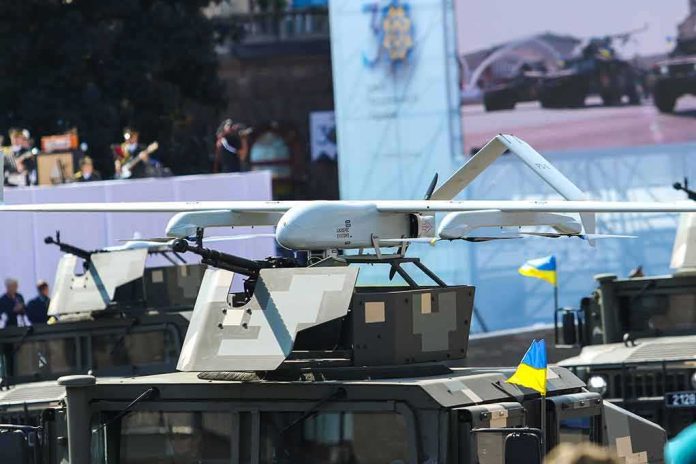
The most important lesson from Ukraine is not that drones have “won” war, but that they have made the battlefield so transparent, fast, and lethal that any force which does not integrate uncrewed systems, electronic warfare, dispersion, and rapid adaptation into its core doctrine will pay unsustainable costs.
The Short Version
- Drones, electronic attack, and cheap precision have upended the cost curve of combat — massed armor movement is often prohibitive without a counter-drone, counter-reconnaissance shield.
- Ukraine’s model shows drones work as a kill-chain enabler across surveillance, strike, and counter-UAS — not as a standalone substitute for combined arms.
- Professional militaries argue armor and infantry remain essential to seize and hold ground; the task is to evolve combined arms for the drone age, not abandon it.
- Allies are already codifying these lessons: interceptor drones, layered EW, doctrinal updates, and training exchanges to internalize Ukraine’s adaptations.
What Ukraine’s Drone War Actually Changed
Four years of high-intensity combat turned Ukraine into the world’s clearest laboratory for uncrewed warfare. The headline change is not a single platform; it is the speed and density of the sensor-to-shooter chain. First-person-view (FPV) quadcopters and fixed-wing scouts now saturate the airspace low to the ground, making any exposed movement — from tank thrusts to casualty evacuation — visible and targetable in minutes. Reuters reported that small FPV drones “dominate” the front and make armored movement “extremely risky,” a shift that has compelled many brigades to replace armor-led assaults with dispersed infantry actions supported by drones and artillery cued by unmanned surveillance.
This is a cost revolution as much as a tactical one. A $500–$2,000 FPV munition, networked with spotters and electronic warfare (EW), can mission-kill a vehicle worth millions; conversely, $2,000 interceptor drones can attrit incoming Shahed-class systems at scale within a multi-layered defense, relieving pressure on scarce air-defense missiles. The cheap, rapid, iterative cycle — build, jam, adapt, repeat — is the new muscle memory. Ukraine’s innovation engine has moved from a “hobbyist era” to an “industrialised autonomy” phase: standardized parts, codified tactics, and kill chains that run at machine speed, fusing uncrewed systems with human command and targeting data.
Mechanism: The Drone-EW Kill Chain, Not a Single Magic Bullet
Drones matter because they connect the battlefield’s sensing, deciding, and striking functions. Reconnaissance UAVs map trenches, EW emitters, and supply nodes; FPV teams execute point strikes; longer-range systems impose pressure deep in the enemy’s rear; and interceptor drones, jammers, and guns close the air-defense loop. Ukraine’s nationwide, layered counter-drone architecture — pairing EW, interceptor UAVs, and mobile guns — has achieved monthly interception rates recorded above 80 percent against massed raids, according to air force data compiled by a leading Ukrainian military charity.
Crucially, this is combined arms by other means. The “arms” are now sensors, software, EW, and loitering munitions as much as tanks and howitzers. Done properly, drones compress the sensor-to-shooter cycle, stretch the enemy’s logistics, and protect infantry by shifting risk onto cheaper, expendable machines. But they still sit inside a larger system that includes artillery, maneuver units, camouflage, deception, and engineering — the things that let you move under observation, breach, and hold.
Where the Real Disagreement Lies
The argument is not whether drones are decisive — they have already reshaped the character of combat in Ukraine; the argument is whether they replace or reframe combined arms. Western professional sources are clear: armor and infantry remain necessary to seize and hold terrain, while drones and EW make those formations more survivable, faster, and more lethal. West Point’s Modern War Institute emphasizes that uncrewed systems should reinforce — not displace — the protection, shock, and staying power provided by armored, infantry, and artillery formations. The Hoover Institution’s analysis is blunter: drones excel at exposing and striking, but they are “less useful in taking and holding ground”; machine guns and artillery still create a “killing zone” that demands protected maneuver to cross.
That view does not contradict Ukraine’s experience; it explains the adaptation imperative. If drones and sensors render massed movement suicidal, then the answer is not to shelve armor but to integrate counter-UAS, deception, remote breaching, and manned–unmanned teaming so armored thrusts occur under a tailored electronic and kinetic umbrella — smaller, quicker, better protected by obscurants and EW, and cued by real-time reconnaissance rather than by map graphics drawn days earlier.
Doctrine and Practice: From Improvisation to Codification
Ukraine’s practice has matured into systematized doctrine and force design. The army has fielded dedicated drone units at brigade level, routinized FPV employment, and integrated unmanned ground vehicles for logistics and casualty evacuation where exposure is deadly. International assessments describe the transition to an industrial-scale, multi-domain uncrewed ecosystem as a tectonic shift in employment, not a sideshow. This codification matters for allies: it is easier to transfer a system of practice — training syllabi, checklists, counter-reconnaissance battle drills, target-development workflows — than to transfer anecdotes.
Allied forces are already incorporating these lessons. The United States and partner militaries stress combined-arms evolution, not abandonment: update manuals, embed counter-UAS as a core task, and design formations and C2 networks that treat the drone fight — reconnaissance, strike, and protection — as a constant background condition for every movement and fire mission. Training exchanges reflect that shift: European troops have sought instruction from Ukrainian units on drone employment and air-defense integration at scale, underscoring the premium on practice honed under fire.
Operational information as of 22:00 on 16th September 2026 regarding the russian invasion
A total of 208 combat engagements have taken place since the beginning of the day.
The enemy launched 71 airstrikes, dropping 233 guided aerial bombs. In addition, it used 4,704 kamikaze… pic.twitter.com/x5qC4mKquR
— Генеральний штаб ЗСУ (@GeneralStaffUA) September 16, 2026
Implications for NATO and Other Modern Armies
First, procurement must chase cycle time, not just exquisite performance. Forces need families of attritable drones, interceptors, jammers, decoys, and rapid software updates as a continuous pipeline; the winner is the side that adapts faster per dollar spent. Second, command and control must assume persistent surveillance — dispersion, deception, electromagnetic discipline, and mobility are protection. Third, logistics and recovery deserve as much innovation as strike: unmanned resupply, robotic breaching and CASEVAC, and field-repair pipelines keep humans alive and momentum intact.
Finally, the strategic layer is now within reach of tactical units. Small teams with medium-range drones can hit depots, bridges, and oil infrastructure, imposing effects that used to demand aircraft or cruise missiles. That compression of strategic effect down to the battalion and below is powerful, but it does not negate the enduring requirement to take and hold ground; it changes how you create the conditions to do so at acceptable cost.
Bottom Line
Ukraine’s war shows a durable truth reframed for our era: combined arms still wins, but “combined” now means drones, EW, software, and decoys braided with armor, infantry, and artillery. Militaries that learn only the first half — buy drones — but fail to harden their forces, update doctrine, and train the counter-reconnaissance fight into every echelon will discover that transparency, not technology, is the decisive factor. Those that integrate the full kill chain, protect it, and iterate faster will dictate the terms of maneuver in a battlespace where being seen is often the same as being struck.
Sources:
reuters.com, defensenews.com, robertbrovdi.com, defstrat.com, smallwarsjournal.com, cnn.com, understandingwar.org, researchcentre.army.gov.au