
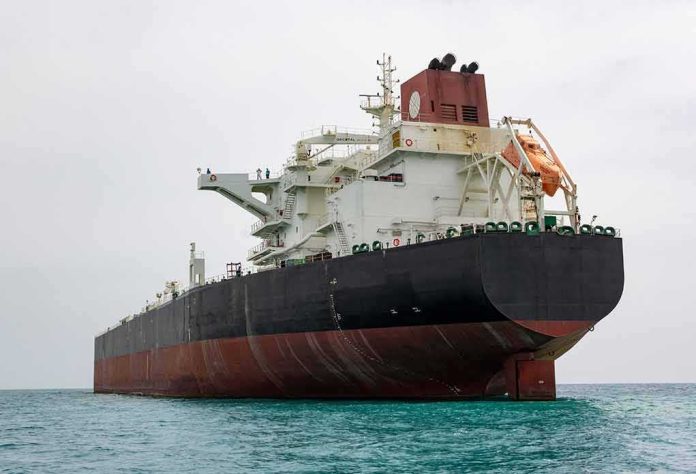
Oil markets do not require a complete closure of the Strait of Hormuz to be shocked; sustained, credible risk to ships—whether from drones, mines, or coerced routing—can slash effective capacity, reroute trade flows, and reprice risk globally almost as forcefully as a blockade.
At a Glance
- The Hormuz crisis produced the largest oil-supply disruption in modern energy-market history, according to the International Energy Agency, prompting a record emergency stock release.
- Attacks and coercive routing lowered crossings and crude flows through the strait, while freight costs and risk premia surged.
- Supply substitution—via pipelines, alternative ports, and ship-to-ship transfers—offset part of the shortfall, but at materially higher cost and with thinner margins for error.
- Iran’s attempt to assert control over Hormuz has not “closed” the waterway; it has made passage dangerous, intermittent, and more expensive—conditions markets treat as real constraint.
Why Hormuz Disruption Hits So Hard
The Strait of Hormuz is the world’s most consequential oil chokepoint because a disproportionate share of globally traded crude and condensates must pass through a narrow, surveilled corridor where alternative routes are scarce and expensive. When the strait’s operating risk rises, the market immediately prices not only barrels lost today but also the probability that tomorrow’s barrels arrive late, off-spec, or not at all. In 2026, the International Energy Agency (IEA) characterized the near-closure of Hormuz as the largest supply disruption in energy-market history and coordinated a 400-million-barrel emergency stock release to stabilize supply expectations. That intervention underlines the core reality: even if some barrels find other paths, the ensemble of delays, diversions, and insurance costs behaves like a supply shock.
Mechanically, that shock expressed itself in three channels. First, physical throughput fell. Independent trackers logged day-to-day collapses in crossings and a step-down in crude flows through Hormuz versus pre-war baselines—on some days to single-digit transits and to roughly three-quarters of normal crude volume, respectively. Second, risk repriced shipping. Very large crude carrier (VLCC) freight rates and war-risk premia spiked, with estimates equating the freight leg alone on Persian Gulf–to–China voyages to around a quarter of cargo value; spot rates on long routes ran multiples of prior norms as owners demanded compensation for attack risk, idle time, and circuitous routing. Third, oil benchmarks and physical grades reflected scarcity anxiety: Brent rallied sharply on days when attack counts rose and transits fell, a classic fear premium on marginal barrels.
Control Versus Disruption: What Iran Achieved—and Didn’t
Tehran and aligned groups claimed to exert operational control over Hormuz, reinforcing the narrative with attempts to redirect commercial traffic into Iranian waters and punitive strikes against noncompliant ships. A Congressional Research Service review documents this pattern—threats and actual attacks used to assert routing prerogatives after late February 2026. Iranian units publicly framed strikes on specific tankers as responses to “unauthorized” transit choices in the southern channel, an explicit attempt to redefine compliance and deterrence at sea. The evidence is clear that Iran could raise risk dramatically and shape ship master behavior; it is equally clear it could not reliably police the full waterway, interdict every convoy, or prevent alternative logistics from diluting its leverage. Disruption, not sovereignty, is the right term of art.
The distinction matters. Maritime law recognizes transit passage through international straits; insurance markets and naval coalitions operationalize that right. In practice, however, if operators face one attack per day somewhere in the corridor, many will avoid it, detour, or demand outsized premiums. That behavioral cascade is what we saw: day-level transits dropping to seven; a week with ten tankers struck; and a cadence of reported attacks across Hormuz and adjacent seas that kept risk elevated and unpredictable. The result is a de facto throttling of capacity without a de jure closure.
How the Market Rewired Around the Chokepoint
Energy systems carry redundancy—just not enough to painlessly replace Hormuz. The IEA and trade trackers describe a mosaic of substitutions: Saudi Arabia’s East–West pipeline and the UAE’s bypass infrastructure pushed more crude to Red Sea or Gulf of Oman load points; national oil companies staged cargoes at safer anchorages; and shippers leaned on ship-to-ship (STS) transfers to reconfigure routes outside the highest-risk lanes. On selected days in late September, regional crude exports even exceeded pre-war levels as barrels were pushed out through alternative ports and pipelines, driving a seven-day average near 18.5 million barrels per day at one point. Exports from the Gulf of Oman coast and the Red Sea increased to roughly 6.7 million barrels per day, cushioning the hit from Hormuz.
None of that is costless. STS transfers multiply handling risk, lengthen cycle times, and tie up tonnage; pipelines have finite spare capacity and upstream–downstream mismatches; and not every crude grade enjoys an easy substitute at refineries engineered for specific slates. The scarcity migrated from molecules to means of transportation: tanker availability tightened, freight costs ballooned, and physical differentials widened as buyers paid more to secure barrels delivered, not just barrels sold. That combination explains why, even as the IEA later judged that “there is plenty of oil in the market” and saw no need for a fresh coordinated stock draw, prices and spreads still reflected elevated logistics risk.
Precedent and Pattern: Lessons from the Tanker War
The 1980s Iran–Iraq “Tanker War” offers the right lens. Then, as now, hundreds of ships were attacked over years, insurance costs soared, and navies escorted convoys; yet Hormuz never stayed shut for long, and Gulf exports persisted at reduced efficiency. The historical through-line is that a state can make a strait hazardous without sustainably monopolizing it. Modern trade patterns and weapons elevate both the stakes and the options; drones, precision munitions, and networked surveillance complicate defense, while pipelines and alternative ports provide partial relief. The 2026 episode fits that pattern—more technologically complex, not fundamentally different.
What Risk-Conscious Investors and Policymakers Should Watch
Four variables determine how long disruption translates into durable price elevation. First, attack cadence and geography: a steady drumbeat in Hormuz and spillover into the Gulf of Aden and Red Sea stretches naval coverage and insurance tolerance simultaneously. Second, logistics elasticity: how quickly Saudi and Emirati pipelines, Red Sea terminals, and Oman-facing ports can add marginal barrels without choking on storage and berth constraints. Third, tanker fleet dynamics: high daily rates and hazard pay bring older hulls back into service, but safety margins shrink and accident risk rises, which can create secondary disruptions and environmental costs. Fourth, policy buffers: the scale and timing of strategic stock releases, sanctions enforcement, and convoy posture all change the market’s perceived floor and ceiling for supply risk.
These levers also explain the apparent contradiction in the record. Both statements can be true: the shock was historically large—big enough to warrant the biggest-ever emergency stock action—and yet, weeks later, substitution and stocks left “plenty of oil in the market” in the IEA’s assessment. The first speaks to the severity and speed of the constraint; the second to the system’s adaptive capacity once prices, policy, and operators respond.
Bottom Line
Iran’s bid to dictate terms in the Strait of Hormuz did not close the artery, but it did what markets fear most: it made the arrival of seaborne barrels less certain and more expensive. The result was a shock delivered through operational risk, not a legal blockade—a form of pressure that history suggests can persist and that pricing mechanisms will continue to respect. For planners and portfolio managers alike, the prudent stance is not to ask whether Hormuz is “open” or “closed,” but to measure how much cost and delay the system is absorbing to keep barrels moving—and how thin the margin has become for the next surprise.
Sources:
cnbc.com, aljazeera.com, reuters.com, iea.org, edition.cnn.com, businessday.ng, iranintl.com, oilprice.com, rnz.co.nz, eia.gov, time.com