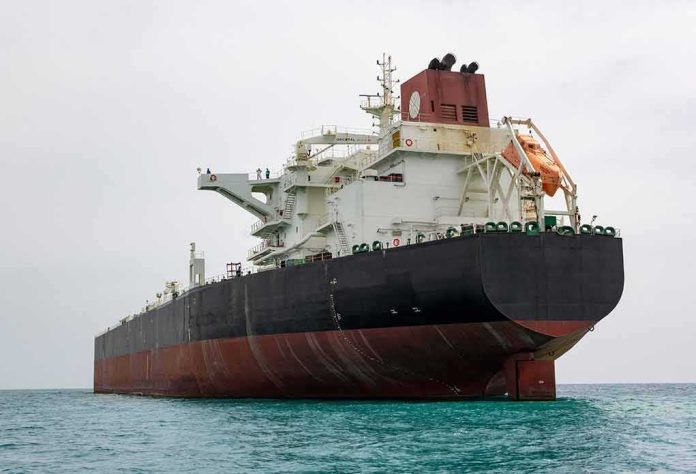
Sanctions policy collides with pocketbook reality when fuel markets tighten; the Russian diesel episode shows how quickly Washington can pivot from isolation to accommodation once the arithmetic of supply, logistics, and election-year prices asserts itself.
The Short Version
- Treasury issued a time-limited authorization allowing transactions in Russian diesel, creating a formal channel rather than a mere political promise.
- President Trump outlined multi-million-ton supply tranches after a call with President Vladimir Putin, positioning the move as price relief for U.S. consumers and global markets.
- Analysts broadly doubt the volumes can materially move U.S. diesel prices; they emphasize scale, timing, logistics, and Russia’s ability to deliver.
- The real test is operational: cargo specs, routing to constrained regions, and measurable pass-through to farm and freight costs, not headline tonnage.
What actually changed: from policy signal to a legal pathway
The decisive step was regulatory, not rhetorical. The administration relied on the Treasury Department to issue a temporary, general license that permitted U.S. persons to transact in specified Russian diesel through early spring, moving the proposal from press lines into compliance binders at banks, traders, and shippers. In sanctions practice, a general license is the on-ramp: it clarifies counterparty scope, settlement mechanics, and due-diligence expectations so commercial actors can lift, finance, insure, and clear cargoes without fear that a subsequent audit turns their invoices into evidence. Without it, even a presidential announcement rarely unlocks barrels at scale; with it, trade desks can at least model feasibility against freight, insurance, and basis spreads.
This is where the diesel story departs from political theater. A general license does not guarantee cargoes will sail, but it makes them legally possible. For a market as operationally conservative as refined products—obsessed with specifications, delivery windows, and credit terms—that distinction matters.
The promise in tons versus the reality in barrels
Trump’s schedule was ambitious on paper: more than 300,000 tons “immediately,” 500,000 tons in November, then roughly 1 million tons thereafter, with a further 3 million tons conditional on Russian refinery status. Even granting those figures, the scale question looms. Analysts quickly translated the first tranche into market-relevant units: roughly under 100,000 barrels per day—about 2% of U.S. daily diesel consumption—if sustained, and only slightly more than half a day’s U.S. distillate demand when viewed as a lump sum. Others estimated the total announced supply through year-end at perhaps a 5% to 6% lift—helpful but not a needle mover for global pricing dynamics.
These are not idle quibbles; they are how refined-products markets adjudicate hype. Diesel price formation reflects global crude slates, refinery yields, regional inventory balances, and distribution bottlenecks. Scale and cadence, not just nominal totals, determine whether a new flow dents the marginal gallon’s price. On that count, the expert consensus is consistent: a modest, time-limited increment can soften local tightness, especially in import-dependent regions, but is unlikely to reset a national price curve absent larger, steadier volumes.
Mechanics matter: getting molecules to where prices are set
Diesel is a logistics story disguised as geopolitics. The East Coast (PADD 1) chronically consumes more distillate than it produces, making it structurally sensitive to import flows, refinery outages, and Atlantic Basin freight. In that context, an additional stream can ease differentials in New York Harbor or Philadelphia if it arrives on-spec, on-time, and priced through to wholesalers. But several blanks remain in the public record: named buyers, port lineups, blending requirements, and terminal allocations have not been disclosed. Analysts also questioned Russia’s ability to deliver the promised volumes given refinery damage from wartime strikes and periodic restrictions on diesel exports to contain domestic shortages. Timing slippage would blunt price effects; diversion to non-U.S. buyers would erase them.
Even with a license in hand, commercial execution faces real constraints. Chartering suitable product tankers, securing insurance consistent with sanctions compliance, scheduling discharge slots at congested terminals, and ensuring the cargo specification aligns with U.S. distribution needs are not formalities. They are the work. Without those logistics lining up—and lining up repeatedly—the announced supply remains a headline, not a basis differential.
The sanctions tension: why energy carve-outs keep reappearing
This move sits inside a longer-running contradiction. Energy sanctions aim to constrict an adversary’s revenues, yet removing a large producer’s molecules from preferred markets raises price volatility and, in turn, domestic political pressure to relax restrictions. The past several years have shown that oil and product sanctions rarely eliminate flows; they reroute them at discounts, through alternative logistics chains, to buyers more tolerant of risk. The strategic question, therefore, is not whether additional diesel exists globally but whether the United States can lawfully and credibly redirect enough of it to the precise chokepoints where delivered prices are set, without supercharging the very revenue streams sanctions targeted.
That is why the general license is bounded in time and scope, and why the administration framed the step as a relief valve rather than a wholesale reversal. Still, congressional critics cast the move as a betrayal of Ukraine policy and a subsidy to Moscow, and that political framing will shadow any measured price relief at the pump. Energy policy rarely escapes geopolitics; it must be managed through it.
Where the disagreement is real—and what would settle it
There is no meaningful dispute that Treasury opened a legal pathway and that Trump personally touted a multi-tranche schedule after speaking with Putin. The contention lies in impact. Skeptics argue the quantities are too small and too uncertain to matter for national pricing; absent sustained flows, they predict, the effect will be local, brief, or both. Proponents counter that in a tight market, marginal barrels can have outsize effects, especially in import-reliant corridors where wholesale rack prices set retail trajectories.
The evidence that would resolve this is straightforward and empirical: bills of lading tied to U.S. terminals; Energy Information Administration import tallies that isolate Russian-origin diesel by month; and a transparent before-and-after analysis of wholesale and retail diesel prices in the East Coast and other targeted regions. If the announced 3 million tons contingent on refinery conditions never materializes, the case for lasting price impact collapses on its own terms. If, however, multiple tranches clear U.S. customs and wholesale spreads compress relative to Gulf Coast benchmarks and European ICE gasoil, the market effect becomes measurable rather than conjectural.
Trump strikes diesel deal with Russia in reversal of years of U.S. pressure over Ukraine war: President Trump announced Friday he has reached an agreement with Russian President Vladimir Putin to supply the U.S. with diesel fuel, starting with more than… dlvr.it/TVrwgn pic.twitter.com/Da3oc1c918
— Quartz (@qz) October 9, 2026
Implications for farmers, truckers, and policy going forward
For fuel-intensive sectors, the relevant question is not who supplies the diesel but whether delivered cost declines in time to change budgets and bids. Farmers and truckers buy the price, not the press release. If the authorized flows consistently land in the regions where diesel scarcity translates into punitive basis premiums, even a few percentage points of price relief can matter in thin-margin operations. If they do not, the episode becomes a case study in the limits of sanction flexibility during commodity tightness: politically visible, operationally constrained, economically marginal.
Sources:
pjmedia.com, cnbc.com, wftv.com, rmb.reuters.com, yahoo.com, economictimes.indiatimes.com, ttnews.com, ground.news, carijournals.org