
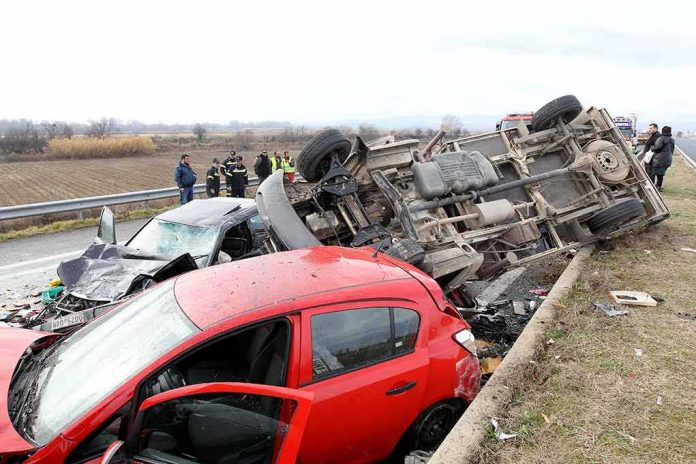
The essential fact in this case is not the lurid allegation but the clock: investigators say a driver’s phone was on a pornographic-video site less than two minutes before she rear-ended a slowing car in a construction zone, triggering a three-vehicle crash that killed a man—an allegation grounded in a warrant-backed forensic extraction and now charged as automobile homicide tied to handheld-device use.
At a Glance
- Charging documents say a phone forensic exam found access to xvideos.com under two minutes before a fatal I-15 crash near Levan, Utah.
- Prosecutors charged second-degree-felony automobile homicide while using a handheld device; the sequence described is a classic failure-to-notice-slowing-traffic rear-end impact in a construction zone.
- The collision killed a 66-year-old Fillmore man and involved three vehicles pushed off the roadway.
- While the allegation is sensational, the core public-safety issue is distraction behind the wheel; nationally, hundreds of fatal crashes each year involve reported cellphone use.
What the charging documents say happened on I-15
According to multiple outlets that reviewed the court filings, the state’s case rests on a straightforward narrative supported by digital records and crash sequence. On June 12, 2026, northbound on I-15 near Levan, traffic had slowed for construction. Investigators say the defendant, driving a blue SUV, failed to perceive the slowdown and struck a white sedan ahead. The force pushed that sedan into a black SUV; all three vehicles left the roadway. A 66-year-old man from Fillmore died as a result. The key evidentiary claim appears in the charging documents: a warrant-based examination of the driver’s phone found access to the adult site xvideos.com less than two minutes before the impact.
That timing anchors the state’s theory of distraction: recent, purposeful phone activity just before a classic rear-end crash in a reduced-speed work zone. Prosecutors filed a second-degree-felony count of automobile homicide while texting, emailing, or using a handheld device—Utah’s statutory framework for lethal outcomes tied to unlawful device use behind the wheel.
How investigators build a digital distraction case
In a modern traffic-fatality investigation, “phone use” is not a hunch; it’s a forensics workflow. Detectives seek a search warrant; once granted, analysts image the handset or pull targeted artifacts—browser history, app logs, cached media, and system events such as screen-on timestamps, touch inputs, and network requests. The reference to a “phone examination pursuant to warrant” signals that investigators had that legal authorization and derived the “less than two minutes” finding from on-device records rather than a witness recollection. In parallel, the crash team documents scene geometry, impact points, crush profiles, and any pre-impact braking or avoidance. Here, the reported sequence—rear-end in a traffic slowdown, energy transfer pushing the lead vehicle forward—tracks with a failure-to-notice scenario rather than, say, a loss-of-control skid or a sudden mechanical failure.
Critically, the legal theory does not require that a video be playing at the instant of contact; it requires proof of unlawful handheld use causally contributing to the fatal outcome. The access timestamp, the construction-zone context, and the absence of braking described in similar cases often form the spine of that proof in court. The reported filings stop at the access timing, not the granular telemetry of screen states or touch sequences; those details typically surface later in discovery and motion practice.
Why construction zones heighten the stakes
Work zones compress margins. Lanes narrow, sightlines change, and speed gradients steepen as traffic oscillates from freeway pace to platoons of brake lights. Rear-end collisions are the predictable failure mode when a driver’s visual and cognitive bandwidth is siphoned away. That is why statutes and enforcement posture are particularly unforgiving about handheld-device use in these contexts, and why prosecutors are comfortable linking recent phone manipulation to causation when the crash mechanism is a clean rear-end into slowing traffic. The charging decision here signals confidence that the device-use evidence aligns with that mechanism and timing.
The allegation’s sensational framing and the public-safety core
Headlines have stressed pornography—a guaranteed attention hook—but the public-health issue is distraction. Whether a driver scrolls social media, checks email, or taps into adult content, the risk pathway is the same: eyes off the road, mental workload diverted, and time-to-collision evaporating. Nationally, distraction accounts for roughly 8% of fatal crashes in recent years; within that, hundreds of fatal crashes annually are reported as involving cellphone use, underscoring the frequency with which devices figure into deadly outcomes. The pornographic nature of the site is not what makes the behavior dangerous; the handheld, interactive use while approaching slowed traffic does.
Focusing on the salacious detail can obscure the mechanics jurors and judges weigh: what the driver was doing with the device, when, and how that activity plausibly displaced the attention and reaction time needed to avoid a foreseeable hazard. The state’s quoted timeline—within two minutes of impact—lands well inside the window during which drivers should be scanning, recognizing brake lights, and modulating speed in a work zone.
What prosecutors must establish, and what often carries the day
In a felony automobile-homicide-by-device-use case, three pillars typically matter. First, unlawful use: evidence of handheld manipulation (as opposed to passive, hands-free audio) proximate to the crash. Second, causation: a coherent link between that use and a failure in the driving task—most often no braking, late braking, or lane-departure without corrective input. Third, foreseeability: a context in which an attentive driver would have had a reasonable opportunity to perceive and respond. The reported facts—recent site access per a warrant-backed exam, a rear-end sequence in a construction slowdown, and a resulting fatality—map neatly to that triad.
Defense arguments in this category of case often probe the timeline granularity and alternative contributors—visibility, sudden stops ahead, or mechanical issues. Those are litigated on the strength of crash reconstruction, event data recorders, and more detailed device logs. The charging posture here suggests investigators found the alignments they needed to proceed; the specifics will be tested under the familiar standards of proof.
🚨 WOMAN ALLEGEDLY WATCHING PORN WHILE DRIVING CAUSES DEADLY CRASH IN UTAH!
Meet Christine Chao, 44, of Rosemead, California, who has been charged with automobile homicide following a deadly three-vehicle crash on Interstate 15 in Utah. According to charging documents,… pic.twitter.com/tKo1fR9URt
— Final Boss Jay (@FinalBossJay) October 21, 2026
Why this matters beyond one case
The broader pattern is stubborn. As vehicles add crash-avoidance technology, human attention remains the irreducible safety system; when it fails, modern mass and speed do the rest. The national numbers remain flat to only slightly improving despite years of messaging and laws constraining handheld use. In 2024, for example, federal analysts attribute hundreds of fatal crashes to cellphone distraction, a grim tally that tracks with prior years and illustrates how small attention lapses can become irreversible within seconds. The Utah charges are thus part of a larger trend: post-crash digital forensics translating personal device behavior into evidentiary timelines that juries can understand.
Sources:
washingtontimes.com, usatoday.com, hoodline.com, ibtimes.co.uk, yahoo.com