
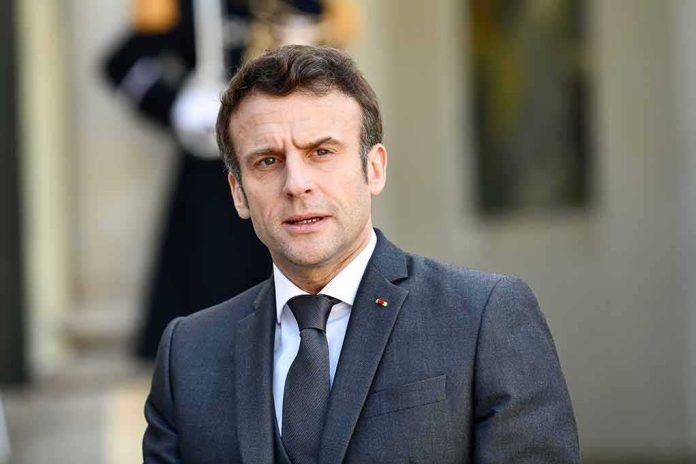
A head of state’s leisure time becomes a political liability the moment it collides, even by accident, with a nation in visible distress — and that is precisely what happened to President Emmanuel Macron on the weekend of October 16 and 17, when images of him and Brigitte Macron enjoying a Céline Dion concert circulated alongside footage of burning buildings and tear gas in the streets of Paris.
Key Points
- Macron and Brigitte Macron were seen at a Céline Dion concert at the Plénitude Arena in Nanterre on Friday, October 16, hours before nationwide demonstrations turned violent the next day.
- French authorities counted roughly 550,000 marchers nationwide while organizers claimed closer to 800,000, with unrest reported in multiple cities including arson and clashes with police.
- Backlash spread quickly on social media, with critics invoking Marie Antoinette and “Nero fiddles” comparisons to characterize the couple as indifferent to the crisis.
- No released schedule, security briefing, or official statement has established what duties, if any, the concert displaced, or what Macron knew about the risk of violence when he attended.
- The episode fits a recognized pattern in how media coverage of protest movements tends to foreground spectacle and disorder over the underlying grievances driving the unrest.
What Happened, in Sequence
The timeline is not in dispute. On the evening of Friday, October 16, the Macrons attended a Céline Dion performance at the Plénitude Arena in Nanterre, watching from a private box. Multiple outlets reported Brigitte Macron singing along and dancing, with the president reportedly clapping and enjoying the show beside her. Less than twenty-four hours later, France experienced one of its largest demonstration days of the year, with marches in Paris and other major cities over cost of living, education funding, and broader inequality grievances.
By Saturday the demonstrations had curdled into confrontation in several locations. Police deployed tear gas and water cannon in Paris; fires and property damage were reported in multiple cities, including damage to a historic town hall whose clock tower reportedly collapsed amid the flames. The Interior Ministry put the national turnout at approximately 550,000, while organizers insisted the real number approached 800,000 — a routine discrepancy in how French authorities and protest organizers count crowds, but one that nonetheless left room for dueling narratives about the scale of the mobilization.
Why the Imagery Landed the Way It Did
Politics runs on contrast, and few contrasts write themselves as cleanly as a president swaying to a pop diva while tear gas drifts through the streets of his own capital. The criticism that followed was immediate and pointed: social media users and commentators invoked Marie Antoinette, the queen famously associated — however apocryphally — with indifference to a starving population, and compared Macron to Nero fiddling while Rome burned. These are not fringe reactions confined to a single outlet; the comparison surfaced across British, American, and French-language coverage alike, suggesting the imagery tapped something broader than partisan animus toward Macron specifically.
It matters here that the concert preceded the worst of Saturday’s violence. Macron was not dancing while buildings burned in real time; he was at a scheduled cultural event the night before escalation occurred. That distinction does not erase the political cost of the optics, but it does complicate the more inflammatory framing — the sense that a leader was visibly carousing as his country burned around him in the same moment. The outrage, in other words, was real and well-documented; the precise causal story some critics told about it was somewhat looser than the viral framing implied.
What the Record Does Not Yet Establish
No published Élysée schedule, security briefing, or official statement has surfaced to clarify what Macron knew about the likelihood of unrest when he chose to attend, whether the concert displaced any scheduled crisis meeting, or whether he was in continuous contact with his interior minister and security services throughout the evening. The reporting that exists documents attendance, visible enjoyment, and public reaction — it does not document intent, scheduling conflicts, or operational failures on Macron’s part. That gap is worth naming plainly, because it is the difference between a legitimate perception problem, which this unquestionably is, and a demonstrated dereliction of duty, which has not been shown by the available record.
Numerical precision around the unrest itself has also varied across outlets — arrest figures ranging from several hundred to over two thousand depending on the source and the day counted, and march estimates spanning a 250,000-person gap between ministry and organizer counts. These discrepancies are typical of fast-moving civil unrest reporting rather than evidence of fabrication, but they counsel some caution before treating any single number as definitive.
Where's Macron? French leader blasted for attending concert as riots escalated
President Emmanuel Macron faces questions over his response to widespread unrest in France after attending a Celine Dion concert the night before demonstrations escalated into violence
French… pic.twitter.com/QPNfMDteAH
— American Politic (@rosewdc) October 18, 2026
The Larger Pattern: Spectacle Versus Substance in Protest Coverage
Scholars who study how media cover mass demonstrations have identified a durable pattern often called the “protest paradigm”: coverage tends to gravitate toward riot and confrontation frames — fires, arrests, clashes with police — rather than the “debate” frame that centers protester grievances and demands. Cross-national research examining more than 1,400 protest articles found this tilt toward spectacle to be consistent across countries and media systems, not a quirk of any one outlet’s politics. Applied here, the Macron concert story is almost a textbook case: a single photogenic contrast — a dancing president, a burning town hall — generated far more coverage and emotional charge than the underlying grievances about teacher shortages, school conditions, and the cost of living that actually drove hundreds of thousands into the streets. The image is memorable precisely because it simplifies a complicated crisis into a morality tale, which is also why it should be weighed alongside, not instead of, the substantive questions the protests were raising.
Sources:
humanevents.com, lbc.co.uk, breitbart.com, noticias.foxnews.com, en.haberler.com