
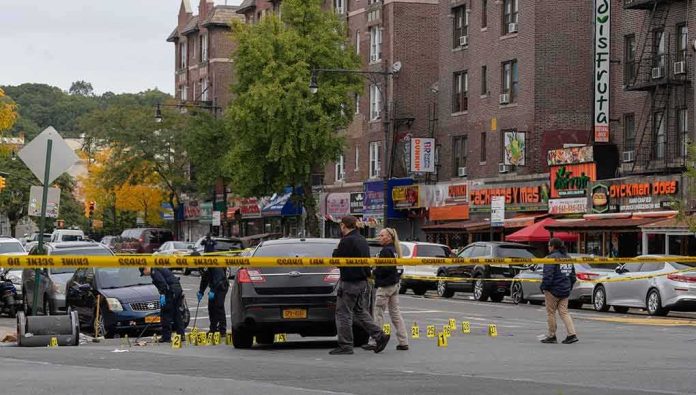
Swift, specific, and consequential: within roughly 48 hours of a chaotic burst of gunfire outside Florida A&M University’s homecoming, Tallahassee police arrested a 15-year-old and a judge ordered secure detention, converting a fluid emergency response into a defined criminal case with adult-court stakes.
At a Glance
- Police arrested 15-year-old Anthony Rivers III about two days after the shooting near FAMU’s Bragg Memorial Stadium.
- Rivers faces 11 counts of attempted second-degree murder and a firearm charge tied to delinquency.
- A judge ordered secure detention; the state attorney says the case will proceed in adult court.
- The incident injured 12 people, 11 by gunfire, after an altercation just before 8 p.m. near Perry and Manatee Streets.
What police say happened and how the case took shape
Just before 8 p.m. on October 24, gunfire erupted near the intersection of Perry Street and Manatee Street, steps from Florida A&M University’s Bragg Memorial Stadium as homecoming festivities wound down. Police and city officials described a fast-moving scene: 12 people were injured, including 11 with gunshot wounds; victims included both adults and juveniles, with one child as young as 11 among the seriously hurt. Within approximately 48 hours, Tallahassee Police Department detectives arrested 15-year-old Anthony Rivers III and announced charges calibrated to the number of gunshot victims: 11 counts of attempted second-degree murder and one count of possession of a firearm by a delinquent.
Authorities characterized the episode as an altercation involving two or three individuals that escalated into gunfire, not a targeted attack on specific victims; some of those struck were not believed to be intended targets. The stated location and timing—Perry and Manatee, just before 8 p.m., after the homecoming game—are unusually precise for first-wave public disclosures, reflecting the density of officers and cameras around a major university event and the urgency of crowd management in the moment.
From arrest to courtroom: the rapid procedural markers
Arrest announcements are one thing; judicial action is another. On October 26, Leon Circuit Judge Andrew Sheeran ordered Rivers held in secure detention under Florida’s statutory criteria for violent felonies pending further proceedings. That decision created an independent procedural anchor beyond police statements. Soon after, State Attorney Jack Campbell made clear the case would be prosecuted in adult court, with Rivers transferred from the Juvenile Assessment Center to the Leon County Detention Facility—an inflection that materially alters exposure, discovery practice, and eventual sentencing possibilities if there is a conviction.
Those steps—swift arrest, specific charging, judicial detention, and an adult-court declaration—are the sequence that turns an emergency into a defined case trajectory. In major, public-facing incidents, this cadence matters: it reassures a rattled community, signals investigative momentum, and sets expectations for the timeline ahead as discovery, hearings, and potential plea negotiations begin.
Charges, counts, and what they signify
Eleven attempted second-degree murder counts track the law’s recognition that each person struck by a bullet can constitute a separate victim and charge when prosecutors allege a depraved-mind act—intent to kill is not required for this offense tier, but an imminently dangerous act evincing a depraved mind regardless of human life is. The additional firearm-by-a-delinquent count reflects status-based firearm prohibitions for juveniles previously adjudicated delinquent for qualifying offenses. In mass-injury shootings, charge arithmetic commonly follows victim-by-victim harm; prosecutors will later align each count with a named victim and injury in formal filings and, if needed, at trial.
Public reports have described the injury total as 12, with 11 gunshot wounds and one person injured while fleeing; some headlines simply cite 11 injuries. The distinction is not unusual in early coverage of large, chaotic scenes. In this case, authorities consistently attribute 11 counts of attempted murder to the 11 gunshot victims; the twelfth injury, by description, does not map to an attempted-murder charge.
15-year-old Anthony Rivers III has been arrested and charged with 11 counts of attempted murder after an open-air mass shooting during Florida A&M Homecoming, injured 11 people, including six children
🎥 WPLG pic.twitter.com/OLcUNLwbmx— HBCU Premier Sports More (@HBCUSports1) October 27, 2026
Location, crowd dynamics, and the police response
The geography matters. Perry and Manatee sit in the shadow of Bragg Memorial Stadium, where homecoming swells foot traffic, vehicle flow, and ad hoc gatherings—conditions that both complicate crowd control and, paradoxically, accelerate evidence development. On-scene officers reported immediately moving victims to ambulances and ATVs through dense crowds. In such settings, the same crowd density that elevates risk also increases the chance that multiple video angles, license-plate readers, and stadium-adjacent cameras captured movements before and after shots were fired. That combination often explains how investigators can identify a suspect, assemble probable cause, and secure an arrest within days rather than weeks.
Juvenile defendant, adult court: why prosecutors make that call
Florida law permits transferring serious violent felonies to adult court for juvenile defendants, particularly in cases involving multiple victims and firearms. Prosecutors weigh the gravity of the harm, the defendant’s age and prior record, and the availability of juvenile dispositions that would both protect the community and provide a credible path to accountability. State Attorney Jack Campbell’s statement that the case will proceed in adult court signals a view that the statutory thresholds are met and that adult sanctions, if proven, are warranted. That shift also expands procedural rights and obligations—jury size, sentencing ranges, and discovery rules differ materially from juvenile proceedings.
How this fits a recurring pattern in mass-casualty shootings
High-casualty incidents reliably generate rapid attribution and intense public attention, particularly when children are among the wounded and the event unfolds near a school or stadium. Communication research is clear: the framing of initial coverage shapes how audiences assign responsibility and evaluate policy responses; that salience effect can persist well beyond the first week’s headlines. In Florida’s capital, that dynamic has another lever—surveillance and public-safety infrastructure. Following the arrest, Campbell publicly urged expanded surveillance coverage to aid future investigations, illustrating how a single event can become a catalyst for local policy advocacy.
What to watch as the case advances
From here, the milestones are predictable. Formal charging decisions will be filed in adult court, aligning each attempted-murder count with a specific victim. Detention review and arraignment will set the early calendar. Discovery—witness statements, video, forensic submissions—will determine whether the case resolves by plea or proceeds to motions and, potentially, trial. Authorities have indicated the investigation remains open, a standard formulation in multi-victim shootings that allows for additional arrests if evidence supports them. One practical note belongs here and no more: an arrest is an allegation; adjudication happens in court.
Sources:
townhall.com, tallahassee.com, abcnews.com, fox29.com, wfla.com, detroitnews.com, news.wfsu.org, miamiherald.com, jmvr.org, pmc.ncbi.nlm.nih.gov