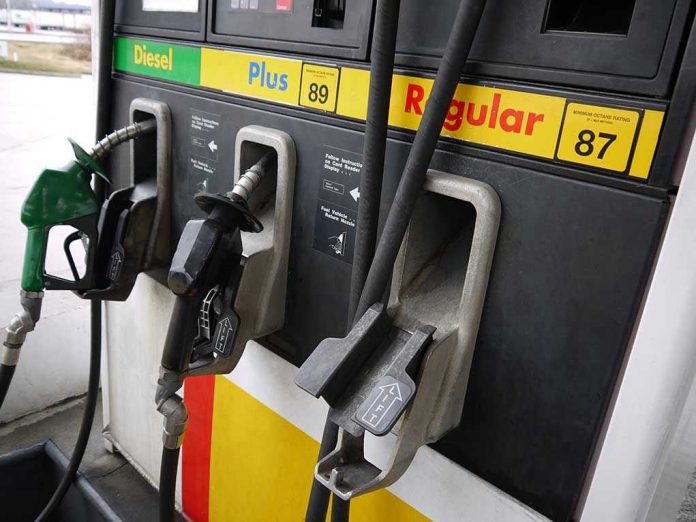
When diesel crosses $6 a gallon, it doesn’t merely sting at the pump; it rewrites farm math in the narrow, high-horsepower windows when crops must be planted, harvested, hauled, and dried—compressing margins and cascading costs through the food supply chain.
At a Glance
- National average diesel prices around $6 per gallon raise per-acre fuel costs materially at harvest and planting.
- Farmers are price takers on both inputs and many crop sales; diesel spikes squeeze margins rather than simply “passing through.”
- Seasonality amplifies impact: concentrated fuel use during brief fieldwork windows magnifies each 25–50 cent move.
- The pattern is recurrent: diesel shocks in 2007–2008, 2021–2023, and 2025–2026 echo through USDA’s historical series.
What $6 Diesel Means on a Working Farm
Diesel is the workhorse energy input in modern row-crop and livestock operations. Tractors, combines, sprayers, grain carts, irrigation pumps, semis, and on-farm generators all run on it. That ubiquity is why the national average price breaching roughly $6 per gallon is not an abstract headline; it is a line item that moves immediately and significantly at scale. Concrete arithmetic explains the stress. Field operations consume gallons per acre that add up quickly. A widely cited back-of-the-envelope example: at 3 gallons per acre, $3 diesel costs $9 per acre; at $6, that doubles to $18—an extra $9 per acre. Multiplied across a 500-acre corn-and-soy rotation, that’s $4,500 more in fuel outlays before a single bushel is sold.
Multiply again by operation size and by the fact that harvest involves multiple diesel-intensive passes—combining, hauling to bins or elevators, running grain dryers where needed, fall tillage on conventional systems—and the sensitivity becomes obvious. The pain is not uniform; no-till adopters and operations with newer, more fuel-efficient power units see less burn per acre than heavy-till or older fleets. But when the national average crests $6, even efficient operators feel it in cash flow and working-capital drawdown, precisely when liquidity is most taxed by custom work bills, trucking, and storage charges.
The Price Spike Is Real, and It’s Broad
Recent reports place the U.S. average diesel price near $6.05 per gallon, a record-setting level driven by tight global refining capacity and geopolitical shocks that pushed the diesel-to-gasoline spread wider than usual. California’s on-road prices soared even higher, reflecting regional fuel specifications and supply constraints that amplify any national move. This is not merely a truckers’ issue; rail, construction, agriculture, and warehousing all ride on diesel—and so do the freight surcharges that ripple into input deliveries and outbound grain movement. AAA-tracked retail levels are the sticker price farmers see; wholesale “dyed” farm diesel—off-highway, taxed differently—typically sits lower than the retail pump but lifts in tandem, leaving on-farm budgets exposed when the national series surges.
USDA’s agricultural transportation dashboards and market reports document the arc of these spikes over time. The series shows repeated shock episodes rather than a one-off aberration: the mid-2000s commodity boom, the 2021–2023 run-up, and a renewed surge in 2025–2026. That history matters for planning: volatility, not just level, is the risk to be managed. Farm businesses built around thin, cyclical margins cannot wish away the tailrisk that fuel will jump precisely when machinery must roll.
Mechanics: How Diesel Costs Flow Through the Farm P&L
Fuel intensity clusters in time. Spring planting windows open and close on weather; fall harvest must happen when grain is at the right moisture and fields are navigable. Because those windows are short, farms transact large volumes of diesel in a matter of weeks. That timing magnifies the budget effect of a sudden $0.40–$1.00 swing. The accounting is straightforward: per-acre fuel use by operation (tillage, planting, spraying, harvesting) multiplied by per-gallon price equals direct variable cost; add transport to elevator or processor, and, for many, dryer fuel. University fieldwork and farm management notes have long quantified this gradient—double the per-gallon price and per-acre fuel costs roughly double for the same operation set. Even modest increases shift breakeven prices by measurable cents per bushel, depending on the crop and yield.
Farmers are price takers twice: they buy diesel at market and they sell grain into markets they do not control. Hedging tools can lock in crop revenues or, separately, some diesel exposure via distillate futures or fixed-price contracts, but basis, timing, and credit constraints limit perfect hedges in real life. Many producers instead manage exposure with operational choices—reduced tillage, fewer passes, route optimization for grain hauling, or postponing discretionary fieldwork. Those tactics help at the margin; they do not erase a structural doubling of the per-gallon price in a critical month.
Beyond the Farm Gate: Freight Surcharges and Food Prices
The diesel story does not end at the edge of the field. Grain still has to move—by truck to local elevators, by rail or barge to processors and export terminals—and every link prices fuel into freight. Shippers and carriers typically adjust fuel surcharges weekly based on published on-highway diesel benchmarks; when those benchmarks spike, surcharge lines fatten. The result is a wider “farm-to-fork” wedge: processors pay more to secure inputs and to ship finished goods, retailers see distribution center costs climb, and consumers encounter higher shelf prices, especially for bulky or heavy products where fuel is a larger share of delivered cost.
Empirically, surcharges and restocking cycles mean there is lag in pass-through. Businesses with inventory bought when diesel was cheaper feel less immediate pain; the hit arrives when they reorder at higher freight costs. That staging effect is why a prolonged period near $6 has outsized consequences compared with a brief spike—more contracts reprice, and more of the supply chain resets to the new level.
Why This Keeps Happening: Structure, Not Surprise
Diesel price shocks are a feature of the fuel’s market structure. Middle distillates depend on refinery configuration and global trade flows; outages, wars that disrupt shipping lanes, and maintenance seasons can tighten supply even when crude is available. The “diesel premium” over gasoline expands when global freight and industrial demand are strong or when middle-distillate yields are constrained. A two-decade look at the diesel-to-gasoline spread shows distinct periods where that premium jumped—2007–2009, and again in the early- and mid-2020s—raising the floor under farm diesel costs despite any relief at the gasoline pump.
For producers, the lesson is strategic. The fuel curve will move; the only controllables are exposure and resilience. Operations that invest in more efficient engines, adopt fewer-pass systems where agronomically appropriate, and build supplier relationships that allow staged purchasing or seasonal pre-buys tend to absorb shocks better. None of that immunizes a fleet from a national average above $6, but it narrows the damage window and preserves optionality when weather cooperation is scarce and credit is tight.
Rising diesel prices, driven by global tensions and refining limits, could escalate costs for farmers and impact consumer prices, experts and officials warn. https://t.co/stCFDaqrvx
— 13 On Your Side (@wzzm13) September 12, 2026
Practical Playbook: Managing Through $6 Diesel
Three tactics consistently pencil out. First, measure precisely—actual fuel burn by operation and field. Precision telematics often reveal avoidable passes or idling time that add up to whole-digit percentages saved over a season. Second, time procurement—coordinate on-farm tank fills ahead of the tightest windows when storage and cash allow, using supplier quotes indexed to USDA or EIA benchmarks to reduce guesswork about relative value. Third, align logistics—maximize backhauls, consolidate partial loads where it does not compromise grain quality, and route to the most efficient outlet even if the nominal bid is a few cents lower; in a high-surcharge world, netbacks, not posted bids, decide farm revenue. Extensions and producer groups have published worksheet-grade comparisons that show how a few gallons per acre saved, or a few miles per ton trimmed, can offset a surprising share of the price shock when multiplied across hundreds or thousands of acres.
Bottom Line
At $6 diesel, American farms are not simply paying more; they are operating inside a narrower margin for timing errors and cost drift. The shock is real, quantifiable at the per-acre level, and recurrent in the historical record. While no single tactic cancels the math, disciplined fuel management, logistics rigor, and agronomic efficiency blunt the worst of it—turning an existential squeeze into a manageable, if painful, season.
Sources:
youtube.com, washingtontimes.com, farms.com, nbcnews.com, agtransport.usda.gov, ams.usda.gov, extension.unr.edu, wz.iz.edu.pl, agriculture.com