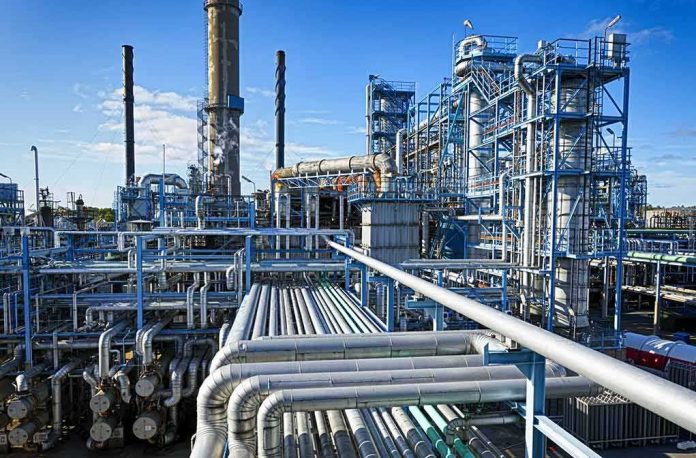
In Libya’s oil heartland, a single turn of a valve can halt production, roil domestic finances, and ripple through global markets—because pipeline chokepoints have become leverage in disputes that are political and economic far more than they are technical.
At a Glance
- Libya’s National Oil Corporation (NOC) says Petroleum Facilities Guard (PFG) units illegally closed a key valve on the Hamada–Zawiya line, forcing shutdowns at three sites and prompting consideration of force majeure.
- PFG-affiliated protesters frame closures as escalatory but deliberate pressure for pay, status, and working-condition concessions—part of a recurrent bargaining pattern since 2011.
- Pipeline valves and field gates are repeat flashpoints; similar disruptions in 2017, 2021, and 2022 followed the same script and were resolved only after negotiations.
- Operational consequences are immediate: pressure surges and safety trips upstream; commercial consequences cascade through crude blending, refining runs, and export schedules.
What happened when the valve closed—and why it matters beyond one pipe
Libya’s NOC reported that members of the security force tasked with guarding oil facilities shut a valve on the Hamada–Zawiya crude pipeline in western Libya. The act precipitated a sudden pressure change and halted operations at multiple upstream sites—exactly what you would expect in a system engineered to trip to safe mode when flow is interrupted. In statements carried by wire services and trade outlets, NOC called the move illegal and signaled it could declare force majeure on affected production and loadings, a commercial shield that acknowledges it cannot fulfill contracts due to circumstances beyond its control.
This is not a procedural hiccup or scheduled maintenance dressed up as drama. In Libya, where hydrocarbons fund the state, any curtailment translates quickly into foregone export revenue, cash flow stress for central institutions, and—if prolonged—domestic product shortages. For shippers and refiners, the immediate concern is supply reliability; for Libya’s government and its rivals, the concern is who holds credible veto power over the taps.
Mechanics first: how a “simple” closure cascades into shutdowns
Crude pipelines behave as pressurized arteries linking reservoirs to terminals. Close a block valve on a live line and you induce a transient pressure wave—operators call it surge or hammer—that travels upstream. Modern fields are knit to supervisory control and safety systems designed to protect equipment and personnel: pumps trip, separators bypass, wells choke back or shut in. That is why a single closure on the Hamada–Zawiya corridor can stall several fields and a pumping station in quick succession. NOC’s description of a pressure spike and subsequent shutdown is consistent with both the physics of fluid transients and standard oilfield safeguarding logic.
Downstream, consequences include stranded crude blends and refinery feedstock shortages. Zawiya refinery depends on these flows; when the intake falters, operators must cut run rates or tap storage and alternative blends—options that exist but are finite and financially punitive. On the export side, force majeure serves as a legal backstop to defer cargoes without penalty, but it does not magic away lost barrels or the market’s risk premium.
The pattern: economic leverage in a fragmented security landscape
The PFG’s public rationale is not technical; it is political-economy. Guards and affiliated groups have routinely used field blockades and valve closures to force responses on salaries, status, and local entitlements. Over the past decade, closures have recurred across the same corridor—Sharara, El Feel, Hamada—and their associated terminals, sometimes cutting hundreds of thousands of barrels per day until a bargain was struck. In 2017, NOC declared force majeure after valves to Zawiya and Mellitah were shut near Reyayna; in 2021, trade sources reported PFG-linked blockades shuttering the same southwest system. In 2022, NOC attributed a 330,000 bpd loss to field closures in the west and southwest—magnitudes that focus minds in Tripoli and abroad.
Reuters’ framing in the current case is explicit: the PFG closed the Hamada–Zawiya valve, operations were suspended at several sites, and NOC weighed force majeure. Simultaneously, PFG members signaled a calibrated escalation—partial cuts followed by full shutdowns if demands were unmet—telegraphing intent to bargain from a position of control over chokepoints, not to damage infrastructure irreparably.
Claims and counter-claims: what holds up
On one side, NOC’s claim of illegality is straightforward: the PFG’s mandate is to safeguard facilities, not to throttle national production. The operational chain—valve closure, pressure surge, shutdown—tracks with standard oilfield systems and is corroborated in independent trade reporting. On the other side, PFG-affiliated voices describe the closures as a last resort after unfulfilled promises on pay and conditions, with threats of broader action coordinated across regions if negotiations stall; even PFG leadership has, at times, condemned such sieges as unlawful, underscoring internal fragmentation and the gap between command and units in the field.
The evidence is not a he-said-she-said about whether a valve was turned; that is uncontested. The dispute is over legitimacy: whether economic protest by armed guards can justify interrupting sovereign oil flows. On the documentary record, NOC’s position is the one embedded in law and commercial norm; the PFG rank-and-file argument is about leverage in a patronage economy. Both truths can coexist descriptively; only one confers lawful authority to close a pipeline.
Force majeure as instrument and signal
Force majeure in Libya is rarely a mere contract clause; it is a political message to domestic actors and counterparties that NOC cannot guarantee continuity under coercion. Declarations have bracketed earlier crises—the Oil Crescent standoffs, the southwest field shut-ins—and typically end when a negotiated settlement unlocks the tap. In this sense, force majeure is the visible tip of a negotiation iceberg: it pauses obligations, disciplines expectations, and buys time for security and political channels to deliver a face-saving off-ramp.
For buyers, cargo cancellations and rescheduling are the immediate headaches; for insurers and lenders, repeated declarations harden perceptions of country risk. The cumulative effect is a higher discount on Libyan crude versus comparable grades when reliability is in question—an invisible tax on national revenue that compounds over time.
What resolves these standoffs—and what does not
History suggests three ingredients end Libya’s pipeline sieges. First, credible negotiation channels that can reach the units physically holding the valve; national statements matter less than who can order a gate reopened. Second, transactional fixes—salary arrears, role recognition, localized development promises—delivered quickly enough to demonstrate good faith. Third, incremental technical hardening: isolatable segments, remote-operated valves with tighter access control, and better surge management reduce the operational blast radius when politics intrudes.
What does not work is performative condemnation without enforcement capacity. Even when PFG leadership labels closures an insult to the state and calls for reopening, on-the-ground units have continued to act autonomously. That asymmetry is the problem to solve if Libya is to replace crisis bargaining with rule-based operations.
The broader stakes: revenue reliability and the price of fragility
Libya’s hydrocarbon system is world-scale in geology and technology; it is small-company fragile in governance. Every episode like the Hamada–Zawiya closure reminds traders, treasury officials, and local communities that production is hostage to non-technical risks. The way out is dull but decisive: align the mandate and incentives of those tasked with protection, ringfence pay and provisioning for critical security units from broader patronage shocks, and continue the slow work of depoliticizing operational control. Until that alignment holds, the country will keep paying for fragility twice—first in barrels it does not ship, then in the discount markets apply to the barrels it can.
Sources:
insiderpaper.com, reuters.com, middleeastmonitor.com, spglobal.com, news.sbs.co.kr, libyaobserver.ly