
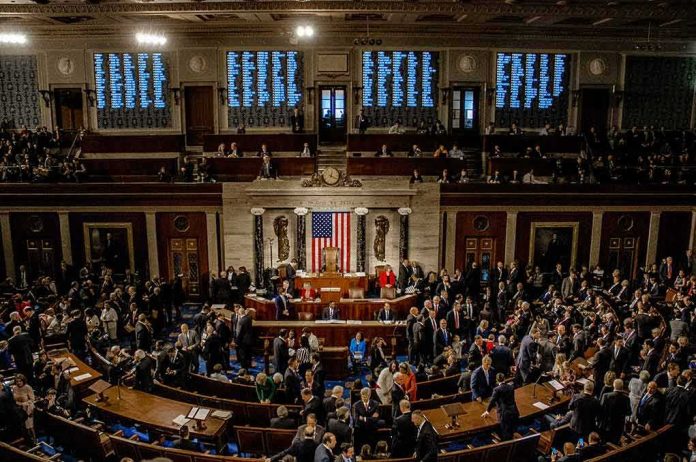
When party leaders say they have “ruled nothing in and nothing out,” they are not dodging so much as preserving leverage; in the modern Congress, conditional language around impeachment is a strategic tool to keep options open while the facts, the vote count, and public sentiment are still in motion.
The Short Version
- Hakeem Jeffries’ formulation—follow the facts, apply the law, be guided by the Constitution—keeps impeachment available without committing to it.
- That stance fits how the House’s impeachment power is designed to work: discretionary, political, and triggered by a simple majority, but costly to deploy.
- Media ecosystems convert conditional language into either “inevitable impeachment” or “word salad,” but the underlying posture is strategic ambiguity, not confusion.
- Within Democrats, there’s tension between accountability and policy focus; leaders like Jim Clyburn argue affordability should come first even as impeachment remains on the table.
What Jeffries actually said—and why it matters
When pressed on whether Democrats would impeach President Trump if they reclaimed the House, Hakeem Jeffries used a tightly calibrated construction: we haven’t ruled anything in or out; we will follow the facts and the law, and be guided by the Constitution. That pairing—non-commitment with a process frame—was not a slip. It is how responsible leaders keep the impeachment option available without handcuffing the caucus to it as a day-one agenda item. Axios captured the posture succinctly at the time, calling it an “impeachment dilemma” should Democrats win: accountability pressures on one side, cost-benefit realities on the other.
The language telegraphs two things to different audiences simultaneously. To activists and members who believe Trump’s conduct merits sanction, it keeps a constitutional remedy in reserve. To swing-district lawmakers and voters worried about partisan overreach, it signals restraint: no pre-cooked outcome, process first. Calling this “word salad” mistakes purposeful ambiguity for incoherence; ambiguity here is the point, not the bug.
How the impeachment power is built to be used
Impeachment is a House instrument, available by simple majority and bounded less by legal thresholds than by political judgment; the Senate’s supermajority requirement to convict amplifies that political character. A credible roadmap, reaffirmed by congressional analysis and institutional histories, is straightforward: alleged misconduct emerges, the House investigates using its oversight tools, and—if warranted—adopts articles by majority vote. The discretion is real: the House may choose not to impeach even if many members believe conduct is impeachable, precisely because political prudence is embedded in the design.
That architecture explains why leaders husband the option. Once the House crosses the Rubicon, the chamber’s agenda, media oxygen, and coalition management revolve around the trial that follows in the Senate. Historically, proceedings have been initiated more than 60 times across offices; only a fraction mature into full impeachments, and fewer still produce Senate convictions. The gap between theoretical availability and actual deployment is the terrain where Jeffries’ phrasing operates.
Oversight, partisanship, and the logic of strategic ambiguity
In divided government, oversight incentives are strongest: policy conflict and electoral competition push Congress to scrutinize the executive more aggressively. That scrutiny can escalate into formal proceedings, but it more often yields hearings, subpoenas, and negotiated constraints. Scholars of Congress have long observed that partisanship and electoral incentives shape these choices, not just legal theory. Members balance district risk, media cycles, and committee jurisdictional turf—realities that reward flexibility.
Against that backdrop, “we haven’t ruled anything in or out” signals a sequencing choice: oversight first, remedies later. It builds a predicate for any eventual step and disciplines the caucus to facts that committees can surface under subpoena. It also manages internal coalition splits—those arguing impeachment is inevitable and those insisting it should not supplant cost-of-living legislation—by subordinating both to a shared process frame. That is coalition management masquerading as anodyne civics; it is also how leaders bank negotiating power without committing political capital prematurely.
Where Democrats genuinely differ
The disagreement inside the party is not over whether impeachment exists as a constitutional remedy—it does—but over prioritization and timing. Senior figures like Jim Clyburn have said plainly that affordability should come first; impeachment, while possible, should not be the opening bid. That view treats impeachment as a high-friction instrument that can crowd out bread-and-butter work. Others emphasize that vigorous oversight may surface conduct that makes impeachment hard to avoid. Jeffries’ process mantra is the tent that can house both wings until facts or public opinion force a choice.
This is why outside commentary that translates conditional language into a binary—impeach on day one or admit it is all theater—misreads congressional behavior. The House’s leverage over the executive runs along a spectrum: letters, hearings, subpoenas, contempt, appropriations riders, and, only at the far end, impeachment. Leaders typically climb that ladder rather than leap to the top rung. The existence of the top rung strengthens all the rungs below it; threatening a vote you could credibly win is a bargaining chip, even if you never take the vote.
One Retort: You have no Power to rule-in or rule-out.#ElectionConsequences
Hakeem Jeffries: ‘We Haven’t Ruled Anything Out in Terms of Impeachment’https://t.co/TFw1oLAuC0
— Alex Hamilton (@Hamiltonian86) September 13, 2026
Media framing and the economy of political language
Short, repeatable phrases—“not ruling anything out,” “let the chips fall where they may”—are discursive Swiss army knives. They travel cleanly across platforms, can be cast as menace or moderation with equal ease, and buy time while committees do the slow, unglamorous work of building records. Media coverage, especially in high-conflict moments, often compresses that nuance into a sharper storyline: inevitability or evasion. The better analytic lens is institutional: what does the phrasing empower the House to do next week and six months from now? On that score, strategic ambiguity preserves room to escalate or de-escalate as evidence, vote counts, and public opinion evolve.
What to watch if this moves from posture to proceedings
If oversight migrates toward articles, the signals will be impossible to miss. Committee chairs will consolidate investigative lanes; counsels will harmonize evidentiary theories with the constitutional grounds historically relied upon—abuse of power, obstruction of Congress, or bribery, not generalized “maladministration,” which the Framers rejected. The leadership will count noses obsessively, because a majority is necessary and public whip counts deter backsliding. And communications will shift from process language to charge language as managers are selected and trial strategy is previewed. Until then, “we haven’t ruled anything in or out” remains exactly what it appears to be: a placeholder that keeps every downstream option intact.
Bottom line
Impeachment is both a constitutional instrument and a political event. Leaders who understand that duality speak in ways that leave them room to maneuver. Jeffries’ phrasing is not a tell of secret intent; it is a recognition of institutional design. In a system that gives the House the sole power to impeach by simple majority while exacting steep political costs for using it, strategic ambiguity is not avoidance. It is stewardship.
Sources:
thegatewaypundit.com, cnbc.com, washingtontimes.com, nbcnews.com, cnn.com, jeffries.house.gov, uspollingdata.com, axios.com