
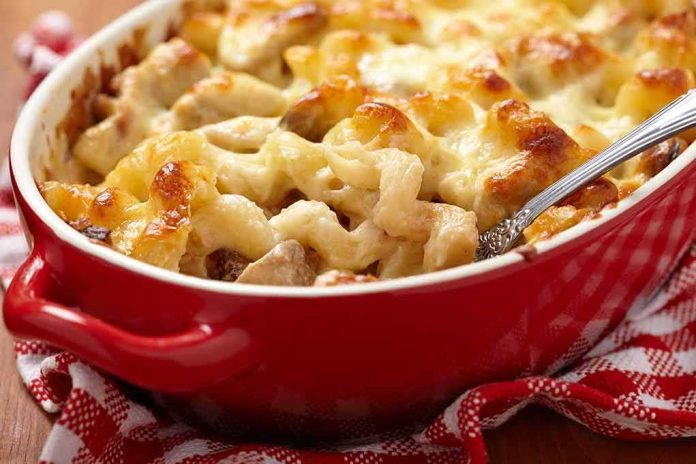
Every few years the same question resurfaces in a different costume — who gets to cook what, and who gets paid or praised for it — and the latest vessel for that argument happens to be a casserole dish of elbow macaroni and cheddar.
Key Points
- TikTok chef Tini Younger’s viral baked mac-and-cheese recipe reignited a long-running debate over whether a white creator can popularize a dish with deep roots in Black American cooking without erasing that history.
- The historical backbone is real: Monticello’s own archives credit James Hemings, an enslaved, French-trained chef, with helping popularize macaroni and cheese in the United States, though not with inventing it.
- Younger has directly and specifically denied taking the recipe from anyone, insisting she developed it over four years of her own experimentation.
- Food historians and critics on both sides agree the dish’s origins are genuinely mixed — Italian, European, and African American threads all run through it — which complicates any claim of exclusive ownership.
- The recurring pattern behind these disputes is less about a single recipe than about who captures attention, credit, and commercial upside when a dish crosses cultural lines.
What set off the latest round
Tini Younger, a TikTok personality and now cookbook author, built an enormous following on the strength of a baked macaroni and cheese recipe she has said took her four years to perfect, a claim she has repeated in press coverage of her cookbook and television appearances. The recipe’s scale — millions of views, a national cookbook deal, an appearance timed to the holiday season — is precisely what made it a flashpoint. Critics online argued that Younger, who is white, was receiving outsized credit and commercial reward for a dish whose signature American form is bound up with Black culinary history, a critique amplified across TikTok and picked up by outlets including The Root, which described the recipe as reigniting “a familiar debate about cultural ownership and appropriation”.
This is not a new argument for Younger specifically, nor for food culture generally. Variations of the same dispute have circulated online since at least 2021, and commentary coverage of the current round opened by noting as much. What gives this iteration staying power is that it sits on top of an actual documented history, rather than an invented one — which is the detail that separates this controversy from pure internet noise.
https://www.youtube.com/watch?v=E8WKVaXacjA
The documented history behind the claim
Monticello, which maintains the most rigorously sourced public archive on Thomas Jefferson’s household, states plainly that James Hemings — an enslaved man whom Jefferson sent to Paris to train in French culinary techniques — “likely learned to make macaroni and cheese during his training in France and helped popularize the dish in America”. Monticello is careful to add the necessary qualifier: Jefferson did not invent macaroni and cheese, and neither did Hemings. The dish predates both of them considerably, with written macaroni-and-cheese recipes traceable to a thirteenth-century Italian cookbook, the Liber de Coquina, under the name de lasanis. The BBC’s own historical account reaches the same conclusion — European antecedents are real, but the baked, casserole version Americans associate with the dish today likely owes its popularization to Hemings’s work in Jefferson’s kitchen.
That nuance matters enormously to how fairly this dispute can be adjudicated. The claim that enslaved Black cooks played a documented, archivally supported role in transmitting and popularizing the American version of mac and cheese is not a social-media invention; it is settled historical record, repeated independently by Monticello, the BBC, Essence, and HistoryNet alike. The claim that macaroni and cheese is therefore the exclusive cultural property of any one group is a separate and far shakier proposition, given the dish’s pre-American, multi-continental lineage.
Where Younger and her defenders push back
Younger’s own response has not been to concede a debt she disputes owing, but to contest the premise directly. She has said she developed her recipe through years of personal experimentation rather than inheriting it from anyone, and she specifically and publicly denied a circulating claim that her husband’s family — specifically Antoine Wright Jr.’s mother — had taught her the dish, stating flatly that “Antoine’s mom did not teach me how to make it, it’s not her recipe,” adding that she had in fact taught Wright’s mother her version of the holiday dish. When criticized for turning the recipe into a racialized controversy, Younger responded with open exasperation: “I’m glad Mac n cheese is a problem to you.” When critics attacked the dish’s texture, she answered just as directly — “What about this says dry?? Also I never lack flavor” — a defense of craft rather than a claim of invention.
Commentators sympathetic to Younger, including Brad Polumbo and Amala Ekpunobi, have argued the backlash mistakes a shared, evolving culinary tradition for a fixed cultural possession, with Polumbo calling the racial-ownership framing “fake racism” and “cultural erasure” and Ekpunobi arguing that food and culture naturally cross group lines rather than remaining sealed within them. Supporters elsewhere have simply argued the obvious: Younger is a trained chef sharing a dish she built, not a historian claiming to have authored an American food tradition.
The deeper pattern this case reveals
Strip away the specific personalities and this controversy fits a well-documented academic pattern in food studies: cultural appropriation disputes recur when a more commercially visible actor introduces a dish to a mass audience without channeling comparable acknowledgment, participation, or economic return back to the community historically associated with it. Researchers studying food media have found measurable asymmetries in who gets filmed, credited, and monetized preparing culturally coded dishes, including one Northwestern analysis of commercial food videos that found recurring imbalances in whose hands appear on camera. None of that research proves intent in any individual case — Younger’s own account of independent recipe development is a specific, named rebuttal that deserves weight, not dismissal — but it explains why disputes like this one keep recurring with near-identical shape regardless of the dish involved, from soul food to barbecue to, now, a baked casserole with a four-hundred-year paper trail.
What makes mac and cheese a particularly instructive test case is that both sides are arguing from real evidence rather than competing myths. The history of Black culinary contribution to the dish is documented, not asserted. The claim of exclusive ownership is contested, not settled. And the creator at the center of the storm has offered a specific, on-record account of her own process rather than silence. Readers weighing the dispute a year from now, in whatever form it next takes, would do well to separate those three questions rather than collapse them into one verdict.
Sources:
twitchy.com, monticello.org, katiecouric.com, bbc.co.uk, theroot.com, essence.com, historynet.com, dspace.univ-guelma.dz, foodanthro.com